 Hair Transplant
9
Stages of Hair Loss: Norwood and Sinclair Scales ExplainedThe stages of hair loss on the Norwood and Sinclair scales, which stage still responds to treatment, and Turkey's official cost floor per graft.
September 13, 2026Read More
Meagan Good has confirmed one cosmetic procedure — an eyebrow transplant — and denied the rest. What she said, and how brow transplants actually work.
Reviewed by the Livist Medical Team · Last updated 22 August 2026
Meagan Good has publicly discussed exactly one cosmetic procedure: an eyebrow transplant, performed in late 2017 by Beverly Hills facial plastic surgeon Dr Jason Champagne. She has denied rumours of other surgery, including a Brazilian butt lift, attributing her physique to fitness and lifestyle.
That is the honest summary, and it is where most articles on this subject stop. The more useful question is the one underneath it: she over-plucked her brows as a teenager, the hair stopped growing back, and tattooing and microblading did not hold. That is not a celebrity problem. It is what happened to a large share of a generation who plucked their brows to a pencil line in the 1990s — and it is treatable.
So this article gives the confirmed facts briefly, and then spends the rest of its length on the thing worth knowing: why over-plucked brows stop growing, what a transplant actually involves, and what it costs.
A note on how we write about real people. We report only what a person has stated publicly or what their treating surgeon has published. We do not assert procedures nobody has confirmed, and this article contains no direct quotation from Meagan Good. What follows is general information, not medical advice, and not a diagnosis of anyone's appearance.
One procedure: a surgical eyebrow transplant, in late 2017. Follicles were taken from the back of her head and placed along the brow line. She has spoken about it publicly, including on the television programme The Doctors, and her operating surgeon published about the case on his own website in April 2018.
The account she has given is consistent across her own appearances and the surgeon's post: she over-plucked her eyebrows as a teenager during the very thin brow trend of the 1990s, the hair did not grow back, and she spent years covering the gap cosmetically before choosing a surgical fix.
And one significant clarification: the transplanted hair behaves like scalp hair, because that is what it was. It keeps growing, so it needs trimming — a detail she has mentioned and one that surprises most people considering the procedure.
Claims of a Brazilian butt lift have circulated online and she has publicly rejected them, attributing her figure to fitness and a healthy lifestyle. No other procedure has been confirmed by her or by any treating clinician.
We are stating that plainly rather than hedging it, because hedging is how speculation gets laundered into fact. A denial is information. "Rumoured" is not.
Where celebrity discussion is useful is as a prompt to understand a procedure properly — the same approach we took with a decade-by-decade look at what one public figure has and has not confirmed. Where it stops being useful is the moment a page starts diagnosing a face from photographs.
Repeated plucking of the same hairs over years can permanently damage the follicle. The mechanism is mechanical trauma: each extraction stresses the follicle, and after enough cycles some follicles scar and stop producing hair altogether. That is why brows plucked heavily in adolescence often never fully return, however long they are left alone.
Three things make brow follicles especially vulnerable:
This is why the 1990s matter. A pencil-thin brow was the dominant look for most of that decade, and the women who followed it hardest were teenagers — the worst possible age to be doing repeated mechanical damage to a follicle. Two decades later, a fashion cycle turned into a clinical caseload.
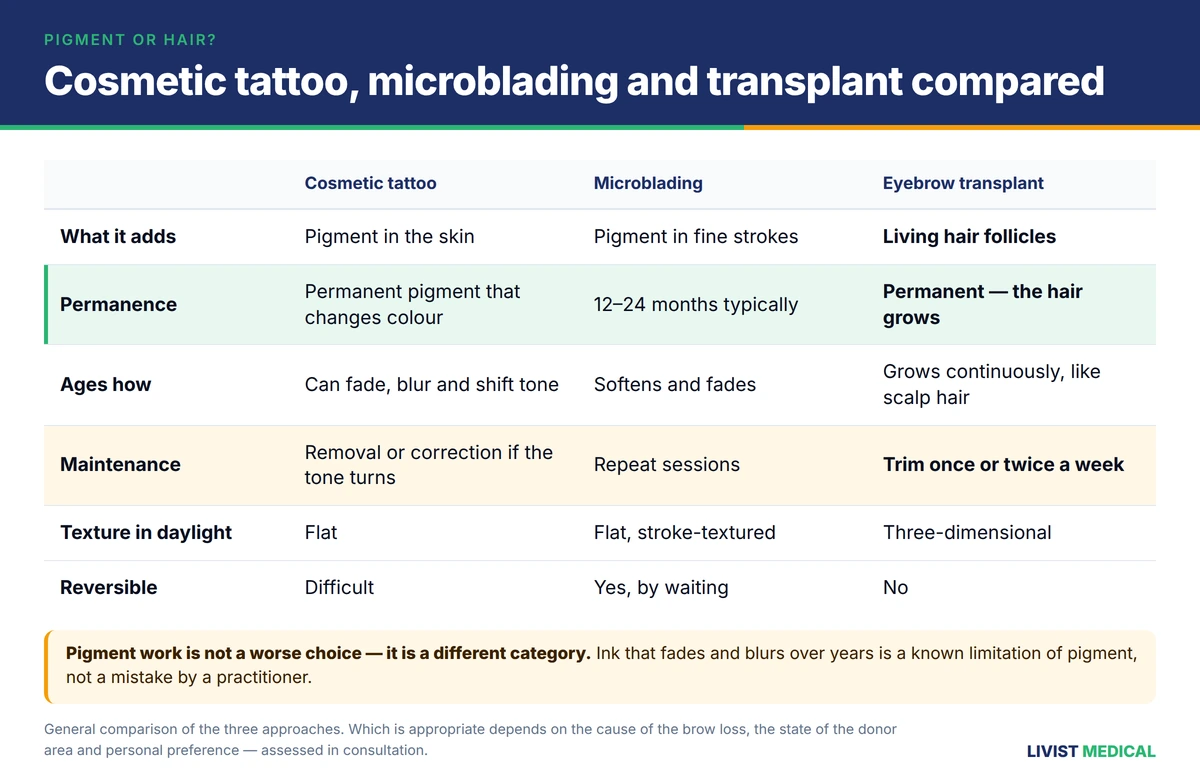
Microblading and cosmetic tattooing add pigment to skin; a transplant adds living hair. Pigment fades, shifts colour and can blur over years, which is exactly what Meagan Good described before choosing surgery. A transplant grows permanently — and, unlike pigment, it has to be trimmed.
| Cosmetic tattoo | Microblading | Eyebrow transplant | |
|---|---|---|---|
| What it adds | Pigment in the skin | Pigment in fine strokes | Living hair follicles |
| Permanence | Permanent pigment that changes colour | 12–24 months typically | Permanent — the hair grows |
| Ages how | Can fade, blur and shift tone | Softens and fades | Grows continuously, like scalp hair |
| Maintenance | Removal or correction if the tone turns | Repeat sessions | Trim once or twice a week |
| Texture in daylight | Flat | Flat, stroke-textured | Three-dimensional |
| Downtime | Days | Days | Days for the donor area |
| Reversible | Difficult | Yes, by waiting | No |
Pigment work is not a bad choice — it is faster, cheaper and non-surgical. It is simply a different category of solution, and the failure mode Meagan Good described, ink that faded and bled together over time, is a known limitation of pigment rather than a mistake by a practitioner.
If the goal is coverage over a scar or a very sparse density and surgery is not wanted, scalp micropigmentation uses the same pigment principle with a different technique.
Hair follicles are harvested from the back of the head — the same donor zone used for scalp transplants — and placed individually along the brow at a very shallow angle to match natural brow direction. The brow area is typically painless afterwards because the grafts sit superficially; the donor area is sore for 24 to 48 hours.
The part that separates a good result from an obvious one is angle. Scalp hair grows out at roughly 45 degrees. Brow hair lies almost flat against the skin and changes direction across the brow — upward at the inner third, then sweeping outward. A surgeon placing 400 grafts is making 400 individual decisions about direction, and that is the whole craft of the procedure.
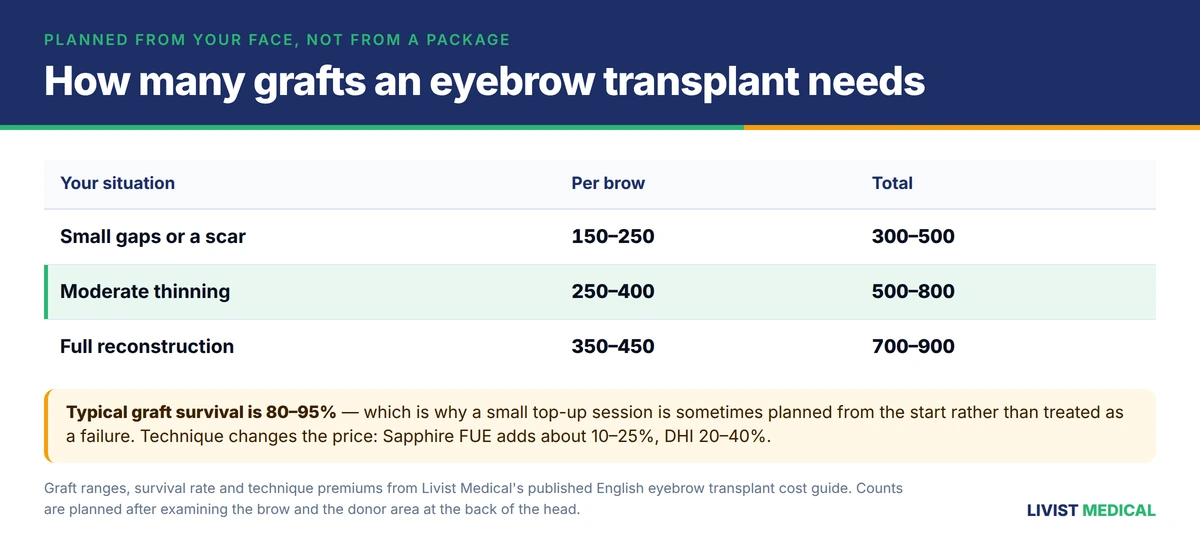
| Your situation | Per brow | Total |
|---|---|---|
| Small gaps or a scar | 150–250 | 300–500 |
| Moderate thinning | 250–400 | 500–800 |
| Full reconstruction | 350–450 | 700–900 |
Typical graft survival is 80–95%, which is why a small top-up session is sometimes planned from the start rather than treated as a failure.
Techniques: standard FUE is the baseline; Sapphire FUE typically adds 10–25% to the cost; DHI adds 20–40% and is often preferred for brows because the implanter pen gives finer control of angle and depth. Full detail of how we perform it is on our eyebrow transplant page.
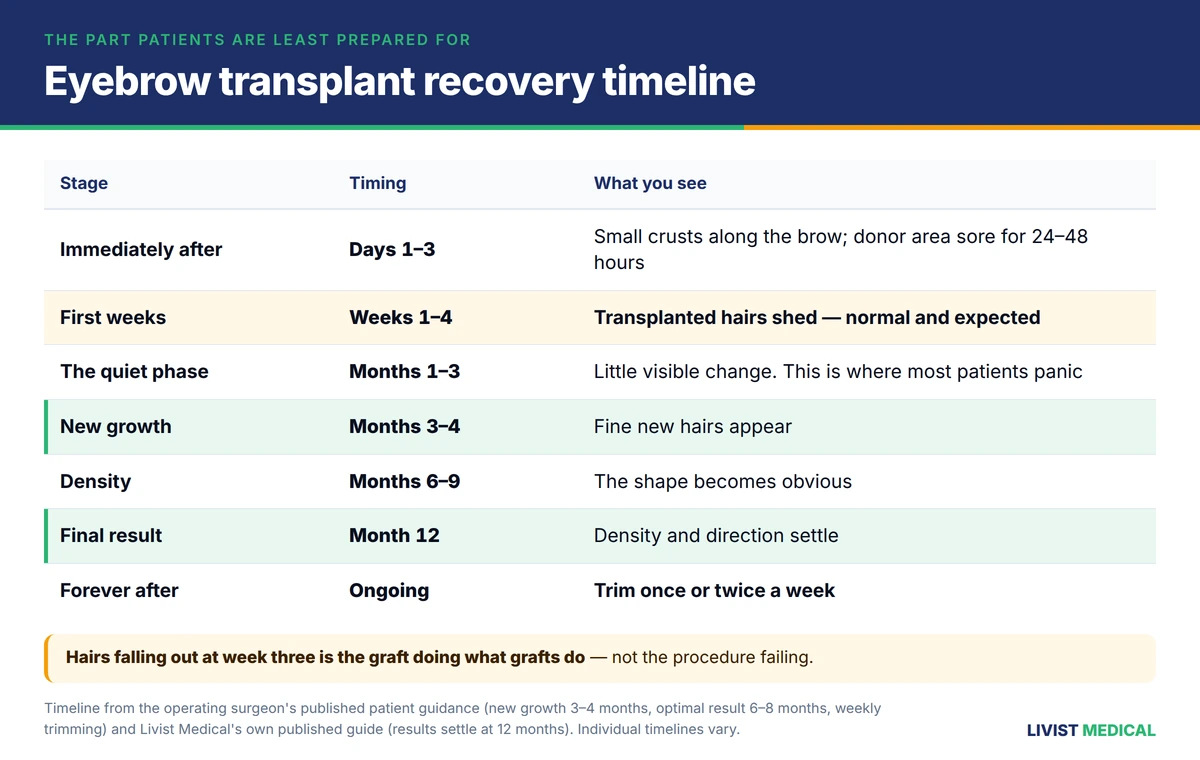
Expect crusting for several days, shedding of the transplanted hairs within the first weeks, then nothing visible for months. New growth begins at three to four months, noticeable density arrives at six to nine months, and the final result settles at about twelve months.
| Stage | Timing | What you see |
|---|---|---|
| Immediately after | Days 1–3 | Small crusts along the brow; donor area sore for 24–48 hours |
| First weeks | Weeks 1–4 | Transplanted hairs shed — this is normal and expected |
| The quiet phase | Months 1–3 | Little visible change. This is where most patients panic |
| New growth | Months 3–4 | Fine new hairs appear |
| Density | Months 6–9 | The shape becomes obvious |
| Final result | Month 12 | Density and direction settle |
| Forever after | Ongoing | Trim once or twice a week |
The shedding phase is the single most misunderstood part of any transplant, brows included — the same pattern we set out week by week for scalp transplant recovery. Hairs falling out at week three is the graft doing what grafts do, not the procedure failing.
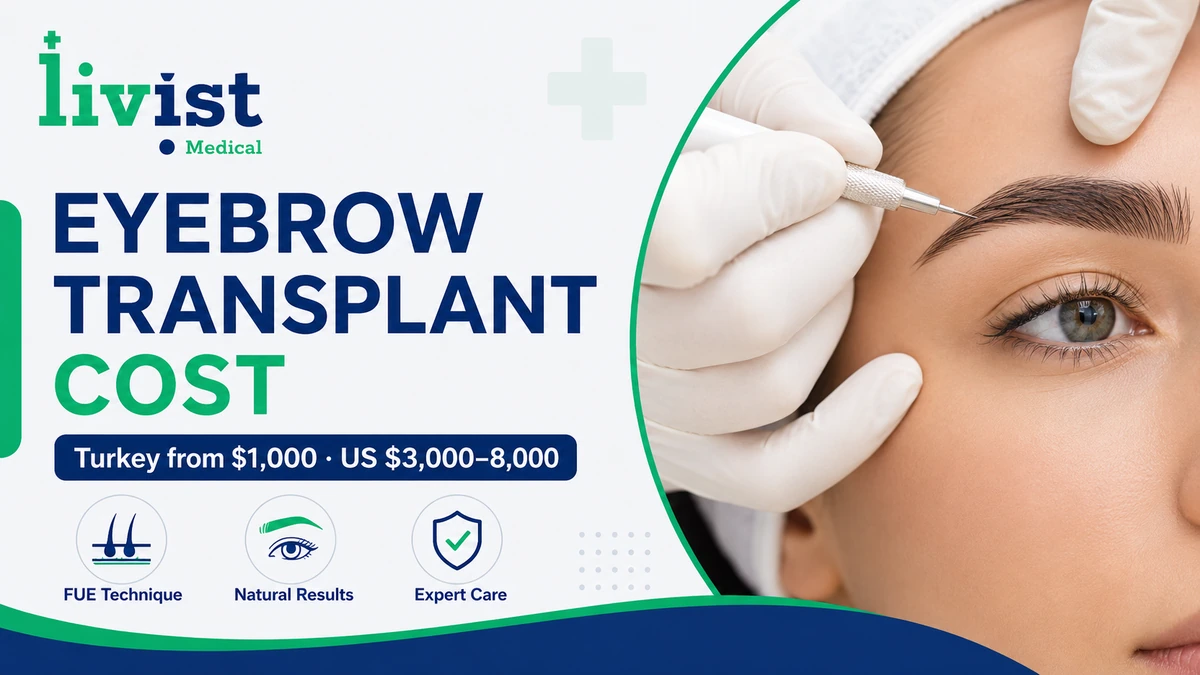
An eyebrow transplant costs $1,000–$3,000 in Türkiye against $3,000–$8,000 in the United States — and up to $15,000 in New York or Los Angeles — and $3,800–$6,300 in the United Kingdom. Price tracks graft count and technique more than anything else.
| Country | Cost |
|---|---|
| Türkiye | $1,000–$3,000 |
| Mexico | $1,800–$3,500 |
| Thailand | $2,000–$4,000 |
| United Kingdom | $3,800–$6,300 |
| UAE / Qatar | $4,000–$7,000 |
| United States | $3,000–$8,000 (up to $15,000 in NYC / LA) |
Turkish packages usually include the surgery, two to three hotel nights, transfers, an interpreter, an aftercare kit and post-operative follow-up. The full breakdown, including how technique changes the number, is in our eyebrow transplant cost guide.
We have deliberately not published what Meagan Good's own procedure cost. One outlet reported a figure; we could not confirm it against a second source, and attaching an unverified number to a named person is not something we will do.
Candidacy is a safety question as much as an aesthetic one. The same filter is set out in is a hair transplant safe, which lists the situations in which the surgery should not be done at all.
A good candidate has stable brow loss, a healthy donor area at the back of the head, and realistic expectations about angle, density and lifelong trimming. Someone whose brow loss is still active — from a medical cause rather than from plucking — is not a candidate until the cause is treated.
Suitable: brows thinned by years of over-plucking · a scar crossing the brow · congenital sparseness · loss following an old injury · thinning with age where the donor zone is intact.
Not suitable yet: anyone with active hair loss of unknown cause, an untreated thyroid disorder, a scalp or skin condition affecting the area, or trichotillomania that is still ongoing — because transplanted hair will be pulled out too. Brow loss can also be a symptom rather than a cosmetic issue, and the first step there is a diagnosis, not a surgery.
Women whose brow thinning comes alongside scalp thinning are usually assessed for both at once — see hair transplant for women — and PRP treatment is sometimes used to support an existing brow rather than replace it. A parallel option for lashes rather than brows is eyelash transplantation.
If you are not sure which category you fall into, send us photographs of your brows and your history and our team will tell you whether a transplant is the right answer — including when it is not. You can also review the surgeons who perform it.
The brow is the least forgiving transplant site on the body, because the result is judged from thirty centimetres away in daylight. These seven questions separate a surgeon who does brows from one who does scalps and takes brow cases.
One red flag above all: a quote given before anyone has examined your donor area at the back of your head. If the donor zone is thin, the graft count you were promised may not exist. Our eyebrow transplant assessment starts there for exactly that reason.
For anyone reading this and recognising their own hairline, the stages of hair loss explain what each Norwood stage still responds to.
Meagan Good confirmed one procedure and denied the rest, and the confirmed one is interesting for a reason that has nothing to do with fame: it is the standard treatment for a very ordinary problem. A brow plucked to nothing in 1997 does not come back on its own, and no amount of pigment permanently replaces hair that is no longer there.
If that describes your brows, the realistic picture is 300 to 900 grafts, three months of looking like nothing happened, a good result at six to nine months, and a trim once a week for the rest of your life.
This article is general information, not medical advice, and not a comment on anyone's appearance. Whether a transplant suits you depends on your donor area, the cause of the loss and your expectations — which takes an assessment. Ask our team to review your case.
Hair TransplantThe stages of hair loss on the Norwood and Sinclair scales, which stage still responds to treatment, and Turkey's official cost floor per graft.
 Hair Transplant
Is a hair transplant safe? Yes with a licensed doctor — infection under 1%. Every risk with its timing, the NHS healing timeline, and 6 checks first.
 Hair Transplant
What an eyebrow transplant really costs in 2026 — by country, graft count and technique