 Hair Transplant
9
Stages of Hair Loss: Norwood and Sinclair Scales ExplainedThe stages of hair loss on the Norwood and Sinclair scales, which stage still responds to treatment, and Turkey's official cost floor per graft.
September 13, 2026Read More
Is a hair transplant safe? Yes with a licensed doctor — infection under 1%. Every risk with its timing, the NHS healing timeline, and 6 checks first.
Yes — a hair transplant is safe when a licensed, experienced doctor performs it personally in a sterile clinical setting. Reported infection rates are under 1%. Swelling, itching and scabbing are normal healing, not complications. The danger in a hair transplant is almost never the operation: it is an undertrained operator, an unlicensed room, and a session pushed past what the donor area can give.
Written and medically reviewed by Prof. Dr. Ali Balevi — Specialist in Dermatology and Dermatologic Surgery, Medipol Mega University Hospital, Istanbul · Last updated: 12 September 2026
This article is for information only. It is not a diagnosis or a treatment plan. Discuss your own case with a qualified doctor before deciding on surgery.
A hair transplant moves your own follicles from the back and sides of the scalp to thinning areas. Nothing foreign is implanted, so there is nothing for the body to reject. It is done under local anaesthetic with sedation, so you are awake and feel no pain during the procedure, and it usually takes a single day with no overnight stay.
"Hair transplant surgery is normally safe when performed by a qualified, experienced board-certified plastic surgeon. Still, individuals vary greatly in their physical reactions and healing abilities, and the outcome is never completely predictable." — American Society of Plastic Surgeons
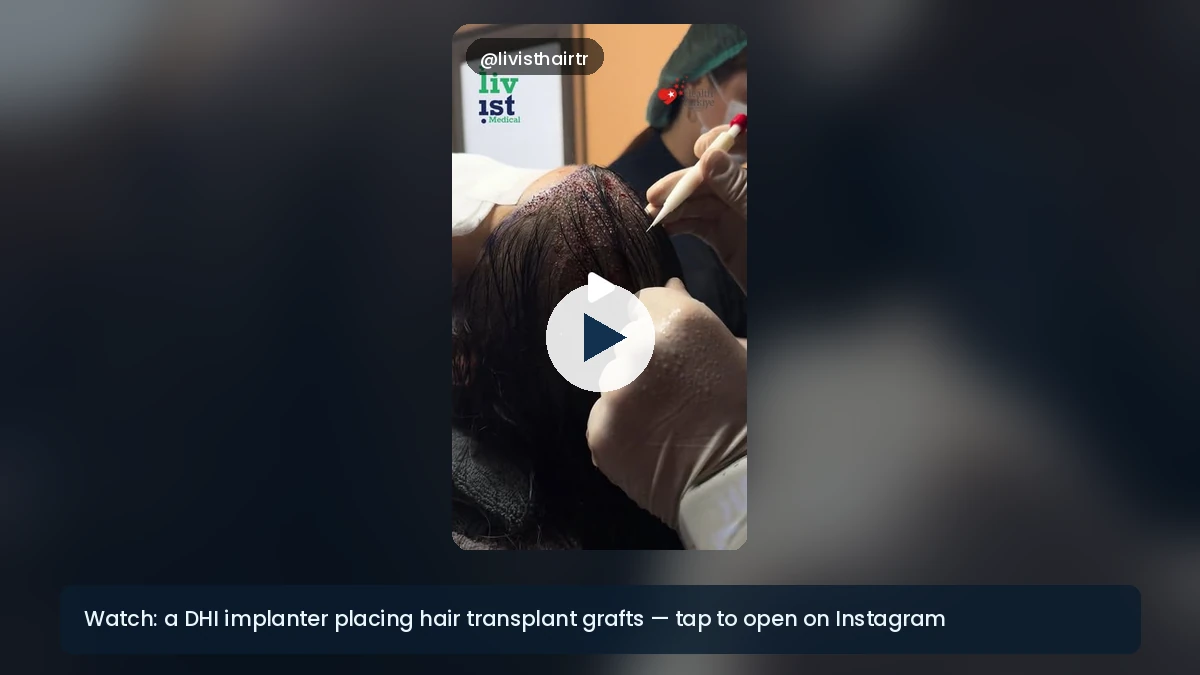
Read that sentence slowly, because every clause in it is a condition. The safety record belongs to the operator, not to the technique. Two people can have the same FUE hair transplant in the same city in the same week and carry completely different risk, depending on who held the punch and how many grafts were taken.
These are not complications. They are the healing process, and almost everyone gets some of them. The NHS lists a tight, achy and swollen scalp for a few days, temporary scabbing where the hair was transplanted, and either a single scar or a number of very tiny ones.
Shock loss frightens people most, because it looks like the transplant failed. It has not. The shed hair is your original hair reacting to surgical trauma. Our week-by-week hair transplant recovery guide shows what each stage looks like.
Swelling appears on the scalp in the first days and can move down to the forehead and around the eyes before it settles. It is caused by the fluid used to anaesthetise and firm the scalp during surgery, and it is expected rather than dangerous. Oral steroids in the post-operative period are used to reduce recipient-area oedema. Sleeping with the head elevated for the first nights shortens it.
Pain during and after the procedure is common and manageable. The 2018 review in the Journal of Cutaneous and Aesthetic Surgery names the factors that make it worse: a wide donor strip, bleeding, tension in the wound, and large sessions with inadequate anaesthesia. Standard care is a local anaesthetic field block with adrenaline during surgery, then non-steroidal anti-inflammatory analgesics afterwards. Persistent pain weeks later is not normal and is a reason to contact the clinic.
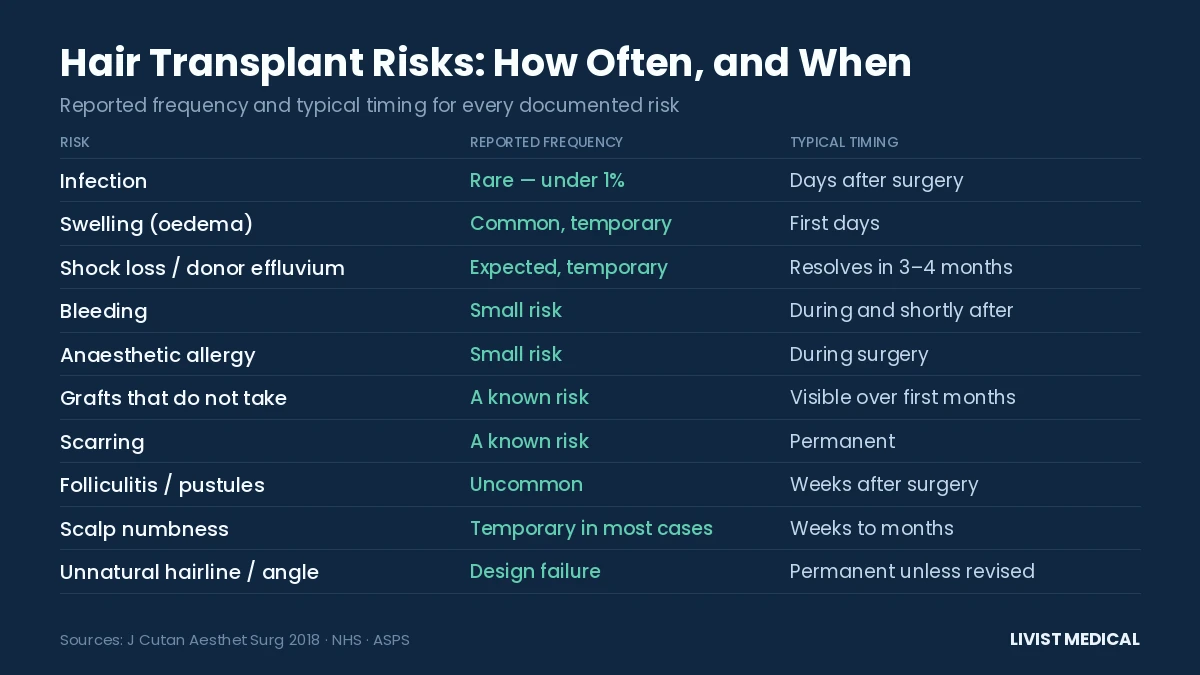
These are the events that need medical attention. Published figures are far smaller than the internet suggests — but they are not zero, and a clinic that tells you the risk is zero has told you something useful about the clinic.
| Hair transplant risk | Reported frequency | Typical timing | Source |
|---|---|---|---|
| Infection | Rare — under 1% | Days after surgery | J Cutan Aesthet Surg, 2018 |
| Swelling (oedema) | Common, temporary | First days | NHS |
| Shock loss / donor effluvium | Expected, temporary | Days to weeks; resolves in 3–4 months | J Cutan Aesthet Surg, 2018 |
| Bleeding | Small risk | During and shortly after surgery | NHS |
| Allergic reaction to the anaesthetic | Small risk — true immune reaction is rare | During surgery | NHS · J Cutan Aesthet Surg, 2018 |
| Grafts that do not take | A known risk; surgery may be repeated | Visible over the first months | ASPS |
| Scarring | A known risk — dots after FUE, a line after FUT | Permanent | ASPS · NHS |
| Folliculitis / pustules | Uncommon | Weeks after surgery | J Cutan Aesthet Surg, 2018 |
| Scalp numbness | Temporary in most cases | Weeks to months | J Cutan Aesthet Surg, 2018 |
| Unnatural hairline or wrong graft angle | A design and execution failure, not bad luck | Permanent unless revised | J Cutan Aesthet Surg, 2018 |
Two entries deserve a note. Scarring is unavoidable in principle — the question is which kind. Grafts that do not take is the failure people actually come back for; when it happens, hair transplant revision is a separate procedure with its own limits.
The incidence of serious infection after a hair transplant is under 1%. When it does happen, the causes named in the literature are poor hygiene, excessive crust formation, or a pre-existing medical risk factor — not the surgery itself. Recipient-site infection usually shows as small pus-filled spots confined to the treated area; a spreading red, tender, fluctuant patch along the incision suggests an abscess and needs same-day medical review. Following the washing and wound-care instructions is the single biggest thing a patient controls here.
Minor oozing on the first night is expected. The NHS lists bleeding among the small risks of the operation and notes your surgeon should be able to treat it quickly. The risk rises with a wide FUT strip, high-tension closure, and blood-thinning medication that was not disclosed before surgery. The 2018 review also recommends an ECG and a physician's anaesthetic-fitness assessment for patients over 40 — a step that quietly disappears in high-volume settings.
It is a misconception that FUE is scar-proof. Each punch can leave a pinpoint white atrophic mark; in skilled hands most are invisible, but patients should be told they may show on close inspection with short hair. This matters more for darker skin tones, because the punch removes melanocytes along with the follicle — so aggressive FUE with very large sessions can leave thousands of pale dots that become obvious once the head is shaved, cancelling the very benefit FUE was chosen for. FUT leaves one linear scar instead, and tension during closure can widen it into what ASPS calls a "stretch-back" scar.
There is no published death rate for hair transplantation, because deaths are too rare to produce one — the peer-reviewed literature describes it as "a relatively safe surgery associated with very few complications". But the mechanism people are actually searching for has a name, and it is worth stating plainly rather than hiding behind reassurance.
A hair transplant uses large volumes of local anaesthetic. The 2018 review lists lidocaine (Xylocaine) toxicity among the causes of fainting at the end of a long operation, and notes it may be associated with convulsions. Its stated prevention is blunt: minimise lidocaine usage by completing the surgery as quickly as possible.
Read that against how a discount mega-session is sold — the biggest possible graft count, in one very long day, at the lowest possible price — and the risk stops being abstract. The danger is not the procedure. It is a procedure stretched far past its safe working time by someone with a commercial reason to do it.
Most hair transplant risks heal. Two do not, and both are caused by taking too much.
Overharvesting permanently damages the donor area, leaving thinning and patchy loss where the hair used to be reliable. The literature gives a working limit that almost nobody quotes to patients: the safe donor area should be marked out before extraction begins, and it is preferable not to extract more than one follicular unit in four. Push past that and the back of the head takes on an "moth-eaten" appearance that no second surgery repairs, because the donor supply used to repair it is the thing that was spent.
The second is design. A hairline placed less than 6 cm from the glabella looks artificial as baldness progresses behind it; grafts set more than 1–2 mm proud of the skin cause cobblestoning; wrong angulation produces hair that grows in the wrong direction permanently. As the review puts it, the hairline is the surgeon's signature — which is exactly why it should not be delegated.
Your donor area is finite and hair loss continues with age. A safe hair transplant is planned around the hair you will still have in fifteen years, not the coverage you want in the mirror today.
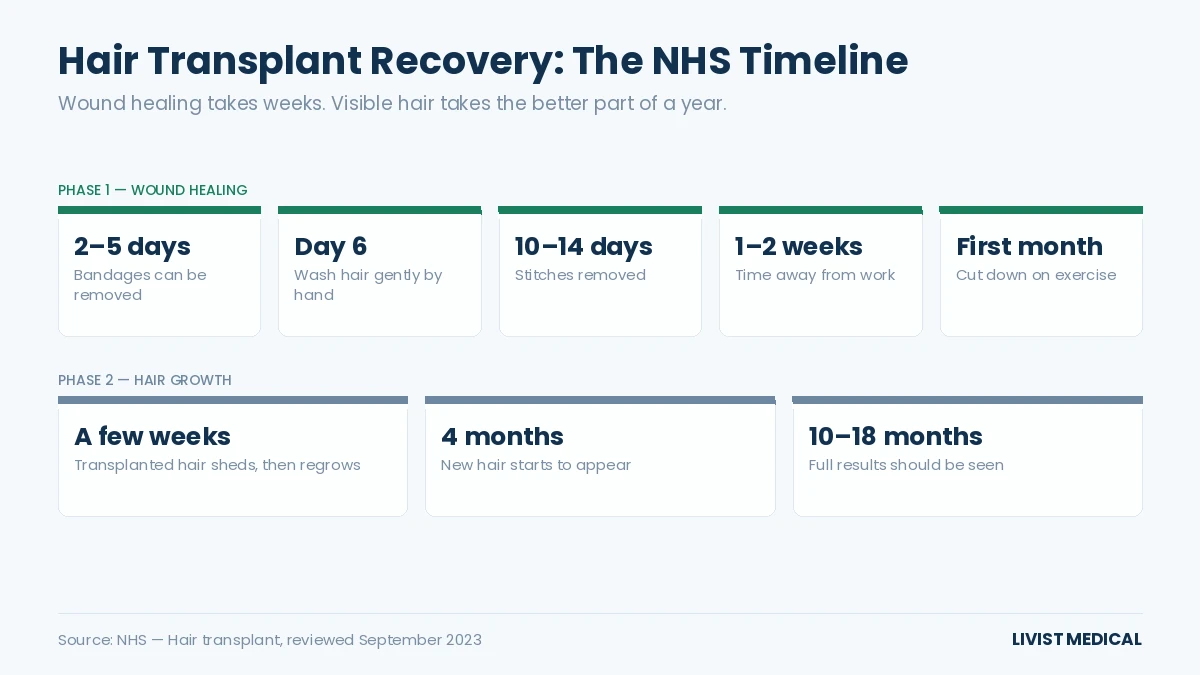
Healing and results run on two different clocks. The wound closes in weeks. The hair takes the better part of a year. The timeline below is the NHS one, used end to end so the stages do not contradict each other.
| Hair transplant milestone | What happens | When |
|---|---|---|
| Bandages | Bandages can usually be removed — do not touch the grafts | 2 to 5 days |
| First wash | You can wash your hair gently by hand | Day 6 |
| Grafts secure | Grafts are not secure before this — be very careful | First 2 weeks |
| Stitches | Non-dissolvable stitches removed | 10 to 14 days |
| Time off work | Most people need time away from work | 1 to 2 weeks |
| Exercise | Cut down on exercise to reduce scarring | First month |
| Shedding | Transplanted hair falls out, then starts to grow back | After a few weeks |
| New growth | New hair usually starts to appear | After 4 months |
| Full result | Full results should be seen | 10 to 18 months |
The gap between month one and month four is where most of the regret on the internet gets written. Nothing is visibly growing, the donor area still looks thin, and it feels like the money is gone. That is the normal shape of the timeline, not a warning sign.
The 2018 review in the Journal of Cutaneous and Aesthetic Surgery is unusually direct about why complication numbers have been rising, and it is not the technique:
"As the technique becomes popular, doctors from different specialties, often with inadequate training, have performed the surgery, and consequently, the total number of complications has shown an increase." — Complications in Hair Transplantation, J Cutan Aesthet Surg, 2018
That is the whole answer to "is a hair transplant safe". The procedure has a good safety record; the market around it does not police who performs it. The NHS makes the same point from the patient's side, telling people to check the surgeon is registered with the General Medical Council and holds a licence to practise, and warning that some clinics simply pay to appear at the top of search results. The principle travels to any country: verify the individual who will hold the instruments, not the brand on the website.
Search "is a hair transplant in Turkey safe" and the first page carries both "read this first" warnings and thousands of satisfied patients. Both are telling the truth, because the question is wrong. Turkey is not a safety category. It is a country with excellent hair-restoration surgeons and, alongside them, a price-driven segment that is where the horror stories come from.
The specific failures behind cheap hair transplants abroad are consistent and identifiable:
None of that is a reason to avoid Turkey; it is a reason to buy the surgeon rather than the price. For context, published prices at the extremes tell their own story: the NHS puts a UK hair transplant at £1,000 to £30,000 (about $1,350 to $40,570 at 12 September 2026 rates), while an all-inclusive VIP hair transplant package in Istanbul is €1,690 (about $1,960) and a hair transplant with PRP is €1,980 (about $2,300). A price far under those is not a better deal — it is a different procedure, performed by different people.
Livist Medical arranges treatment at contracted health institutions holding a health-tourism authorisation certificate, with named contracted doctors you can look up before you travel — for example Prof. Dr. Ali Balevi, a specialist in dermatology and dermatologic surgery in Istanbul. The network covers 10 contracted institutions, 42 doctors and more than 30 specialties.
No technique is risk-free, and the differences are smaller than the marketing suggests. What changes between them is donor-site trauma and the healing pattern — not whether the operation is fundamentally safe. Who performs it still matters more than which of the three is chosen.
If you are not yet a surgical candidate, non-surgical options carry lower risk by definition: PRP hair treatment and, for patchy autoimmune loss, alopecia areata treatment. Both preserve what you still have rather than moving it.
Safety is also candidacy. A hair transplant is generally a poor idea in these situations:
A doctor who examines your scalp, asks about your medical history, and is willing to tell you no is performing the safety check that matters most. Procedure detail differs by patient too — see hair transplant for men and hair transplant for women.
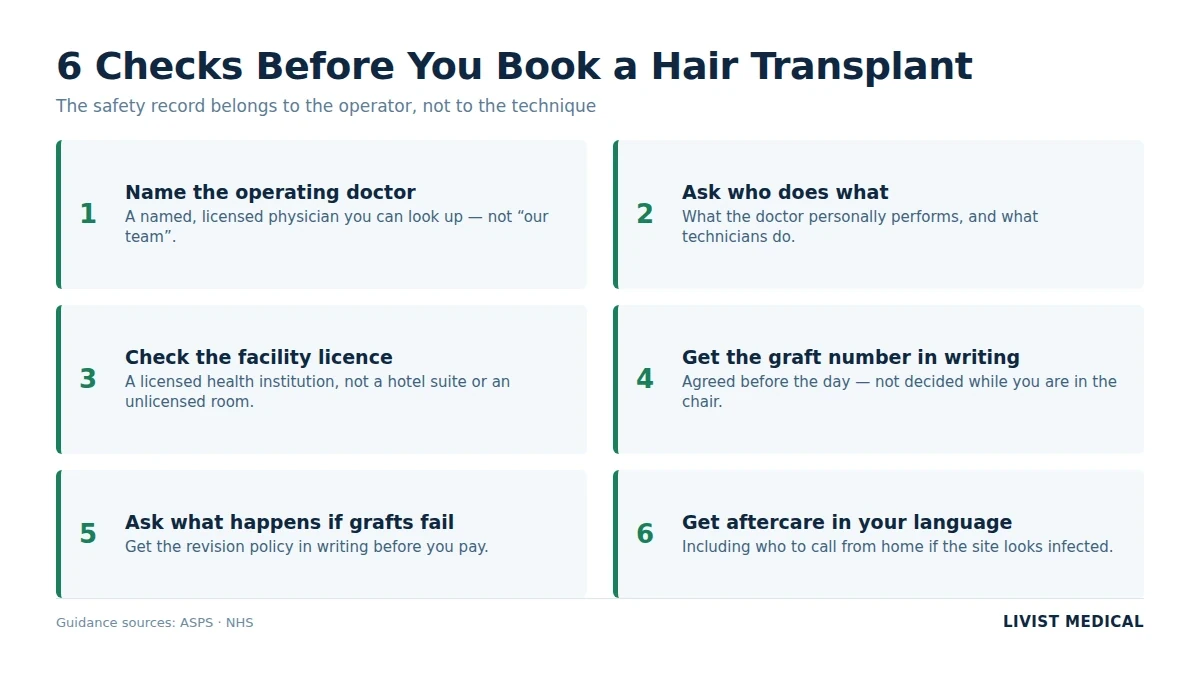
Six questions, in writing, before any deposit — anywhere in the world. The NHS version of this list asks surgeons how many transplants they have performed, how many had complications, and what follow-up to expect if things go wrong.
Before you weigh the risks, it helps to know how far the loss has already gone: the stages of hair loss on the Norwood and Sinclair scales decide whether medication or surgery is the honest answer for you.
A hair transplant is safe in the hands that meet the six checks above and unsafe in hands that do not — and the only way to know which you are dealing with is to ask before you pay. Send photographs of your scalp and get a named contracted doctor's assessment of whether you are a candidate at all, what your donor area can safely give, and what it costs, before you book anything.
Request a free hair transplant assessment with Livist Medical.
Hair TransplantThe stages of hair loss on the Norwood and Sinclair scales, which stage still responds to treatment, and Turkey's official cost floor per graft.
 Hair Transplant
Meagan Good has confirmed one cosmetic procedure — an eyebrow transplant — and denied the rest. What she said, and how brow transplants actually work.
 Hair Transplant
What an eyebrow transplant really costs in 2026 — by country, graft count and technique