 Hair Transplant
5
Eyelash Transplant: Risks, Results and Real CostsEyelash transplants use scalp hair, so lashes keep growing and need lifelong trimming. Published risks, who it is for, and Turkey's official price floor.
September 20, 2026Read More

Grafts needed = bald area x planned density. Published figures: 35 grafts/cm2 for the frontal zone, 600-900 for a hairline, plus cost per count.
The number of hair grafts you need is your bald area in square centimetres multiplied by the density your surgeon plans per square centimetre. Published surgical guidance puts the frontal zone at around 35 grafts per cm², and a hairline transition zone alone at 600 to 900 grafts. Any number quoted before your scalp is measured is a guess.
Written and medically reviewed by Prof. Dr. Ali Balevi — Dermatology, doctor profile
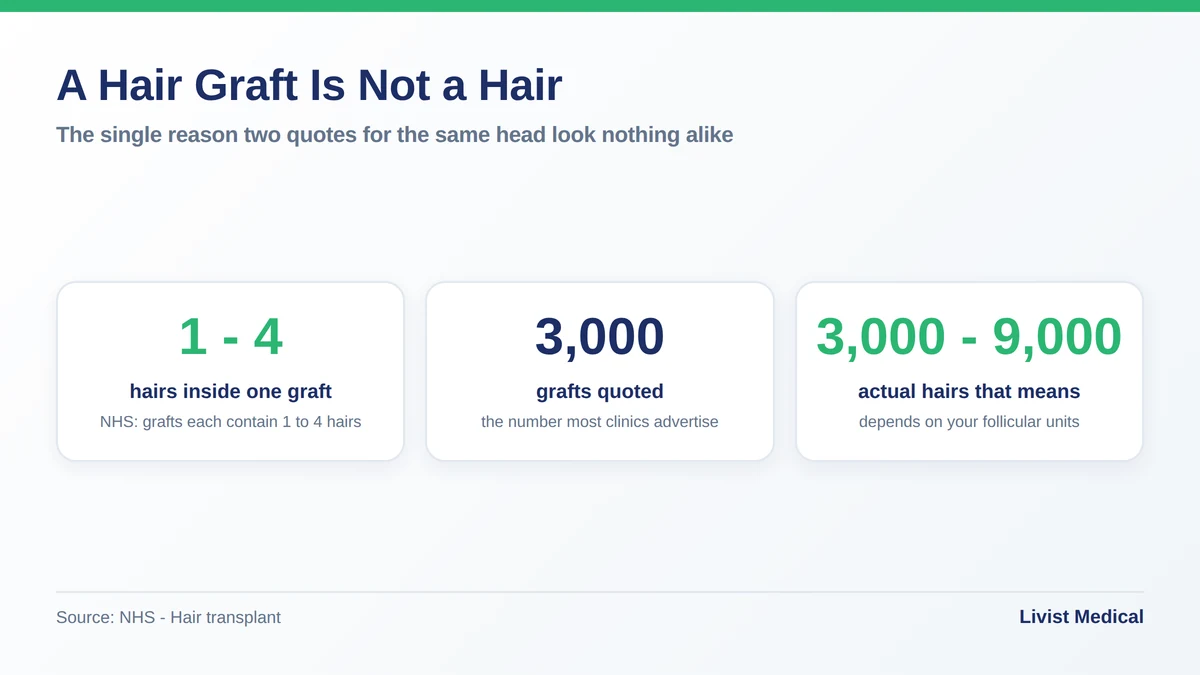
This is where most quotes become misleading. A graft is not a hair. The NHS describes the strip method as taking a piece of skin and dividing it "into pieces, each containing 1 to 4 hairs (hair grafts)". So 3,000 grafts is not 3,000 hairs — it is somewhere between roughly 3,000 and 9,000 hairs, depending on how many hairs sit in each follicular unit on your head.
Two clinics can quote you wildly different numbers for the same head and both be technically honest, because one is counting grafts and the other is counting hairs. Before comparing any two prices, confirm which unit each quote uses.
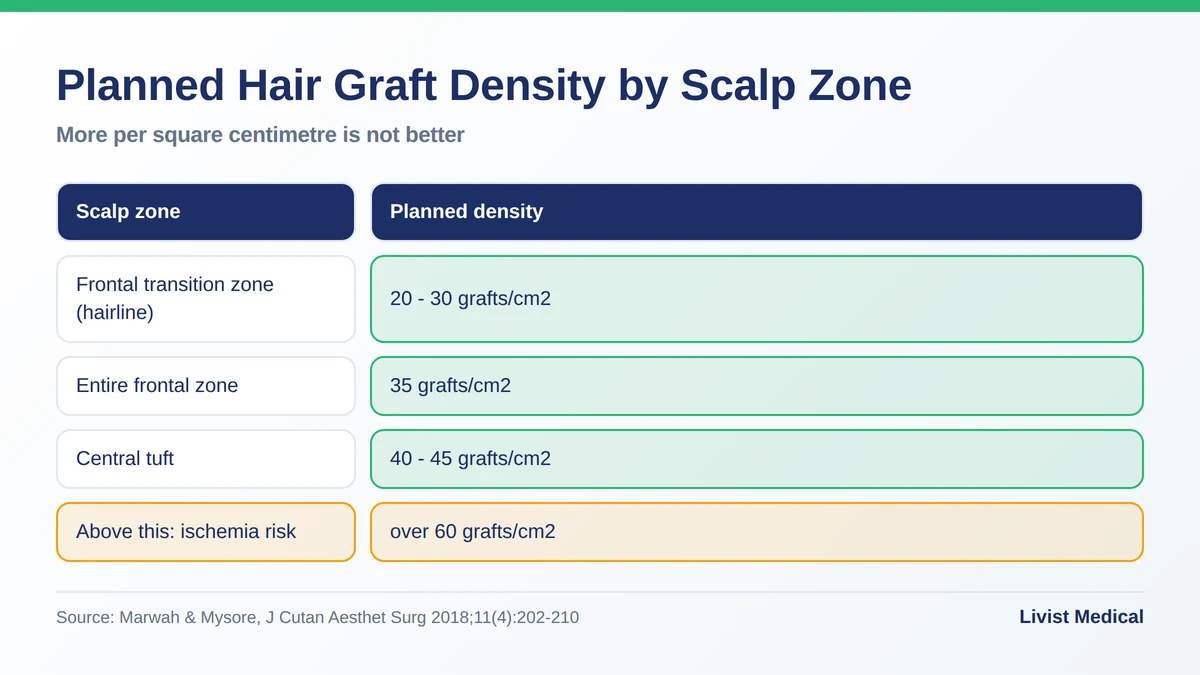
Graft planning in the surgical literature is an area calculation, not a menu. In the Journal of Cutaneous and Aesthetic Surgery (2018), Marwah and Mysore describe marking "the transition zone and lateral tuft area (desired density, 25 grafts/cm2), central tuft (desired density, 45 grafts/cm2), and the entire frontal zone (desired density, 35 grafts/cm2)". They also state that "35 units/cm2 is the optimal density required to give an acceptable result in Asian patients".
| Scalp zone | Planned density | What the literature says |
|---|---|---|
| Frontal transition zone (the hairline itself) | 20–30 grafts/cm² | "on an average 600–900 grafts are required to fulfil this" |
| Central tuft | 40–45 grafts/cm² | The densest zone, giving the visual impression of fullness |
| Entire frontal zone | 35 grafts/cm² | Stated as the desired density for the whole zone |
| Upper safe limit | above 60 grafts/cm² | "can hamper the dermal vasculature and create an environment of ischemia, leading to less graft survival" |
Read that last row twice. More hair grafts per square centimetre is not better. Past roughly 60 per cm², the blood supply cannot support them and survival drops — so a clinic promising maximum density is promising something the literature warns against.
A hairline-only case is the smallest common plan, and it is the one with the clearest published anchor: 600 to 900 grafts for the transition zone at 20 to 30 grafts per cm². Add the lateral tufts at the temples and the number rises; restore density behind the hairline as well and you are into frontal-zone territory at around 35 grafts per cm² across a larger area.
The judgement that cannot be outsourced to a table is where the new hairline should sit. A line drawn too low in your thirties becomes unnatural in your fifties as the hair behind it continues to thin.
The crown consumes grafts faster than any other zone because it is a whorl: hair radiates outward, so the eye sees scalp through it at densities that would look full on the front. Many surgeons deliberately treat the front first and the crown later, or not at all, because the crown can keep expanding with age and swallow a donor supply that cannot be replaced.
Where your own loss sits on the Norwood scale is the starting point for that conversation, and it is laid out stage by stage in stages of hair loss.
There is a second, harder ceiling: your permanent donor area is finite, and every graft taken from it is gone from it forever. Two people with identical bald areas can need the same number of grafts and only one of them may be able to supply it.
What the surgeon measures is donor density, hair calibre, and the size of the safe zone. This is also why a second procedure years later is not guaranteed — the donor budget may already be spent. A plan that uses your whole donor supply on the crown at 30 leaves nothing for the hairline at 45.
Session size is limited by graft survival, not ambition. Grafts kept outside the body longer lose viability, and very long sessions extend that window. The NHS notes that if a large area is being treated "you may need to have 2 or more sessions on different days" — the standard answer when the required number exceeds what one safe session can deliver.
Treat an unusually large single-session promise as a question to ask rather than a benefit to accept: how long will the grafts be out of the body, and how many staff are placing them?
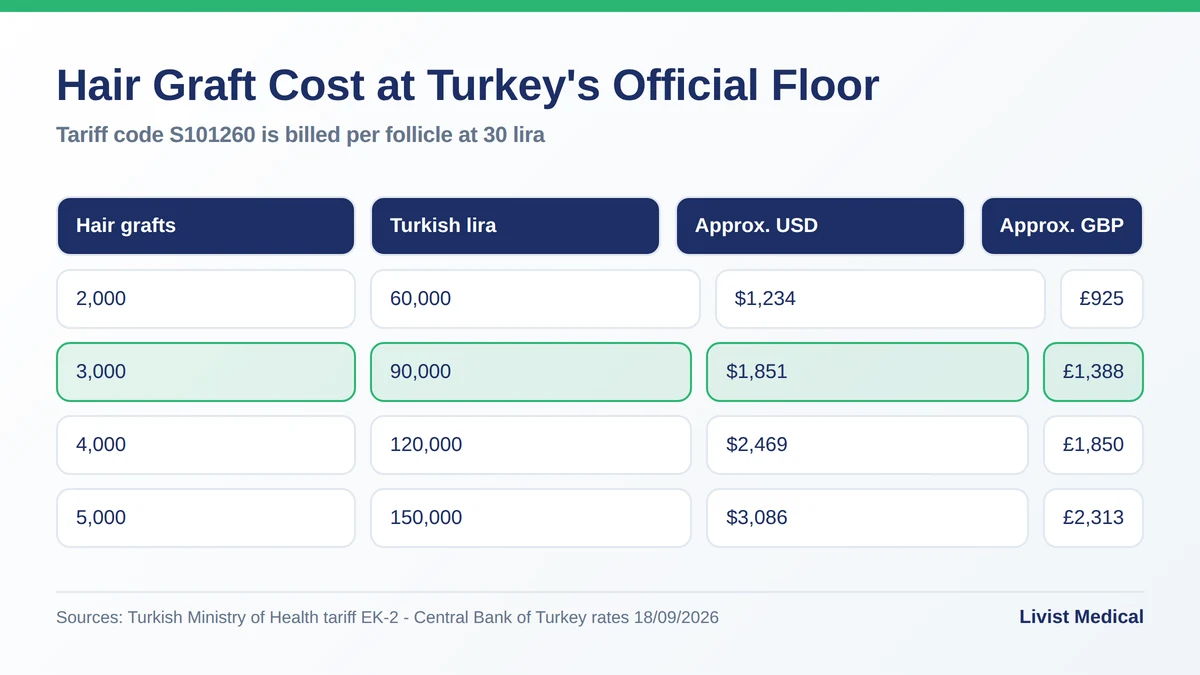
Turkey's Ministry of Health tariff (annex EK-2) prices scalp hair transplantation under code S101260 explicitly per follicle — folikül başına faturalanır — at 30 lira. That makes the floor price of any graft count a simple multiplication. Converted at Central Bank of Turkey buying rates published on 18/09/2026:
| Hair grafts | Turkish lira | Approx. USD | Approx. GBP |
|---|---|---|---|
| 2,000 | 60,000 | $1,234 | £925 |
| 3,000 | 90,000 | $1,851 | £1,388 |
| 4,000 | 120,000 | $2,469 | £1,850 |
| 5,000 | 150,000 | $3,086 | £2,313 |
For contrast, the NHS states that a hair transplant in the UK "can cost anywhere between £1,000 and £30,000, depending on the extent of hair loss, the type of procedure you have, and the quality of the clinic and its team". The tariff figure above is the surgical floor only, excluding travel, accommodation and follow-up.
If you are still weighing up the day itself, is a hair transplant painful covers what the procedure actually feels like, and is a hair transplant safe covers the risk side.
A graft number is only worth what the measurement behind it is worth. Livist Medical coordinates assessment and treatment inside contracted health institutions holding a health-tourism authorisation certificate, with contracted doctors in hair restoration. Ask for your donor density and planned density per zone in writing. Start from the hair transplant procedure page.
This article is for information only. It does not replace a direct medical consultation and contains no guarantee of results.
Hair TransplantEyelash transplants use scalp hair, so lashes keep growing and need lifelong trimming. Published risks, who it is for, and Turkey's official price floor.
 Hair Transplant
The NHS says a hair transplant is done under local anaesthetic and sedation, with no pain during it. What the injections and first week really feel like.
 Hair Transplant
The stages of hair loss on the Norwood and Sinclair scales, which stage still responds to treatment, and Turkey's official cost floor per graft.