 Hair Transplant
5
Eyelash Transplant: Risks, Results and Real CostsEyelash transplants use scalp hair, so lashes keep growing and need lifelong trimming. Published risks, who it is for, and Turkey's official price floor.
September 20, 2026Read More

Hair transplant recovery week by week: bandages off at 2–5 days, 1–2 weeks off work, shedding, new hair from month 4 and full results at 10–18 months.
Hair transplant recovery follows a predictable timeline. The first 7–10 days cover wound healing, scabbing and careful washing; weeks 2–4 bring scab shedding and "shock loss," where most transplanted hairs fall out; months 1–3 are a quiet dormant phase; new growth starts around month 4; and full, final results appear at 12–18 months. Knowing what is normal at each stage stops the temporary shedding phase from causing panic — it is an expected part of the process, not a failed transplant.
Written and medically reviewed by: Op. Dr. Caner Gelbal — Hair Restoration, Medipol Mega University Hospital, surgeon profile · Last updated: 27 September 2026
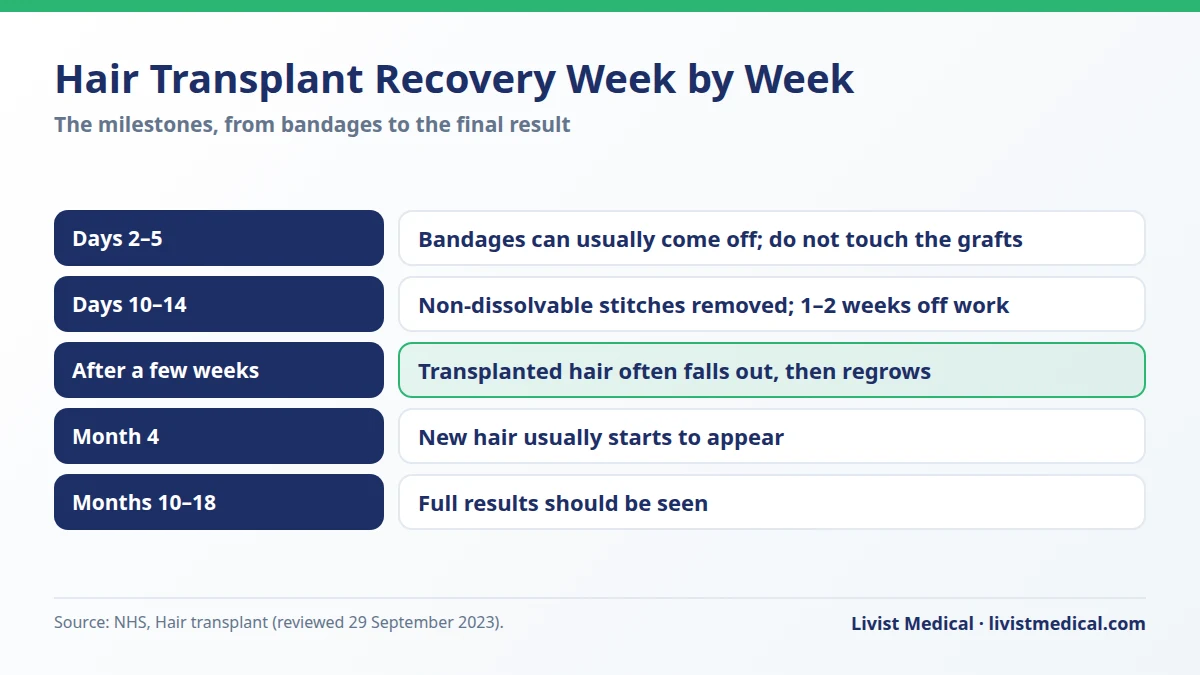
This week-by-week guide walks you through exactly what happens to the grafts, the donor area and the way your hair looks at every stage, along with the aftercare that protects your results.
A modern FUE or DHI hair transplant moves individual follicular units from a donor area (usually the back of the scalp) to thinning or bald areas. Two regions heal on different schedules:
The grafts are at their most fragile in the first few days, which is why aftercare in the first week matters more than at any other point.
"After 2 to 5 days: any bandages can usually be removed, but you should not touch the grafts." "After a few weeks: the transplanted hair will often fall out, and later start to grow back." "After 4 months: new hair will usually start to appear." "After 10 to 18 months: the full results should be seen."
— NHS, Hair transplant (checked 27 September 2026)
| Stage | What's happening | How your hair looks |
|---|---|---|
| Days 1–3 | Swelling, redness, tiny scabs forming around grafts | Visibly "operated," small crusts and redness |
| Days 4–7 | Swelling settles; gentle washing begins; donor surface heals | Scabs softening; redness fading |
| Weeks 2–3 | Scabs shed; shock loss begins | Transplanted hairs start falling out |
| Weeks 3–4 | Most shock loss complete | Looks close to your pre-op state — this is normal |
| Months 1–3 | Dormant phase; follicles resting | Little visible change |
| Months 4–6 | New growth emerges, thin at first | Early density returns |
| Months 6–9 | Hairs thicken and mature | Noticeable, natural coverage |
| Months 12–18 | Final density and texture | Full, permanent result |
Expect mild swelling (sometimes spreading to the forehead), redness and tenderness in both the recipient and donor areas. Tiny scabs form around each graft. The single most important job now is protecting the grafts: sleep semi-upright, avoid touching or scratching, skip alcohol and smoking, and follow your clinic's exact washing and spray instructions. Grafts are not yet anchored, so any rubbing can dislodge them.
Swelling usually peaks around day 2–3 and then fades. Most clinics start a gentle, structured washing routine around days 3–5 to soften scabs. The donor area surface typically heals within 5–7 days. Many people with desk jobs feel comfortable returning to light, non-strenuous work toward the end of week one — often more concerned about appearance than discomfort.
For most patients, days 1–3 are the most uncomfortable because of swelling, tightness and disrupted sleep. The more emotionally difficult phase comes later — during weeks 3–4, when shock loss makes it look like the transplant "didn't work." Both are completely normal stages.
By the start of week two, scabs begin to fall away with gentle washing. Then comes the stage that worries people most: shock loss. The transplanted hairs shed — sometimes almost all of them. This is expected and does not mean the grafts have failed. The follicle stays safely in place beneath the skin; only the visible hair shaft is shed before the follicle enters a resting phase and later regrows.
After shock loss, your scalp often looks much like it did before surgery, with residual redness fading. This can feel discouraging, but it is simply the calm before regrowth. By now the grafts are far more secure.
Grafts become meaningfully more secure after about 7–10 days, once the body has begun anchoring them and the scabs have lifted. They are not fully "permanent-feeling" yet, so you should still avoid heavy friction, swimming pools, saunas and intense exercise until your surgeon clears you — usually around weeks 3–4.
This is the quietest stretch. The transplanted follicles rest, and there is little visible change. Patience matters here — many people mistakenly think nothing is happening. Behind the scenes, the follicles are preparing to produce new, permanent hair.
Around month 4, fine new hairs start to emerge. They may look thin, wispy or unevenly distributed at first — this is normal. Density builds steadily through month 6.
The new hairs thicken, darken and mature. By this point most patients see a clear, natural improvement in coverage and can style their hair normally.
Full results typically appear between 12 and 18 months, when the hair reaches its final density and texture. Crown areas and larger sessions can take the longer end of that range.
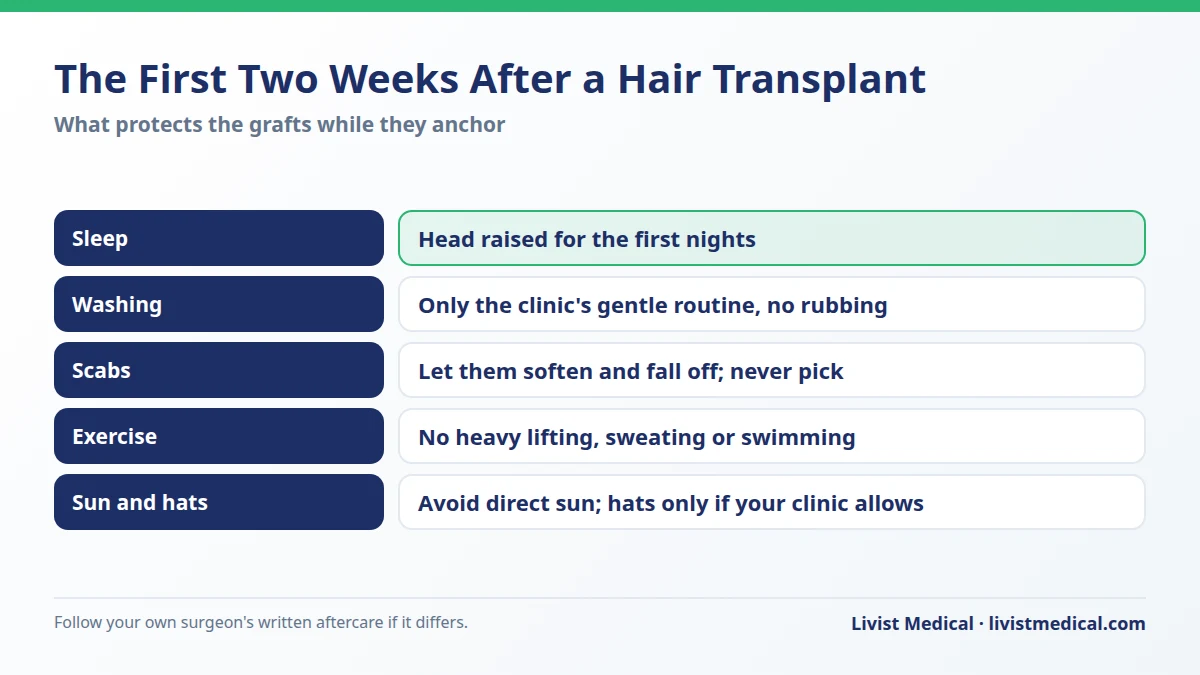
The transplant is only half the story — aftercare in the first weeks determines how many grafts survive. Key habits:
Yes, slightly. Minimally invasive methods generally mean faster surface healing:
The overall growth timeline (shock loss → dormancy → regrowth → final result) is similar across techniques.
Recovery is only half of what most people are really asking. If you are still weighing the decision itself, our guide to whether a hair transplant is safe sets out every documented risk with its reported frequency and timing.
Turkey is one of the world's busiest hair-restoration destinations, where ISHRS-experienced surgeons perform high-graft FUE and DHI procedures at contracted health institutions holding a health-tourism authorisation certificate — typically at a fraction of US or UK prices, often as an all-inclusive package with hotel, transfers and aftercare guidance. Whether you are researching a hair transplant for men or an unshaven hair transplant for women, you can review our surgeons and partner hospitals before deciding.
Planning your procedure or recovery? Book a free consultation for a personalised graft estimate, technique recommendation and a clear recovery plan within 24 hours.
How dramatic the shedding phase feels depends partly on where you started, which is why it is worth checking your own position on the stages of hair loss before judging week three.
Recovery is easier to plan once you know which parts hurt and when — is a hair transplant painful breaks the sensations down day by day. And if you are still at the quoting stage, how many hair grafts do I need explains why two clinics can give you very different numbers for the same head. The same single-hair technique is used on the lash line, where recovery and risk are different again: eyelash transplant.
Livist Medical arranges hair transplants with contracted surgeons in partner hospitals in Istanbul and gives you written aftercare for each stage of the timeline above. Book a free consultation and send photos of your hairline and crown to get a graft estimate and a recovery plan built around your travel dates.
Healing timelines vary between individuals based on the technique, the number of grafts, skin type and how closely aftercare is followed. Some redness, numbness or uneven early growth is normal. If you ever notice signs of infection — spreading redness, pus, fever or severe pain — contact your clinic promptly. A good provider supports you throughout the full 12–18 month timeline, not just on the day of surgery.
Related articles: Beard Transplant in Turkey: 2026 Cost, Grafts & Results, Nose Job in Turkey Cost 2026: Prices, Packages & What’s Included, Lipo 360 Recovery Time: Week-by-Week Timeline & What to Expect (2026).
Hair TransplantEyelash transplants use scalp hair, so lashes keep growing and need lifelong trimming. Published risks, who it is for, and Turkey's official price floor.
 Hair Transplant
The NHS says a hair transplant is done under local anaesthetic and sedation, with no pain during it. What the injections and first week really feel like.
 Hair Transplant
Grafts needed = bald area x planned density. Published figures: 35 grafts/cm2 for the frontal zone, 600-900 for a hairline, plus cost per count.