Hair TransplantThe NHS says a hair transplant is done under local anaesthetic and sedation, with no pain during it. What the injections and first week really feel like.

Eyelash transplants use scalp hair, so lashes keep growing and need lifelong trimming. Published risks, who it is for, and Turkey's official price floor.
An eyelash transplant moves hair follicles, usually from the back of the scalp, into the lash line. It is a real surgical procedure with a real ophthalmic risk, and in the published literature it is mostly reconstructive rather than cosmetic. Turkey's official health tariff sets a floor of 42,675 lira per session for the operation itself.
Written and medically reviewed by Prof. Dr. Ali Balevi — Dermatology, doctor profile

Single-hair follicular units are taken from a donor site and placed one by one along the lid margin, angled to follow the natural lash curve. Because the donor hair is scalp hair, it keeps scalp behaviour: it grows continuously instead of stopping at lash length. That single biological fact drives almost everything else on this page.
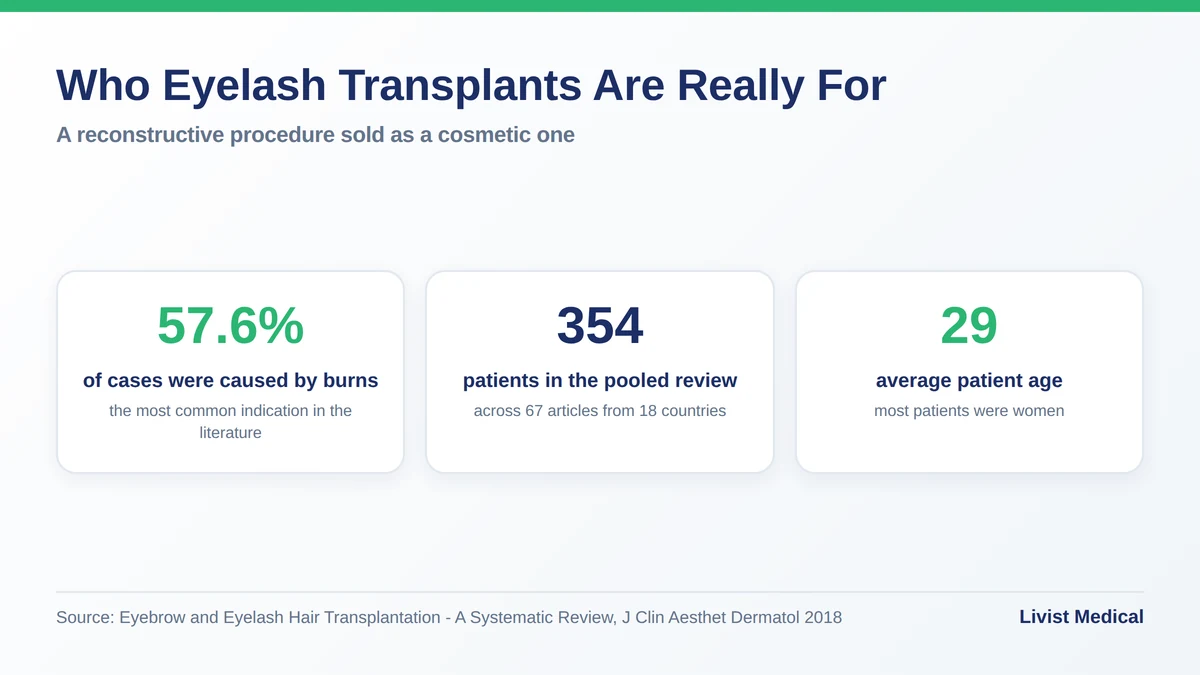
The systematic review of eyebrow and eyelash hair transplantation published in the Journal of Clinical and Aesthetic Dermatology in 2018 pooled 67 articles covering 354 patients from 18 countries, and reports that both eyebrow and eyelash transplantation "use follicular unit transplantation techniques most commonly".
The marketing picture is a woman who wants fuller lashes. The published picture is different. In that same review of 354 patients, "the most common etiology requiring hair transplantation was burns, occurring in 57.6 percent of cases". Most patients were women, with an average age of 29.
That matters when you are deciding. An eyelash transplant has its strongest case where lashes are absent or scarred — after burns, trauma, surgery, or trichotillomania — and a much weaker one as an alternative to mascara. A procedure developed for reconstruction is being sold as a beauty upgrade, and the risk profile did not change when the marketing did.
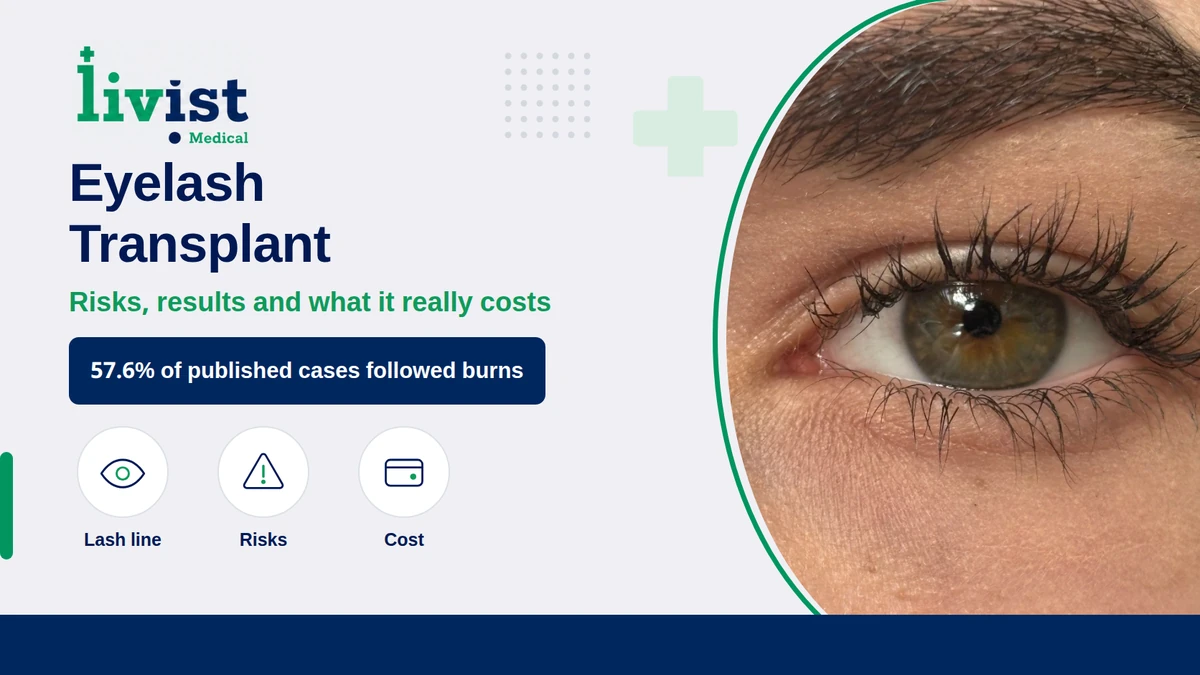
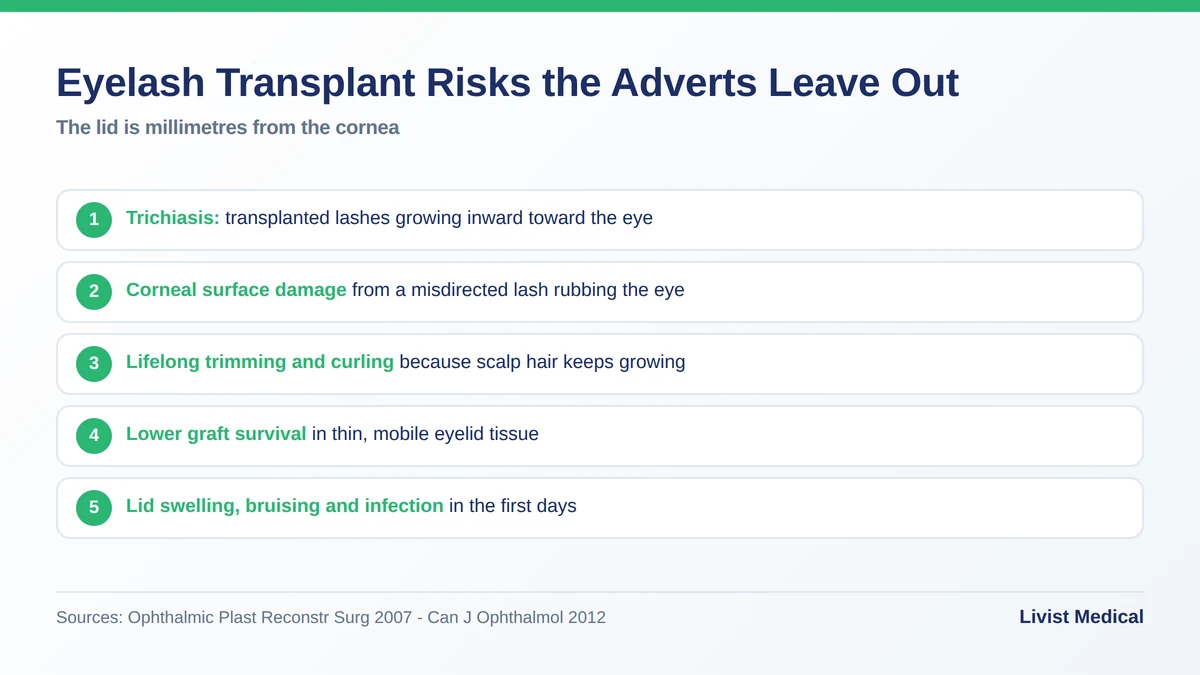
The eyelid is millimetres from the cornea, and a lash pointing the wrong way is not a cosmetic problem — it is an ocular one. Two case reports in the ophthalmic literature document exactly that after eyelash transplantation.
Murchison and Wojno reported "Trichiasis after eyelash augmentation with hair follicle transplantation" in Ophthalmic Plastic and Reconstructive Surgery in 2007. Chaudhry, Chaturvedi and Maino reported "Corneal punctate epitheliopathy secondary to trichiasis following eyelash transplantation" in the Canadian Journal of Ophthalmology in 2012 — transplanted lashes turning inward and abrading the surface of the cornea.
| Eyelash transplant risk | Why it happens | What it means for you |
|---|---|---|
| Trichiasis — lashes growing inward | Graft angle or direction is wrong | Documented in ophthalmic case reports; can abrade the cornea |
| Corneal surface damage | Persistent rubbing by a misdirected lash | Needs ophthalmic assessment, not a beauty clinic |
| Lashes that keep growing | Donor scalp hair keeps scalp growth behaviour | Lifelong trimming and curling |
| Poor graft survival | Very fine grafts in a mobile, thin lid | Density may be lower than hoped |
| Lid swelling, bruising, infection | Standard surgical risks in delicate tissue | Short-lived, but needs a plan and a contact |
Scalp hair does not know it has become a lash. Transplanted lashes typically need trimming every few weeks and curling to hold a lash-like shape, permanently. This is the single most common reason patients regret the procedure, and it is rarely on the page that sold it to them.
Ask your surgeon directly: how often will I need to trim, and who checks the direction of growth at follow-up? If the answer is vague, the follow-up plan is vague. Anyone who wears contact lenses or has dry eye should raise it before booking, not after.
Transplanted follicles are intended to be permanent, which is the appeal and also the commitment. The grafts shed early and regrow over the following months, in the same pattern as any hair transplant. Because they are permanent, a misdirected lash is also permanent until it is treated — which is why the angle at the time of surgery matters more than the number of grafts.

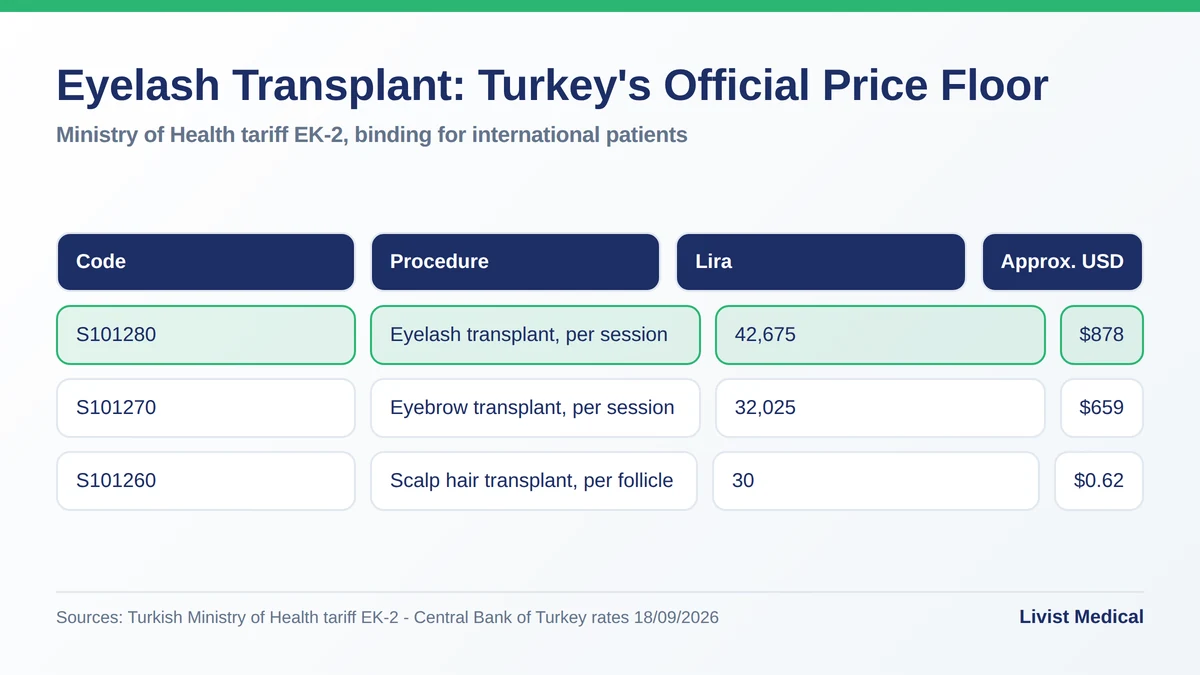
Turkey's Ministry of Health price tariff (annex EK-2) sets a binding minimum for international patients. Code S101280, kirpik ekimi — eyelash transplantation — is priced per session, and code S101270 covers eyebrow transplantation. Converted at the Central Bank of Turkey buying rates published on 18/09/2026:
| Official tariff code | Procedure | Turkish lira | Approx. USD | Approx. GBP |
|---|---|---|---|---|
| S101280 | Eyelash transplant, per session | 42,675 | $878 | £658 |
| S101270 | Eyebrow transplant, per session | 32,025 | $659 | £494 |
| S101260 | Scalp hair transplant, per follicle | 30 | $0.62 | £0.46 |
This is the floor for the surgery, not a package price, and it does not include travel, accommodation, or follow-up. Its use here is simple: any quote far below it should prompt one question about what has been removed from the service. The companion figures for eyebrow work are in eyebrow transplant cost in Turkey.
The alternatives are not equivalent, and honesty about that is more useful than a comparison table weighted to sell surgery. Extensions are temporary, reversible and repeatable, with the trade-off of maintenance and possible traction damage. Prescription lash-growth drops are medical and reversible, and lashes return to baseline when they are stopped. A transplant is the only permanent option, which cuts both ways.
For someone with absent lashes after burns or trauma, that permanence is the point. For someone choosing between a transplant and a monthly lash appointment, the lifetime trimming and the documented ophthalmic risk belong in the decision.
Livist Medical coordinates eyelash transplantation inside contracted health institutions holding a health-tourism authorisation certificate, with contracted doctors. Ask for a direction-of-growth plan and a written follow-up schedule before travelling — those two items separate a considered eyelash transplant from a sold one. Start from the eyelash transplant procedure page, or read is a hair transplant safe for the wider safety picture.
This article is for information only. It does not replace a direct medical consultation and contains no guarantee of results.
Hair TransplantThe NHS says a hair transplant is done under local anaesthetic and sedation, with no pain during it. What the injections and first week really feel like.
Hair TransplantGrafts needed = bald area x planned density. Published figures: 35 grafts/cm2 for the frontal zone, 600-900 for a hairline, plus cost per count.
Hair TransplantThe stages of hair loss on the Norwood and Sinclair scales, which stage still responds to treatment, and Turkey's official cost floor per graft.