 Hair Transplant
5
Eyelash Transplant: Risks, Results and Real CostsEyelash transplants use scalp hair, so lashes keep growing and need lifelong trimming. Published risks, who it is for, and Turkey's official price floor.
September 20, 2026Read More
The NHS says a hair transplant is done under local anaesthetic and sedation, with no pain during it. What the injections and first week really feel like.
A hair transplant is not painful during the procedure. The NHS states that a hair transplant "is usually carried out under local anaesthetic and sedation, which means you'll be awake but will not feel any pain." The part patients actually feel is the anaesthetic injection at the start, and a tight, achy scalp for a few days afterwards.
Written and medically reviewed by Prof. Dr. Ali Balevi — Dermatology, doctor profile
Every clinic page answers this question with the word "comfortable". That is marketing language, not information. The accurate answer has three parts: the injections sting for a few minutes, the surgery itself is felt as pressure and nothing more, and the days after it are achy rather than painful. Knowing which part is which is what removes the fear.
The NHS describes the anaesthetic plainly: local anaesthetic and sedation, awake, no pain. That is the same technique used for a dental procedure, scaled up in area and time. It is not general anaesthetic, and you are not asleep.
Local anaesthetic has to be injected into the donor area at the back of the head and into the recipient area on top. The needle entry and the pressure of the fluid spreading under the skin are what most patients describe as the worst moment of the day. It is short: a few minutes per area, at the start of each stage.
Most teams reduce this deliberately. A fine needle, a slow injection, a vibration device or chilled skin, and sedation given beforehand all lower what you feel. Ask which of these your team uses before you book, because the difference between clinics is almost entirely in this one step.
Once the scalp is numb, the extraction of grafts and the making of the recipient sites are felt as touch, tugging and pressure. Patients typically watch a screen, eat, or talk through the session. The NHS notes that a hair transplant "usually takes a day", and that if a large area is being treated "you may need to have 2 or more sessions on different days".
Top-up anaesthetic is normal as the hours pass. Say something the moment sensation returns rather than waiting; the point of the technique is that you should not be feeling the work.
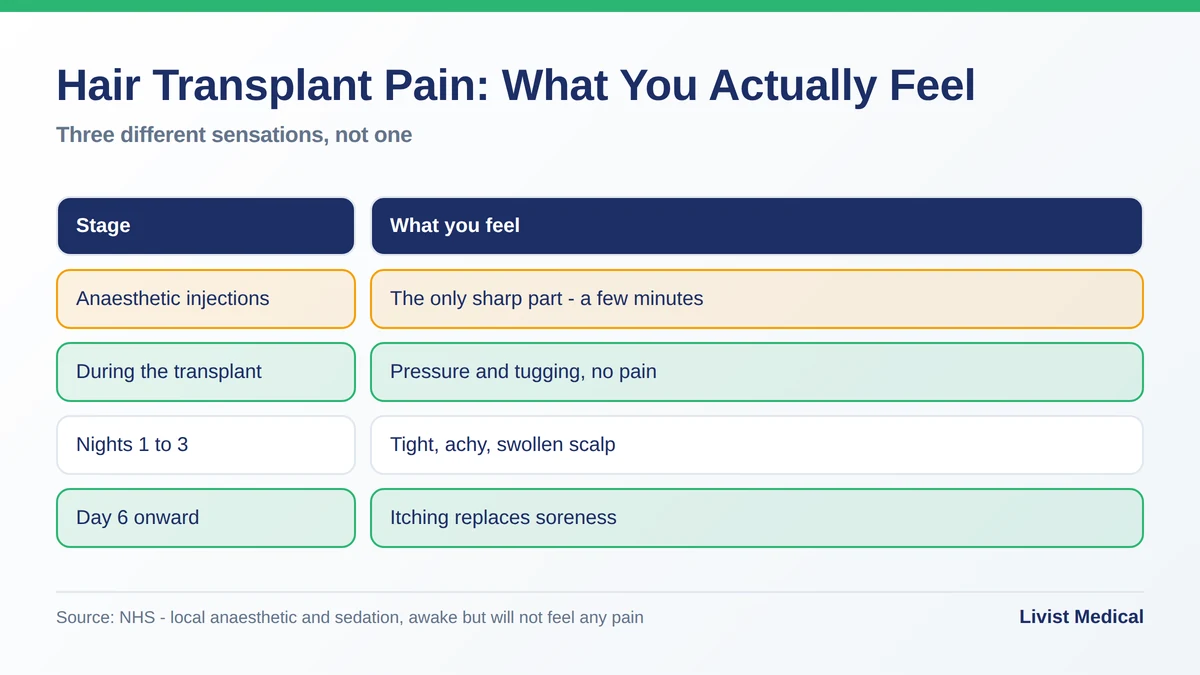
The NHS lists what is common after a hair transplant: "a tight, achy and swollen scalp for a few days", "temporary scabbing where the hair was transplanted", and "a single scar or a number of very tiny scars". That word — achy — is the accurate one for the first week.
| Stage after a hair transplant | What most people feel | What is happening |
|---|---|---|
| Day of surgery | Stinging during injections, then pressure only | Local anaesthetic and sedation |
| Night 1 to night 3 | Tight, achy scalp; sleeping upright is easier | Swelling peaks, often reaching the forehead |
| Days 2 to 5 | Soreness at the donor area more than the top | NHS: bandages can usually be removed after 2 to 5 days |
| Day 6 | Itching begins to replace soreness | NHS: you should be able to wash your hair gently by hand |
| Days 10 to 14 | Occasional zings or numbness, not pain | NHS: non-dissolvable stitches can usually be removed |
| Weeks 3 to 8 | Numb patches fading; no pain expected | Nerve recovery in the donor area |
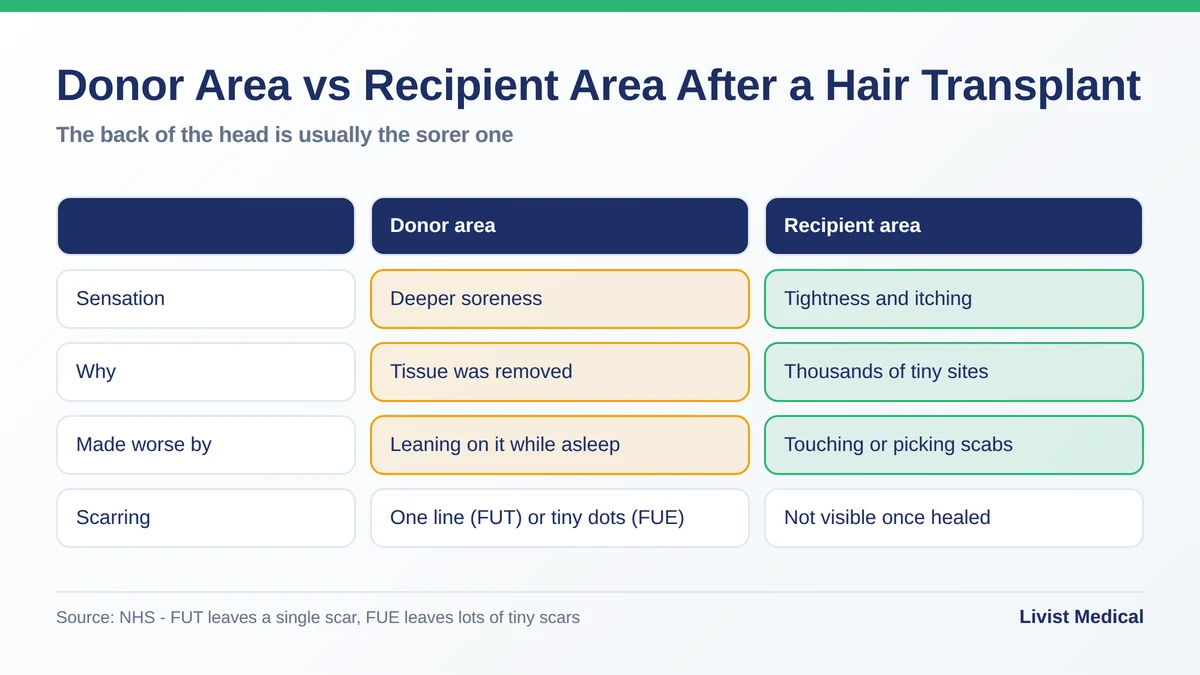
These two areas hurt differently, and most patients are surprised by which one dominates. The recipient area on top is covered in thousands of tiny wounds but is usually only tight and itchy. The donor area at the back carries the deeper soreness, because tissue has been removed from it, and it is the area you lean on when you sleep.
The difference is larger with the strip method. The NHS describes follicular unit transplantation as removing "a thin strip of skin with hair" from the back of the head, closed "with stitches", leaving a single line scar. Follicular unit extraction removes hairs "1 by 1", leaving "lots of tiny scars" instead. A closed stitch line pulls; thousands of punch sites sting. Neither is agony, and they do not feel the same.
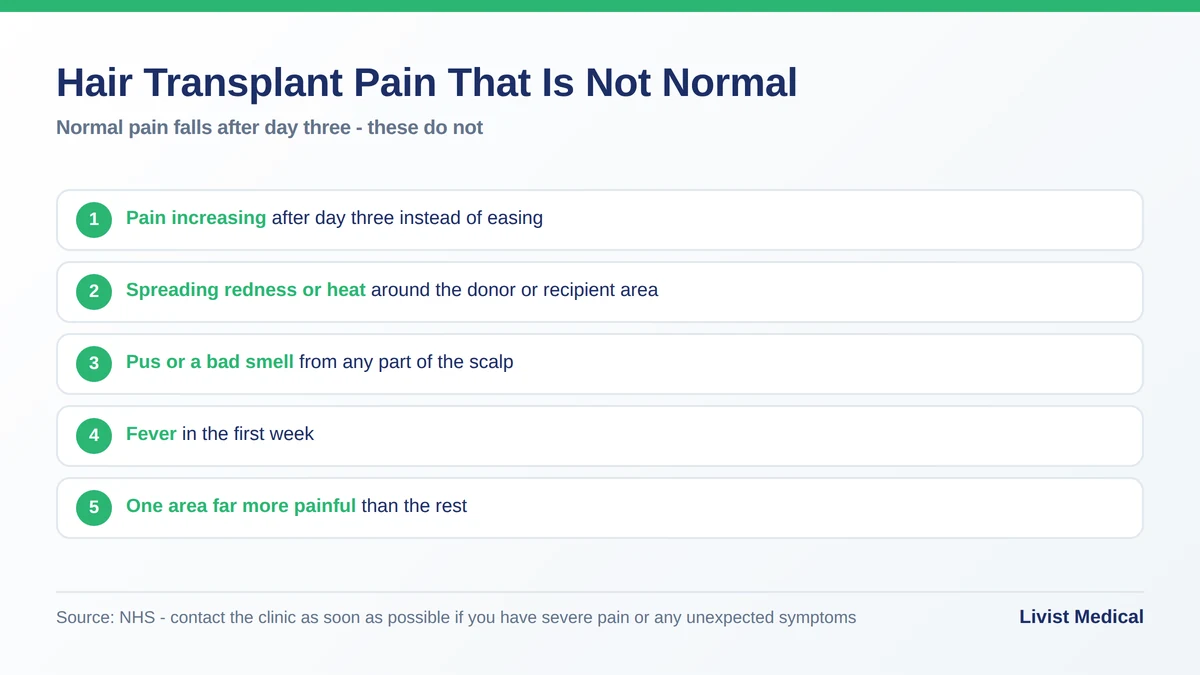
Normal discomfort peaks in the first two or three days and then falls. Anything that reverses that curve needs a phone call, not a wait. The NHS is explicit: contact the clinic where you had your hair transplant "as soon as possible if you have severe pain or any unexpected symptoms".
Call the same day for pain that increases after day three, spreading redness or heat, pus or a bad smell, fever, or one area that hurts far more than the rest. The NHS lists bleeding, infection and an allergic reaction to the anaesthetic among the small risks of the procedure and notes that a surgeon "should be able to treat these problems quickly" — which only happens if they hear about it. Our full breakdown of those risks is in is a hair transplant safe.
No procedure that involves needles is painless, and a clinic promising one is describing a mood, not a method. What exists is a well-anaesthetised transplant in which the only real discomfort is a few minutes of injection at the start. If a clinic advertises "painless", ask them what they do differently at the injection stage. A specific answer is a good sign; a slogan is not.
Be equally careful with the opposite claim. Sessions pushed past a reasonable length to maximise graft counts trade your comfort, and sometimes your results, for a bigger invoice. What you can expect afterwards is set out week by week in hair transplant recovery week by week, and the number of grafts your case actually needs is covered in how many hair grafts do I need.
Livist Medical coordinates your procedure inside contracted health institutions holding a health-tourism authorisation certificate, with contracted doctors in hair restoration. Ask for the anaesthetic protocol and the planned session length in writing before you travel — both are answerable questions, and both decide how your day feels. Start from the hair transplant procedure page.
This article is for information only. It does not replace a direct medical consultation and contains no guarantee of results.
Hair TransplantEyelash transplants use scalp hair, so lashes keep growing and need lifelong trimming. Published risks, who it is for, and Turkey's official price floor.
 Hair Transplant
Grafts needed = bald area x planned density. Published figures: 35 grafts/cm2 for the frontal zone, 600-900 for a hairline, plus cost per count.
 Hair Transplant
The stages of hair loss on the Norwood and Sinclair scales, which stage still responds to treatment, and Turkey's official cost floor per graft.