Stages of Hair Loss: Norwood and Sinclair Scales Explained
Hair Transplant

Stages of Hair Loss: Norwood and Sinclair Scales Explained

September 13, 2026
9
Share Article :

Stages of Hair Loss: Norwood and Sinclair Scales Explained

The stages of hair loss on the Norwood and Sinclair scales, which stage still responds to treatment, and Turkey's official cost floor per graft.

The stages of hair loss are graded on the Norwood scale for men (seven stages) and the Sinclair scale for women (five stages), and the stage you are at decides what treatment can still do for you. Stages 1 and 2 are not balding. Stages 3 to 5 are where hair loss becomes visible and where medication still holds ground. Stages 6 and 7 are where only surgery redistributes what is left.

Written and medically reviewed by Prof. Dr. Ali Balevi — Specialist in Dermatology and Dermatologic Surgery, Medipol Mega University Hospital, Istanbul · Last updated: 13 September 2026

This article is for information only. It is not a diagnosis or a treatment plan. Discuss your own case with a qualified doctor before starting any medication or booking surgery.

The seven Norwood stages of hair loss from stage 1 to stage 7
The seven Norwood stages of hair loss — stages 1 and 2 are not balding, stage 3 is the first balding stage.

The 7 Stages of Hair Loss on the Norwood Scale

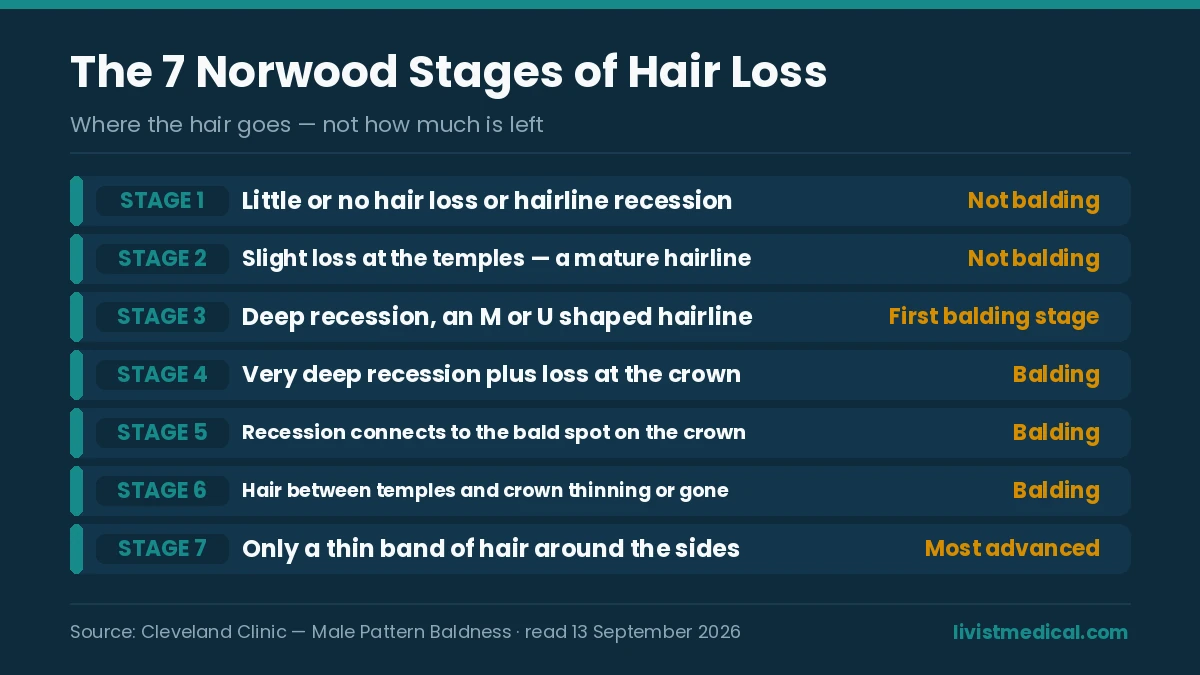
The Norwood scale grades the stages of hair loss in men from 1 to 7 by where the hair has gone, not by how much is left. Cleveland Clinic describes the seven stages of male pattern baldness in the exact terms below — memorise the boundary between stage 2 and stage 3, because that is the line between a maturing hairline and clinical balding.

StageWhat the scalp showsIs this balding?
Stage 1"There's little or no hair loss or hairline recession."No
Stage 2"There's slight hair loss near the skin between your ears and forehead (temples)."No — a mature hairline
Stage 3"You have deep hairline recession around your temples, and your hairline may have an 'M' or 'U' shape."Yes — first balding stage
Stage 4"You have very deep hairline recession and a loss of hair at the top of your head (crown)."Yes
Stage 5"Your hairline recession connects to the bald spot on your crown."Yes
Stage 6"The hair between your temples and crown is thinning or gone."Yes
Stage 7"You have no hair on the top of your head and a thin band of hair around the side of your head."Yes — most advanced

Source: Cleveland Clinic — Male Pattern Baldness (Androgenic Alopecia), read 13 September 2026.

Early Stages of Hair Loss: Shedding Is Not the Same as Balding

Losing hair every day is normal and is not a stage of anything. The NHS puts the normal figure plainly: "We can lose between 50 and 100 hairs a day, often without noticing." Cleveland Clinic gives the same ceiling — "Most healthy people lose up to 100 strands of hair per day." Shedding becomes one of the early stages of hair loss only when the hairs that fall are not replaced and the pattern is geographic: temples first, crown second.

  • Shedding: hair comes out all over the scalp, density stays the same, and it usually follows an event — illness, surgery, childbirth, crash dieting.
  • Pattern hair loss: the hairline moves backwards in an M shape, or the crown thins, while the back and sides stay untouched.
  • The mirror test for early hair loss: compare a photograph of yourself from five years ago at the same angle and the same light, not your memory of it.

Cleveland Clinic sets out how early this starts: "About 25% of men see the first signs of hair loss before age 21. By age 50, half experience hair loss, and about 70% will lose hair as they get older."

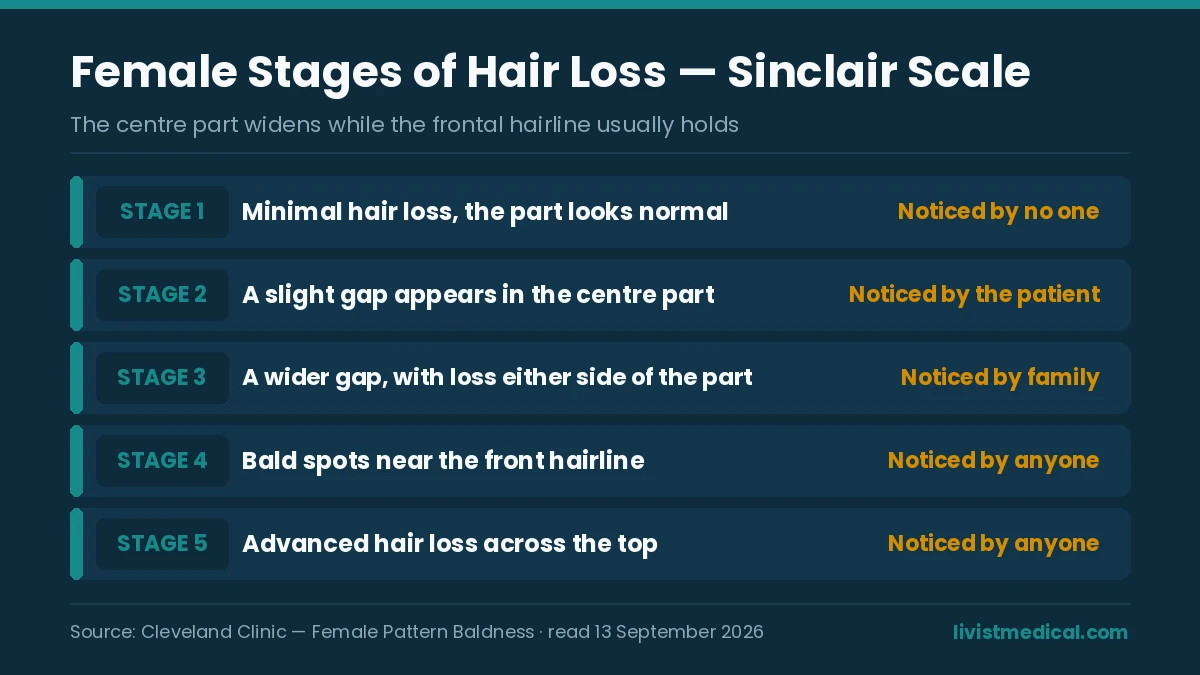
The five Sinclair stages of hair loss in women
The stages of hair loss in women on the Sinclair scale — the centre part widens while the frontal hairline holds.

Female Stages of Hair Loss: The Sinclair Scale for Women

Female pattern hair loss does not follow the Norwood pattern. It starts at the centre part and widens outwards, and the frontal hairline is usually preserved. Cleveland Clinic stages it on the Sinclair scale and describes the progression as "a slight gap appears in your center hair part", then "a wider gap is present in your center hair part, and there's hair loss on either side", before bald patches appear near the front.

Sinclair stageWhat the centre part showsUsually noticed by
Stage 1Minimal hair loss; the part looks normalNo one
Stage 2A slight gap appears in the centre partThe patient only
Stage 3A wider gap, with hair loss on either side of the partFamily, in bright light
Stage 4Bald spots appear near the front hairlineAnyone
Stage 5Advanced hair loss across the topAnyone

Scale is the reason women are under-diagnosed: "Approximately 30 million women in the United States have female pattern baldness," and it is the most significant cause of hair loss in women. If you are a woman reading your own stage, our guide to hair transplant options for women covers what is possible at each one.

What Pushes Hair Loss From One Stage to the Next

Pattern hair loss is hormonal and inherited, and it progresses because the follicle shrinks a little with every growth cycle until it stops producing a hair you can see. Cleveland Clinic names the mechanism: dihydrotestosterone (DHT), an androgen, and "there might be a link between DHT and your hair follicles shrinking", with the AR gene's sensitivity helping to determine male pattern baldness.

That has one practical consequence that governs every decision below. As Cleveland Clinic states it: "Without medications or treatment, hair loss due to male pattern baldness is permanent." The NHS says the same in its own words — "Some types of hair loss are permanent, like male and female pattern baldness. This type of hair loss usually runs in the family."

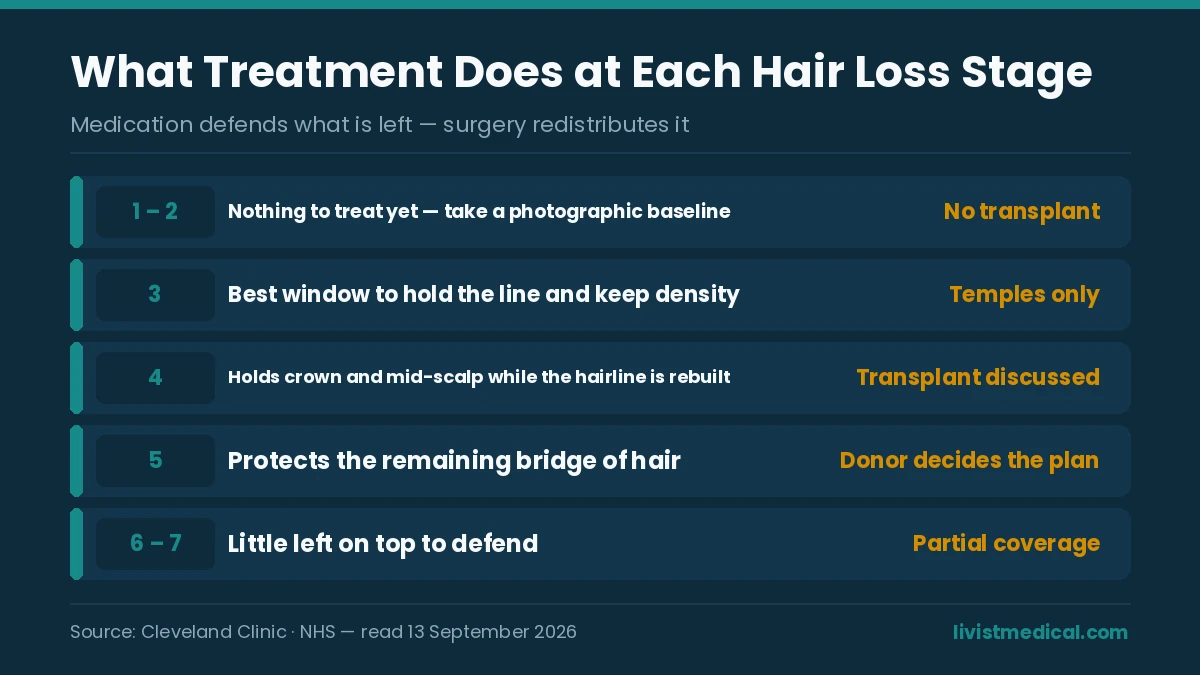
Which stages of hair loss respond to medication and which need a transplant
The treatment window across the stages of hair loss — medication defends, surgery redistributes.

Which Stages of Hair Loss Still Respond to Treatment

Medication defends the hair you still have; it does not rebuild a bald scalp. That is why the stage matters more than the treatment. And the defence only lasts while you keep taking it — Cleveland Clinic is explicit: "If you stop using either medication, your regrown hair will fall out."

Hair loss stageWhat medical treatment realistically doesIs a transplant usually discussed?
Stages 1–2 (Norwood)Nothing to treat yet; establish a photographic baselineNo
Stage 3Best window to hold the line and keep density behind the hairlineSometimes, for the temples only
Stage 4Holds the crown and the mid-scalp while the hairline is rebuilt surgicallyYes
Stage 5Protects the remaining bridge of hairYes — donor supply now decides the plan
Stages 6–7Little left to defend on topYes, but coverage is partial by definition

Is stage 4 hair loss reversible? Not by medication alone. At stage 4 the follicles at the crown and the receded hairline have already miniaturised past the point where a drug brings them back, so medication is used to hold the hair that remains while any regrowth on the bald areas comes from surgery. The earlier stages are the reversible ones, and only while treatment continues.

Non-surgical support at the earlier stages of hair loss is where PRP hair treatment and hair mesotherapy are normally discussed, alongside the medication your own doctor prescribes.

Stage by Stage Hair Loss: What a Transplant Can and Cannot Do

A transplant does not create hair. It moves follicles from the back and sides — the donor area — to where they are missing, so the total number of hairs on your head never rises. The later the stage of hair loss, the more area needs covering from a donor supply that has not grown.

  1. Stage 3 hair loss: the smallest, cheapest operation, because only the temples are being rebuilt.
  2. Stage 4–5 hair loss: hairline and crown compete for the same grafts; a good surgeon will tell you which one you are choosing.
  3. Stage 6–7 hair loss: full coverage is rarely possible in one session, and framing the face is usually prioritised over filling the crown.

Before booking anything at any stage, read whether a hair transplant is safe and who should perform it, and what recovery looks like week by week. Techniques differ in how the follicles are extracted and implanted — see DHI, Sapphire FUE and unshaven hair transplant.

A hair transplant result five months on at the later stages of hair loss
Five months after a hair transplant, filmed at a contracted health institution holding a health-tourism authorisation certificate. One patient's result — results vary from person to person and are not guaranteed.
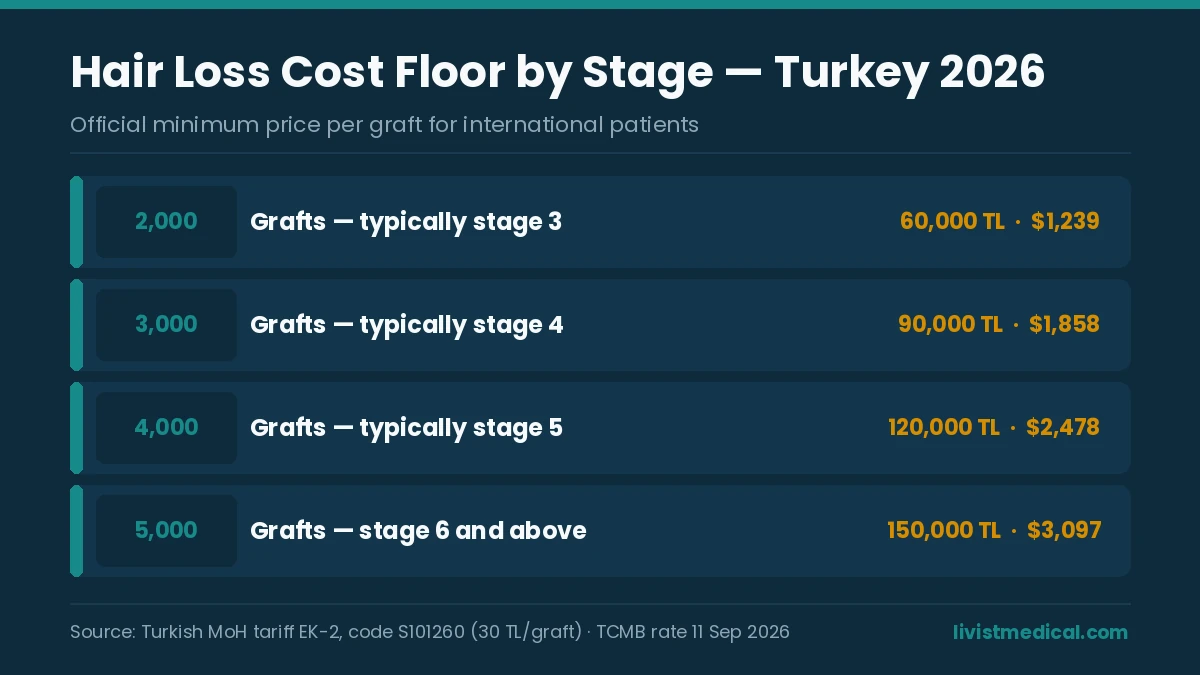
Official Turkish price floor for treating the stages of hair loss by graft count
Turkey's official per-graft floor applied to the graft counts typical of each stage of hair loss.

What Treating Hair Loss Costs by Stage in Turkey

Turkey publishes an official price floor for international patients, which makes it the one market where the stage-to-cost question has a documented answer. Under the Ministry of Health's international health tourism tariff (annex EK-2, in force 16 February 2026 and amended 28 July 2026), hair transplantation is billed per follicle — code S101260, 30 TL per graft — and that figure is a mandatory minimum for every public and private provider, not an average.

Grafts needed (by stage of hair loss)Official floor (TL)≈ USD≈ SAR
2,000 grafts — typically stage 360,000 TL$1,2394,652 SAR
3,000 grafts — typically stage 490,000 TL$1,8586,978 SAR
4,000 grafts — typically stage 5120,000 TL$2,4789,305 SAR
5,000 grafts — stage 6 and above150,000 TL$3,09711,631 SAR

Converted at the Central Bank of the Republic of Türkiye buying rate of 11 September 2026 (1 USD = 48.4305 TL; 1 SAR = 12.8965 TL), which is the rate the regulation itself binds prices to. Graft numbers are illustrative of typical stages; your own number comes from a donor-area assessment, not from a scale. Anaesthesia, hospital fees, hotel and transfers sit on top of the floor.

The practical use of this table is defensive: an all-inclusive package quoted below the floor for the surgery alone is a question to ask before it is a bargain to take.
Book a Hair Loss Stage Assessment with Livist Medical

Your stage of hair loss decides everything that follows — whether you need medication, a transplant, or simply a photograph to compare against next year. Send clear photographs of your hairline and crown, and a named contracted doctor will tell you which stage you are at, what your donor area can safely give, and what it would cost before you commit to anything.

Request a free hair loss assessment with Livist Medical.

Frequently Asked Questions

Share Article :
Related Articles
Is a Hair Transplant Safe? Risks, Recovery and Red Flags
Hair Transplant
13
Is a Hair Transplant Safe? Risks, Recovery and Red Flags

Is a hair transplant safe? Yes with a licensed doctor — infection under 1%. Every risk with its timing, the NHS healing timeline, and 6 checks first.

September 12, 2026Read More
Meagan Good Plastic Surgery: What She Has Confirmed
Hair Transplant
10
Meagan Good Plastic Surgery: What She Has Confirmed

Meagan Good has confirmed one cosmetic procedure — an eyebrow transplant — and denied the rest. What she said, and how brow transplants actually work.

August 23, 2026Read More
Eyebrow Transplant Cost in Turkey 2026: Prices & Packages
Hair Transplant
10
Eyebrow Transplant Cost in Turkey 2026: Prices & Packages

What an eyebrow transplant really costs in 2026 — by country, graft count and technique

July 15, 2026Read More
Chat on WhatsApp