Kris Jenner Before and After: The Full Timeline
Plastic Surgery

Kris Jenner Before and After: The Full Timeline

August 19, 2026
10
Share Article :

Kris Jenner Before and After: The Full Timeline

Kris Jenner before and after, decade by decade: what she has confirmed, what surgeons only speculate, and what a deep plane facelift really involves.

Kris Jenner before and after: what she has confirmed

Kris Jenner has publicly confirmed having a deep plane face and neck lift, and has said people should choose a trusted physician and do what makes them feel good. That confirmation covers the lift itself. Other changes discussed online — the nose, the cheeks, injectables — remain speculation by commentators and by surgeons who have never treated her, not established fact.

That distinction is the point of this article. Most kris jenner before and after coverage blurs two categories that are not equivalent: one operation the person concerned described in her own public words, and a list of additional procedures that strangers inferred from photographs. The first is a matter of record. The second is opinion, however confidently delivered.

The timeline, decade by decade

Born in November 1955, she is 70 in 2026 and has been photographed continuously since the mid-1990s. Across those three decades, the only facial surgery on the record is the deep plane face and neck lift she has publicly confirmed. Everything else in the kris jenner before and after timeline is appearance, styling, lighting and commentary.

The 1990s

She entered wide public awareness in the mid-1990s, in her late thirties. Those photographs became the baseline every later comparison is measured against — worth naming, because a baseline taken from someone's late thirties makes the next three decades look dramatic by default. Ageing between 38 and 70 involves elasticity loss, fat pad shrinkage and change to the facial skeleton itself.

The 2000s and early reality-TV years

From 2007 she appeared in a continuously filmed television format, in her early fifties. This created the comparison material: high-definition television captures a face hundreds of times a season under studio lighting. Small gradual changes then read as a sequence rather than a jump, and sequences invite interpretation.

2015–2023

Through her sixties, commentary intensified around skin quality, the eye area and midface volume. Be precise about what that commentary is: published speculation. Commentators have suggested injectables, resurfacing and eyelid work across this period, none of it confirmed by her. The eye region draws a disproportionate share of attention across this genre, a pattern examined in eyelid surgery in celebrity before-and-afters.

2024–2026: the change people noticed

Appearances across 2024 and 2025 prompted a fresh wave of comment about a visibly tighter jawline and neck. This is where the record changes character, because she went on to publicly confirm a deep plane face and neck lift rather than leave the question to inference. The conversation stayed active into 2026, driven by technique commentary from surgeons on social media who have never examined her.

What is a deep plane facelift?

A deep plane facelift lifts the skin and the underlying muscular layer together as one connected unit, after releasing the ligaments that anchor that unit to the facial bones. It works beneath the layer a conventional facelift tightens. The aim is to reposition the midface and jawline as a block rather than pull skin tighter over an unchanged foundation.

The face is built in layers, like a laminated structure. From the outside in: skin, subcutaneous fat, a continuous sheet of fibrous tissue and thin muscle called the SMAS, retaining ligaments tethering that sheet to the skull, then deeper fat pads, facial nerve branches, muscle and bone. Every facelift technique is defined by which of those layers it moves, and how far.

SMAS vs deep plane, in plain language

SMAS stands for superficial musculoaponeurotic system. Think of it as a fibrous stocking wrapping the face and continuing into the neck as the platysma muscle. When people say a face has lost its structure, they are describing this sheet and its ligaments loosening over decades. Both techniques address it. They differ in how.

In a SMAS facelift, the surgeon first separates skin from SMAS so the two layers become independent. The SMAS is tightened on its own — folded and stitched, or with a strip removed and the edges closed — and the skin is redraped separately over the top and trimmed. Two layers, moved in two directions, in two steps. The retaining ligaments are largely left in place, which limits how far the deeper tissue can travel, so a meaningful share of the visible tightening ends up carried by the skin.

In a deep plane facelift, the surgeon never separates skin from SMAS. The dissection passes underneath the SMAS, the retaining ligaments are deliberately released, and skin and SMAS are repositioned together as one composite flap. Because those ligaments have been let go, the block can travel further and more vertically — which is why the technique is associated with movement in the cheek and in the fold running from nose to mouth, areas a skin-tension lift reaches poorly.

Two consequences follow, and they explain nearly every claim made about the two operations.

  • Where the tension sits. In a deep plane lift the load is carried by the released deep layer and the skin is laid down unstretched. In a SMAS lift more of that load reaches the skin closure. Skin is viscoelastic: under sustained tension it lengthens over time. That is the mechanism behind claims that deep plane results hold longer.
  • Where the blood supply lives. Facial skin is fed largely through the fat layer beneath it. A deep plane lift leaves that connection intact because it never separates the two, whereas a SMAS lift raises a skin flap away from its supply. This underlies claims about different bruising and healing, and it is why smoking is taken so seriously before skin-flap techniques.

Recovery is not simply shorter with one than the other: a deep plane dissection is deeper, so early swelling can be more pronounced while surface bruising may be less. Published longevity claims — commonly ten to fifteen years for deep plane against five to seven for a traditional SMAS lift — come from clinical practice pages, not head-to-head trials, so treat them as working expectations rather than measured facts.

Why surgeons argue about which one was done

The argument exists because a surgical plane is invisible in a photograph. Nobody outside the operating room can see which layer was lifted; they can only reason backwards from a result, and every such inference is contaminated by lens, lighting, head position, weight change and retouching. Surgeons who have never treated her have suggested a range of specific technique variants publicly, and those suggestions contradict one another — the clearest evidence of how unreliable photographic inference is. Her own public confirmation names the technique; everything on top is inference.
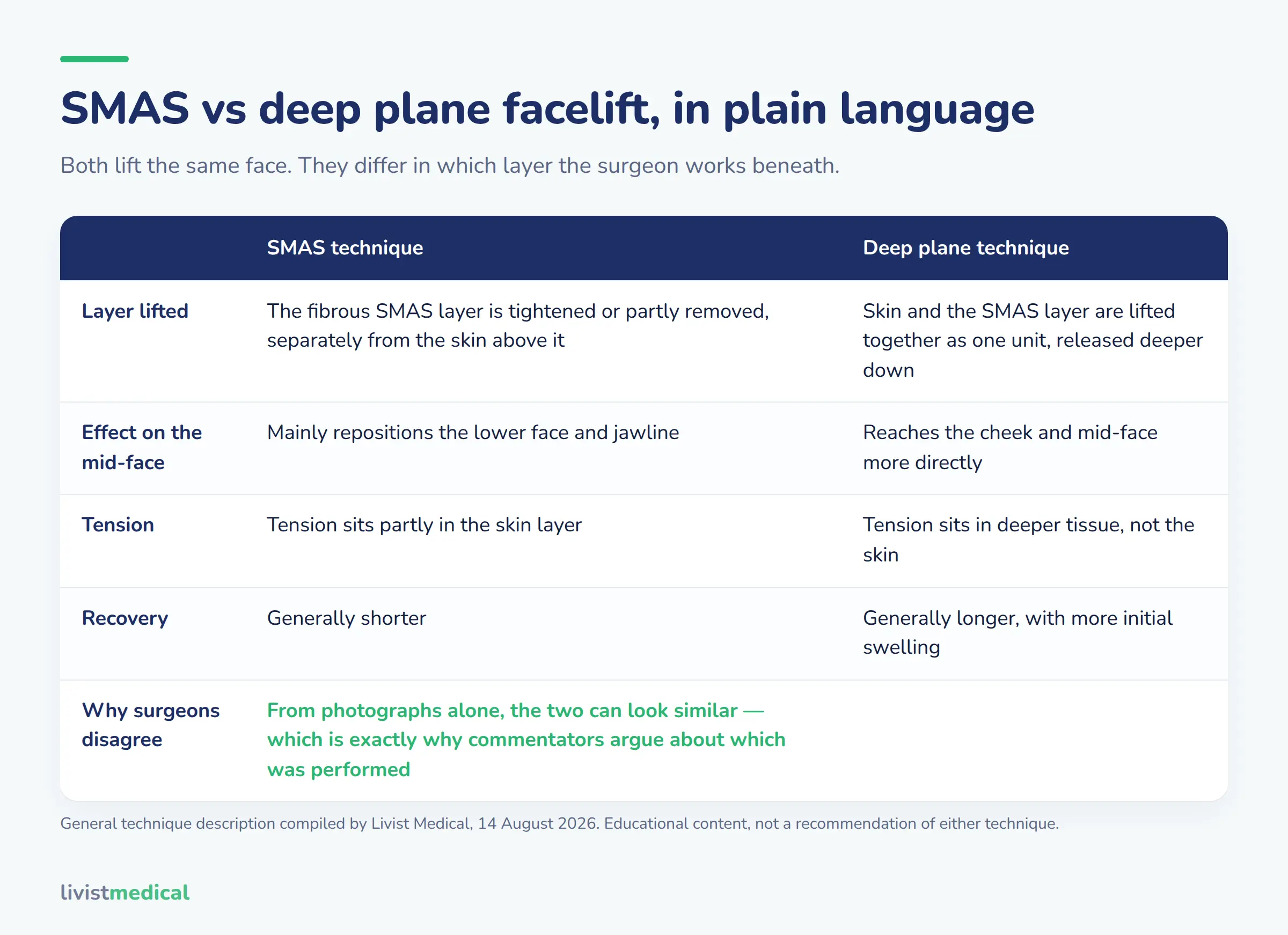

SMAS versus deep plane facelift explained by which anatomical layer each technique lifts

What a facelift and neck lift like this involves

A combined face and neck lift is a general-anaesthetic operation lasting several hours, with incisions in the hairline, around the ear and often under the chin. Face and neck are treated as one unit because the SMAS continues into the neck as the platysma, and lifting one without the other is why some results look incomplete at the jawline.

The neck is what patients underestimate. Loose neck skin comes from three problems that look identical from outside: excess skin, separated platysma bands, and fat above or below the muscle. Surgery addresses all three; non-surgical approaches address a narrower set, which is why the non-surgical neck lift option and its limits are worth understanding before assuming they are interchangeable.

Skin quality, bone structure, laxity and neck anatomy decide which operation suits you, and none can be judged from a photograph — so ask which approach suits your face before fixing on a procedure name.

Recovery, week by week

NHS guidance on facelift surgery, reviewed on 14 August 2026, states that full recovery takes about two to four weeks and that this time should be taken off work, that bruising stays visible for at least two weeks, and that the full effect can take six to nine months to appear.

  • Week 1. Dressings, sometimes drains, marked swelling and bruising, and a face that does not yet resemble the intended result.
  • Week 2. Sutures removed in stages, bruising still visible, mobile at home but not presentable in public.
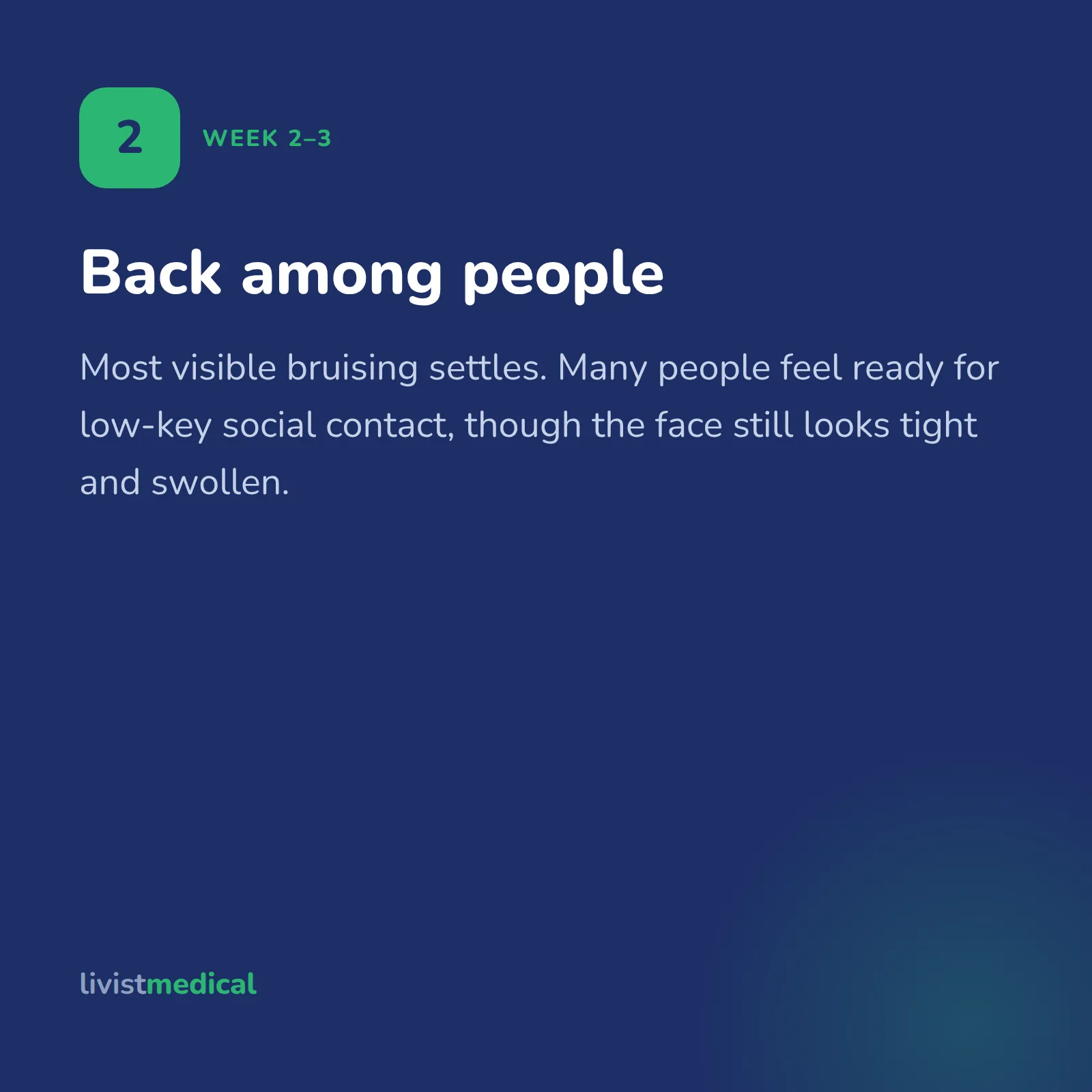
  • Weeks 3–4. The NHS window for returning to work. Deep plane guidance published in 2026 puts return to social activity at two to three weeks, with peak swelling settling around week three.
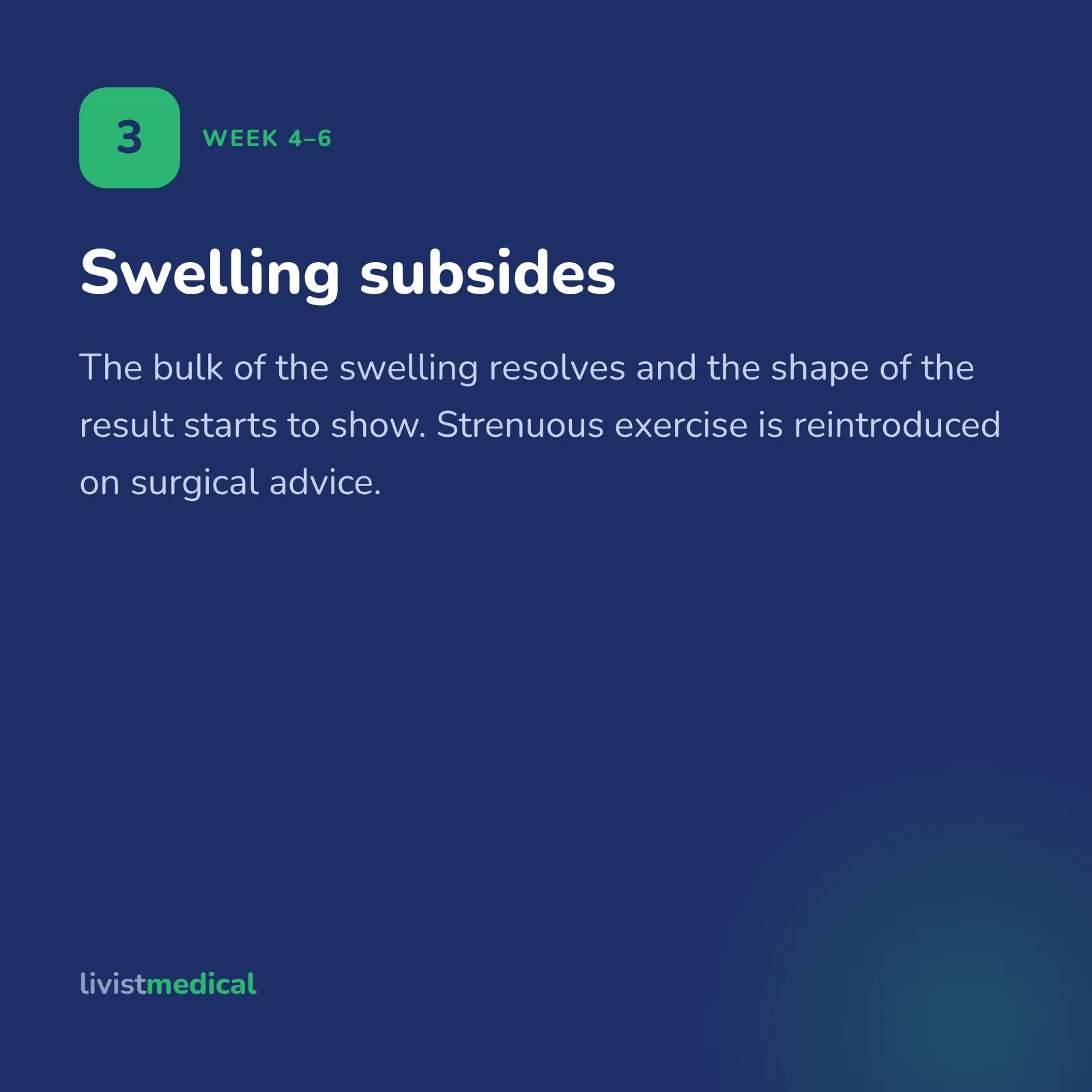
  • Weeks 4–6. Full exercise generally resumes. Firmness and numbness around the ears and neck are normal and can last longer.
  • Months 3–9. Swelling resolves slowly and the result becomes the result — which is why judging a facelift at six weeks tells you very little.

Facelift recovery week one: swelling and bruising peak

Facelift recovery weeks two to three: visible bruising settles

Facelift recovery weeks four to six: swelling subsides and the shape shows

Facelift recovery months three to twelve: the settled result

What does a facelift like this cost?

Published facelift prices run from about $11,395 for the American surgeon's fee alone to $75,000 for a comprehensive deep plane procedure at a specialist US practice, with NHS guidance putting a private UK face and neck lift at up to £10,000. The spread is enormous because these figures do not measure the same thing.

Source Published figure What it covers Date
American Society of Plastic Surgeons Facelift $11,395 · neck lift $7,885 Average surgeon fee only. Excludes anaesthesia, facility, tests and medication 2023 statistics report
American Society of Plastic Surgeons Facelift $9,281 · neck lift $6,267 Same definition, prior year — year-on-year movement 2022 statistics report
NHS (United Kingdom) A few thousand pounds for a mini facelift, up to £10,000 for a face and neck lift Private-sector guidance. Facelifts are not routinely available on the NHS Reviewed 14 August 2026
Facial Plastic Surgery Institute (US specialist practice) $25,000–$50,000 standalone deep plane · $40,000–$75,000 comprehensive All-inclusive at that practice: surgeon, anaesthesia, facility, follow-up. Notes the same range covers surgeon's fee alone elsewhere Published 20 March 2026, updated 29 June 2026
Deep plane facelift guide (commercial procedure site) US $35,000–$75,000 · UK £15,000–£35,000 · Turkey $8,000–$18,000 International comparison. A commercial source, not a professional body — weigh accordingly Updated August 2026

Always ask what a figure includes: a surgeon's fee and an all-inclusive package are not comparable quantities. Smaller procedures follow the same logic — see what a mini neck lift costs in 2026 — and if the concern is confined to under the chin, review the neck and jawline options short of surgery first.

Where the $300,000 figure comes from — and what it likely includes

A figure of $300,000 circulates widely on social media in connection with her face. It should be treated as an unverified circulating number: there is no invoice, no named clinic, no disclosed quotation and no verified reporting behind it that we could locate. It appears in social posts and in commercial content repeating it as a celebrity-tier price point, which is repetition, not corroboration.

What a six-figure total could plausibly contain explains how such numbers are generated: a top-of-market surgeon's fee, a private facility rather than a hospital theatre, a dedicated anaesthesia team, private nursing, privacy arrangements, and several separate procedures across several years aggregated into one headline.

Set against the published ranges above, the distance between $300,000 and $11,395 is not a measure of surgical quality. It measures how much aggregation and speculation can attach to a number before people repeat it. Budget from dated published ranges and a written quotation, never from a figure circulating without a source.

Will the result "drop"? What actually happens over time

A facelift result does not drop in the sense most people fear — lifted tissue does not detach and fall. What happens is that ageing continues from a new starting point: skin loses elasticity, deep fat pads shrink, and underlying bone recedes slightly. The face changes again because it is alive, not because the operation failed.

Searches for face drop and for cheeks describe two different anxieties that get confused. The first is early change in the first weeks. What looks like a result dropping soon after surgery is usually swelling resolving: a face at week one is inflated with fluid, and as that clears it gets smaller. Genuine early relapse is uncommon after a properly executed deep-layer lift, precisely because tension is held by deep tissue rather than skin. Asymmetry of a mouth corner or eyebrow early on more often reflects temporary bruising of a nerve branch, which typically recovers.

The second is the cheeks flattening years later, and this is the more important misunderstanding. A facelift repositions tissue; it does not replace tissue that has been lost. Cheek fat pads keep atrophying with age regardless of any lift, so someone who looks hollower in the midface five or eight years on is usually experiencing a volume problem, not a failed lift. The jawline can still be holding well while the cheek looks deflated — different problems, treated differently.

Weight loss after surgery also makes any result look deflated, and sun exposure and smoking accelerate the skin-quality half of the equation, which no lift addresses. A face lifted at 70 will still look different at 78 — the comparison that matters is against your own untreated trajectory.

What has only been speculated, not confirmed

Only the deep plane face and neck lift is confirmed. Everything else attached to her name — the nose, the cheeks, dermal fillers, botulinum toxin, eyelid surgery, and any claim about a total number of procedures — is published speculation by commentators and by surgeons who have never examined or treated her.

The recurring items are easy to list: commentators have suggested nasal refinement across decades of photographs, midface volume change attributed to fillers or fat transfer, injectables around the eyes and forehead, skin resurfacing, and upper eyelid work. None of it has been confirmed by her or by anyone who treated her, and several of those public analyses contradict each other.

There is a structural reason to distrust confident photographic analysis. Weight change alters the midface more than people credit, makeup contouring shifts perceived cheekbone position, dental work changes the lower face, and lighting alone can create or erase a nasolabial fold.

The pattern is not unique to her. The same cycle appears in how the same conversation played out with Madonna and in another case surgeons publicly analysed without ever examining the patient.

Choosing a surgeon for facial surgery

Choosing a surgeon for a face and neck lift comes down to four checks: board certification in plastic or facial plastic surgery, documented experience with the technique proposed, an accredited facility with a qualified anaesthetist, and a written plan describing your anatomy rather than a celebrity's. That matters more than any before-and-after gallery.

Useful questions to bring: which layer do you plan to lift in my case and why; what should this look like at five years and at ten; who pays for a revision if I am unhappy; and is the neck being addressed in the same operation. There are also honest reasons to be turned down — uncontrolled hypertension, active smoking, unstable weight and unrealistic expectations are legitimate grounds to delay surgery, and a surgeon willing to say so is showing the judgement you are paying for.

At Livist Medical you can review our facial plastic surgeons and their credentials before committing to anything, and see the accredited hospitals in Istanbul where facial surgery is performed. Accreditation and the operating environment are as much a part of safety as technique.

The useful takeaway from any kris jenner before and after discussion is not a procedure name to request. It is that one operation was confirmed by the person who had it, everything else is inference from photographs, and your own face needs an examination rather than a comparison. When you are ready for that, book a facial assessment and get a plan based on your anatomy, your skin and your timeline — not on a number circulating on social media.

Frequently asked questions

#celebrity#facelift#neck lift#before and after
Share Article :
Chat on WhatsApp