Lipo 360 Cost in 2026: Why the Same Procedure Is $3,000 in Miami and $12,000 in California
Lipo 360 averages $8,051 in the US but ranges from $2,000 to $15,000. What drives the gap, what to ask about a low quote, and how other countries price it.
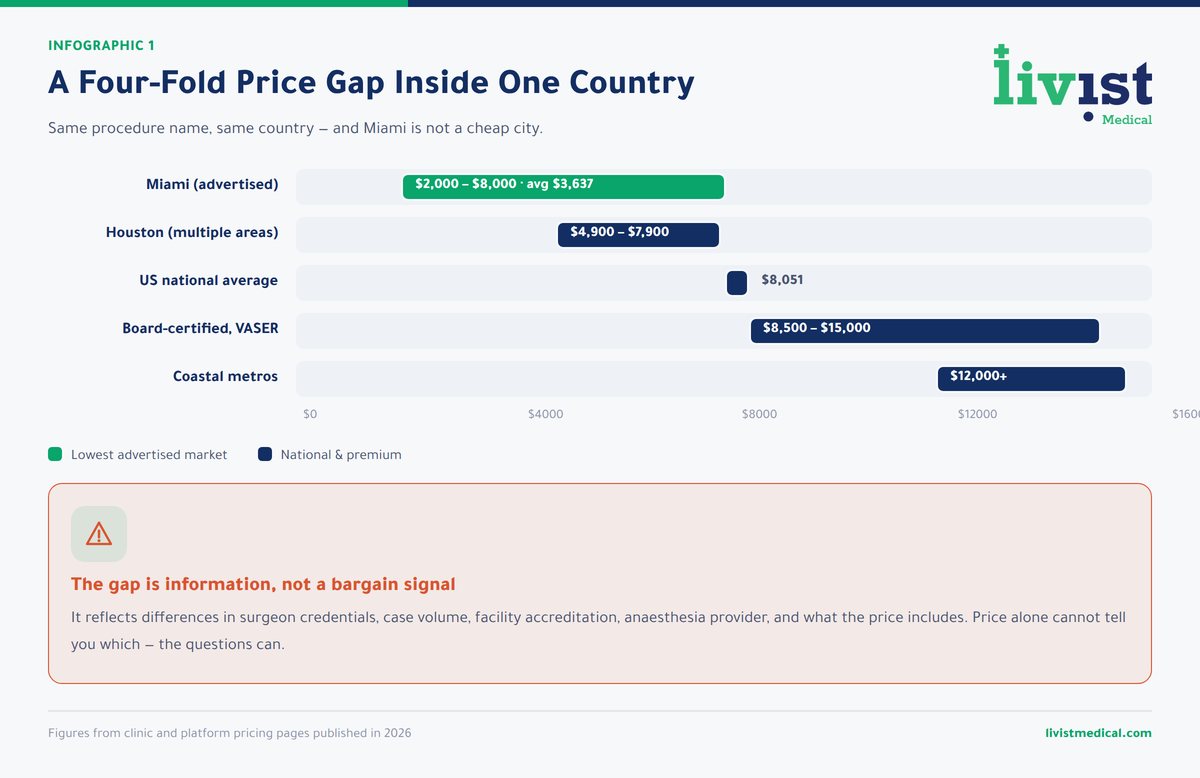
The average cost of Lipo 360 in Miami is around $3,637. The national US average is $8,051. Board-certified practices using VASER quote $8,500 to $15,000, and in coastal metros that climbs past $12,000.
Same procedure name. Same country. Four times the price.
The obvious explanation is cost of living — except Miami is not a cheap city. Something else is going on, and no page on the first two results pages explains it.
This guide does three things the rest of this topic does not. It explains what actually drives that gap and gives you seven questions that reveal what sits behind any quote. It answers the two questions Google shows people are asking but nobody addresses — is Lipo 360 high risk, and what happens ten years later. And it adds international pricing to a topic where every published figure is American.
How Much Does Lipo 360 Cost?
Lipo 360 costs a national average of $8,051 in the United States, with a typical range of $6,380 to $14,660. Advertised prices run as low as $2,000 in some markets and above $15,000 at premium practices — a spread driven more by who operates and where than by the procedure itself.
Market / source
Quoted price
Miami market (advertised)
$2,000 – $8,000 · local average $3,637
Houston (multiple areas, all-inclusive)
$4,900 – $7,900
US national average
$8,051
Board-certified practices, VASER
$8,500 – $15,000
Coastal metros
$12,000+
What a complete quote should contain: surgeon's fee · facility fee · anaesthesia · pre-operative labs · compression garment · follow-up visits. If a headline price does not name these separately, it is not yet a quote.
The US price map
Why the Same Procedure Costs $3,000 in One City and $12,000 in Another
Six things drive it, and only one of them is geography.
1. Who performs the surgery. In the United States, board certification in plastic surgery is not a legal requirement to advertise cosmetic procedures in every state. A physician from an unrelated specialty can, in some jurisdictions, offer liposuction. A low quote may reflect a different level of surgical training — or it may not. You cannot tell from the price. You can tell by asking.
2. Case volume per day. High-volume models run several cases a day. That is not automatically bad, but it changes how much of the surgeon's time and attention your operation receives.
3. Facility accreditation. Accredited surgical facilities cost more to run — staffing, equipment, monitoring, emergency protocols. That cost appears in your quote or it does not appear at all.
4. Anaesthesia provider. A board-certified anaesthesiologist costs more than sedation administered by less specialised staff. For an operation involving fluid shifts and extended time under, this is not a line to economise on.
5. What "all-inclusive" excludes. Compression garments, post-operative lymphatic massage, laboratory work and revision surgery are frequently outside the advertised figure.
6. Genuine efficiency. Some low prices are entirely legitimate. A well-run, accredited, high-volume practice in a lower-overhead market really does cost less to operate. Price alone cannot tell you which situation you are looking at.
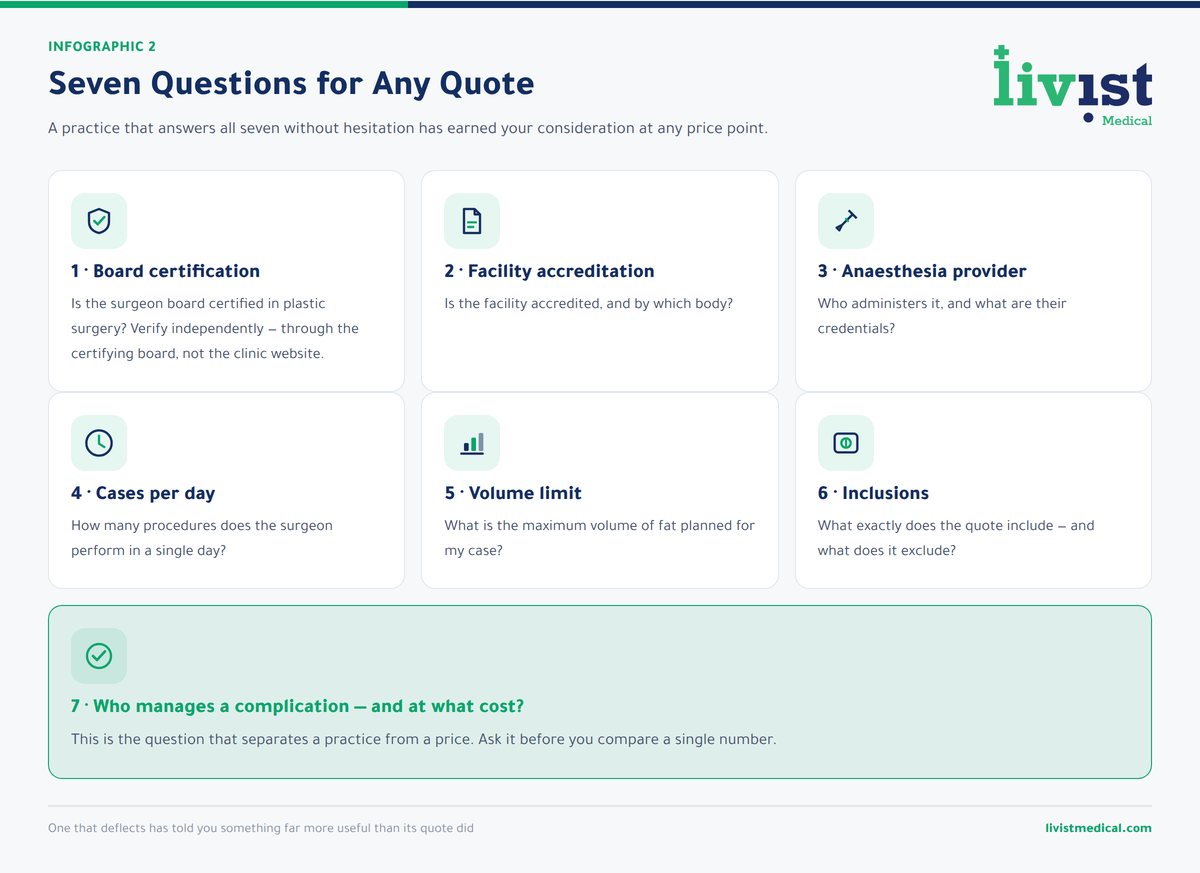
The seven questions that can
Is the surgeon board certified in plastic surgery? Verify it independently — through the certifying board, not the clinic's own website.
Is the facility accredited, and by which body?
Who administers the anaesthesia, and what are their credentials?
How many procedures does the surgeon perform in a day?
What is the maximum volume of fat planned for my case?
What exactly does the quote include — and what does it exclude?
Who manages a complication if one occurs, and what does that cost me?
The rule: a practice that answers all seven without hesitation has earned your consideration at any price point. One that deflects has told you something far more useful than its quote did.
Seven questions for any quote
Is Lipo 360 High Risk?
Lipo 360 carries meaningfully higher risk than single-area liposuction, and the reason is simple arithmetic: it treats the abdomen, flanks, and back in one operation. That means a larger total volume of fat removed and a longer time under anaesthesia — and volume and duration are the two variables most closely associated with liposuction complications.
This is not an argument against the procedure. It is an argument for knowing what you are agreeing to.
Risks worth naming:
Large-volume aspiration and fluid shifts. Surgeons work to defined safe volume limits. Ask what yours is and why.
Contour irregularity. More surfaces treated means more opportunity for unevenness — this is where surgeon skill shows most.
Seroma. Fluid collection under the skin, more common when wider areas are treated.
Prolonged anaesthesia. Risk scales with time under.
Persistent skin laxity. Covered in its own section below, because it is the outcome issue most people do not anticipate.
What lowers risk: an accredited facility · a qualified anaesthesia provider · realistic volume limits · and not stacking multiple major procedures into one session because the package price is attractive.
That last point deserves weight. The dramatic-value packages people share online are usually combinations — Lipo 360 plus a tummy tuck plus a BBL. Combining saves money and adds risk at the same time. That trade should be made in a consultation with a surgeon, not on a spreadsheet.
Lipo 360 Is Not Weight Loss
This belongs high in any honest guide, because the misunderstanding drives a lot of disappointment.
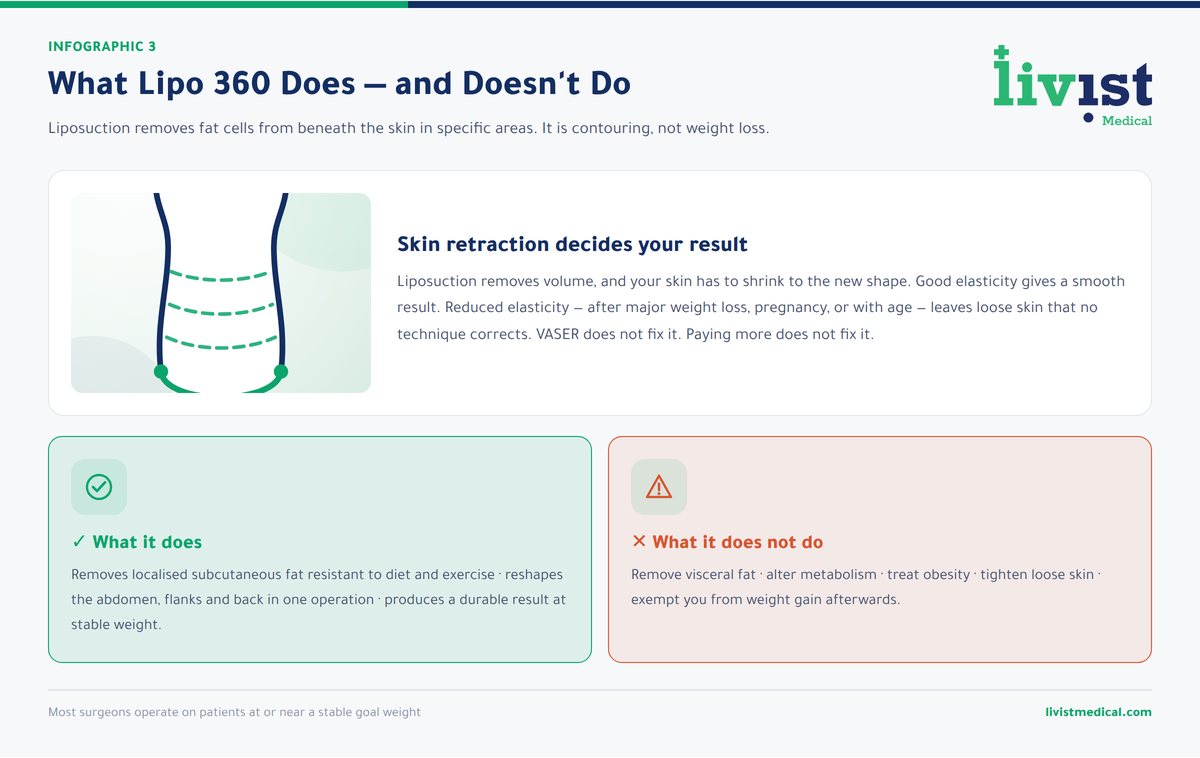
Liposuction removes fat cells from directly beneath the skin in specific areas. It does not remove visceral fat around the organs, does not alter your metabolism, and is not a treatment for obesity. Most surgeons operate on patients who are at or near a stable goal weight.
Two practical consequences:
If you are still actively losing weight, wait. Your contour will keep changing underneath the result you just paid for.
If your BMI is high, the honest answer may be that this is not your procedure today. A surgeon who tells you that is protecting your money as much as your safety.
Skin retraction: the variable that decides your result
Liposuction removes volume. Your skin then has to shrink to the new shape underneath it — and whether it can is determined by your skin's elasticity, not by the technique used or the price paid.
Good elasticity gives a smooth, tight result. Reduced elasticity — after major weight loss, after pregnancy, or simply with age — leaves loose skin that no liposuction technique corrects. VASER does not fix it. AirSculpt does not fix it. Paying more does not fix it.
Patients in that situation need skin excision, which is a different and larger operation with a scar. A good consultation identifies this before surgery, not after.
What Lipo 360 does and doesn't do
What Happens 10 Years After Liposuction?
The fat cells that are removed do not grow back. But the fat cells that remain can enlarge if you gain weight — and because there are now fewer of them in the treated areas, weight gained afterwards tends to distribute differently than it would have before.
What that means in practice:
Results are durable if your weight stays stable. This is the single biggest predictor of long-term satisfaction.
Significant weight gain will show — often in untreated areas first, which can look disproportionate.
Ageing continues. Skin laxity progresses over a decade regardless of what was done to the fat beneath it.
Pregnancy after Lipo 360 will change the abdominal result, as it would have anyway.
The honest framing: Lipo 360 removes a fat deposit that diet and exercise were not shifting. It does not exempt you from what comes after. The people happiest at the ten-year mark are the ones whose weight stayed roughly where it was on the day of surgery.
Lipo 360 vs Tummy Tuck: Which Do You Need?
Lipo 360
Tummy tuck
What it removes
Fat, circumferentially
Skin and fat, plus muscle repair
Addresses loose skin
❌ No
✅ Yes
Addresses separated abdominal muscles
❌ No
✅ Yes
Scars
Several tiny incisions
One long horizontal scar
Recovery
Shorter
Longer
Turkey cost
$3,900 – $6,000
$3,200 – $5,400
US cost
$6,380 – $14,660
$7,500 – $15,000
How to decide: good skin tone with stubborn fat that will not shift → Lipo 360. Loose skin or separated abdominal muscles after pregnancy → tummy tuck; liposuction alone will make loose skin look worse, not better. Both problems present → the two are frequently combined, subject to the risk caveat above.
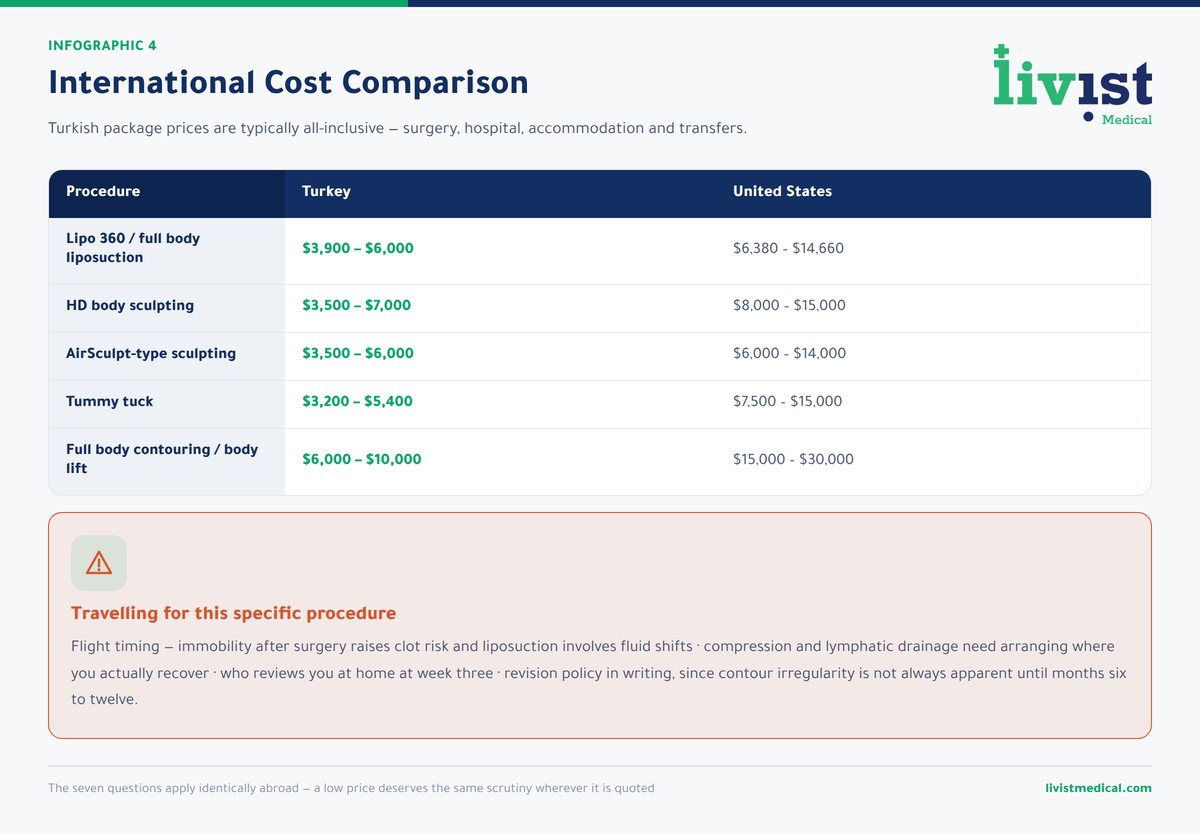
International Cost Comparison
Procedure
Turkey
United States
Lipo 360 / full body liposuction
$3,900 – $6,000
$6,380 – $14,660
HD body sculpting
$3,500 – $7,000
$8,000 – $15,000
AirSculpt-type sculpting
$3,500 – $6,000
$6,000 – $14,000
Tummy tuck
$3,200 – $5,400
$7,500 – $15,000
Full body contouring / body lift
$6,000 – $10,000
$15,000 – $30,000
Figures compiled from clinic and medical-platform pricing published in 2026. Turkish package prices are typically all-inclusive, covering surgery, hospital, accommodation and transfers.
The seven questions apply identically abroad. Board certification, facility accreditation, anaesthesia provider, volume limits, inclusions, and complication management are exactly as relevant in Istanbul as in Miami. A low price deserves the same scrutiny wherever it is quoted — that is the point of the checklist, and it cuts in every direction.
Additional considerations when travelling for this specific procedure:
Flight timing. Extended immobility after surgery raises clot risk, and liposuction involves fluid shifts. Ask how long before flying is safe and treat the answer as a hard constraint.
Compression and lymphatic drainage. Both matter for the result and both need arranging where you actually are during recovery.
Who reviews you at home if something looks wrong at week three.
Revision policy in writing — contour irregularity is the most common reason for revision, and it is not always apparent until months six to twelve.
Return to desk work · lymphatic massage often recommended
Weeks 4–6
Exercise resumes gradually
Months 3–6
Swelling resolves progressively
Months 6–12
Final contour visible
Judging your result at six weeks is judging swelling. Liposuction swelling is uneven and slow to settle, and week-six panic is the most common unnecessary distress in this entire procedure. Photograph yourself at intervals and compare month to month, not day to day.
Is Lipo 360 Worth the Money?
✅ Worth it if:
Your weight is stable and near your goal
You have good skin elasticity
The fat is localised and genuinely resistant to diet and exercise
Your expectations are about contour, not about a number on the scale
You have verified the surgeon and the facility
⚠️ Think again if:
You are still losing weight
You have significant skin laxity — you may need excision instead
You are choosing on price alone
You are planning a pregnancy
❌ Not the right procedure if:
You are looking for weight loss
Loose skin is your main complaint
Your BMI makes it unsafe today
If you are also comparing premium branded options, our breakdown of AirSculpt cost puts those quotes next to the ASPS average and Turkey's official price floor.
The Bottom Line
That four-fold price gap is not noise — it is information, and it is telling you that quotes labelled "Lipo 360" are not describing the same thing.
Before you compare a single number, work the seven questions: who is operating, what they are certified in, where, with what anaesthesia, at what volume, including what, and who handles it if something goes wrong.
Then be clear about what the procedure is. Lipo 360 is contouring, not weight loss. And the variable that determines most of your result is not the technique or the surgeon's marketing — it is whether your skin can retract to the shape underneath.
This content is for general health education and does not replace consultation with a qualified, board-certified plastic surgeon. Whether a procedure is appropriate and safe for you requires individual assessment.
 Plastic Surgery