 Plastic Surgery
4
How to Tighten Face Skin: From Retinol to FaceliftHow to tighten face skin by degree of sagging: retinol and SPF, radiofrequency and ultrasound, or a facelift. What works, what doesn't and what it costs.
October 24, 2026Read More
Fat dissolving injections in 2026: only Kybella is FDA-approved, and only for the chin. How they work, cost in the US and Turkey, and who should skip them.
Fat dissolving injections, also called injection lipolysis, use deoxycholic acid to destroy fat cells in small, localised areas such as a double chin; the body clears the debris over several weeks. Only one product, Kybella, is FDA-approved, and only for fat under the chin. They are a contouring treatment, not a way to lose weight.
Written and medically reviewed by: Op. Dr. Nazım Ramazanov — Plastic and Reconstructive Surgery, surgeon profile; editorial review: Murat Şandaroğlu · Last updated: 27 September 2026
Search "fat dissolving injections" and the first result is not a clinic. It is a US Food and Drug Administration warning page titled "Fat-Dissolving Injections That Are Not FDA Approved Can Be Harmful."
That is unusual, and it tells you something before you read a single clinic's marketing.
Read a little further and you find a genuine contradiction sitting in plain sight. Summaries of this treatment routinely list the common target areas as "the double chin, jawline, upper arms and abdomen" — and then, a few lines later, note that the only FDA-approved product is "strictly meant for under the chin."
Both statements are true. Together they describe the gap between what is marketed and what has been approved — and that gap is the single most useful thing anyone can explain to you before you book.
This guide covers what is actually approved and what that means, real prices with the regulatory status attached to each product, the side effects most pages leave out, and the point at which liposuction becomes the better and often cheaper answer.
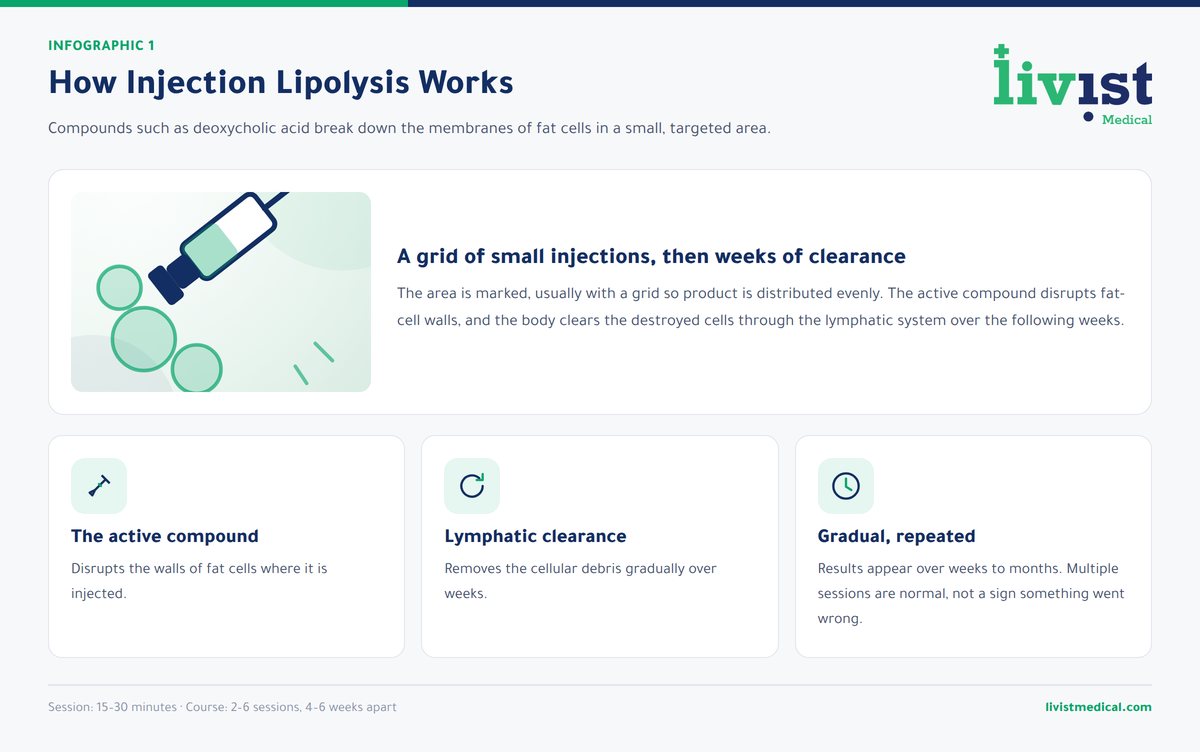
Fat dissolving injections — known clinically as injection lipolysis — use compounds such as deoxycholic acid or phosphatidylcholine to break down the membranes of fat cells in a small, targeted area. The body then clears the destroyed cells through the lymphatic system over several weeks. Most courses require multiple sessions.
The mechanism is real and well described in the literature. The questions worth asking are about which product, which area, and who is injecting it.
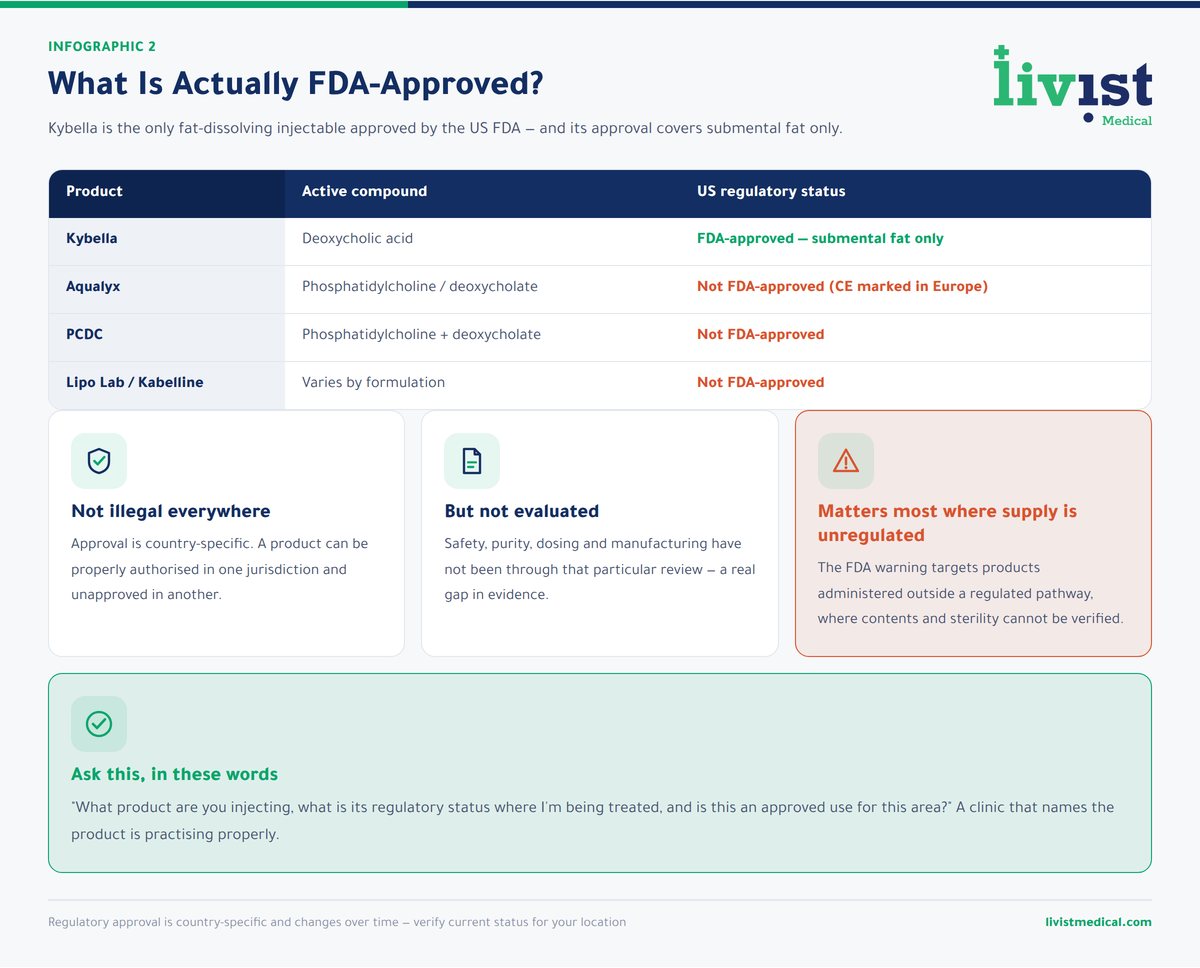
Kybella — the brand name for deoxycholic acid — is the only fat-dissolving injectable approved by the US FDA. Its approval covers submental fat only: the pocket beneath the chin.
Everything else marketed under this heading sits in a different regulatory category.
| Product | Active compound | US regulatory status |
|---|---|---|
| Kybella | Deoxycholic acid | FDA-approved — submental fat only |
| Aqualyx | Phosphatidylcholine / deoxycholate | Not FDA-approved (CE marked in Europe) |
| PCDC | Phosphatidylcholine + deoxycholate | Not FDA-approved |
| Lipo Lab / Kabelline | Varies by formulation | Not FDA-approved |
This phrase gets used loosely in both directions, so it is worth being precise.
It does not mean illegal everywhere. Regulatory approval is country-specific. Aqualyx, for example, is CE marked in Europe and used there under regulated conditions. A product can be properly authorised in one jurisdiction and unapproved in another.
It does mean the FDA has not evaluated that product for that use. Safety, purity, dosing and manufacturing have not been through that particular review. That is a real gap in evidence, not a technicality.
It matters most where supply is unregulated. The FDA's warning is aimed at products bought and administered outside a regulated pathway — where what is actually in the vial, and whether it is sterile, cannot be verified.
Treating the abdomen or arms with Kybella in the United States is off-label use of an approved drug. Off-label prescribing is legal and common throughout medicine, and it is not inherently wrong. But it means that specific use has not been reviewed for that area — and you are entitled to know which category your treatment falls into before you consent to it.
Ask this, in these words:
"What product are you injecting, what is its regulatory status where I'm being treated, and is this an approved use for this area?"
A clinic that answers clearly and names the product is practising properly. A clinic that will not name what is in the syringe is precisely why the FDA published a warning page.
Yes — for the right target. That target is a small, localised pocket of fat in someone already close to their goal weight. They do not work as weight loss, and they do not work well on large volumes.
The best-studied indication is the area under the chin, which is also the only one with FDA approval behind it. That is not a coincidence.
Where expectations most often break:
The honest comparison: for a modest double chin in someone at a stable weight who wants no downtime, injections are a reasonable choice. For anything larger, liposuction removes more fat in one session with more predictable results — and often for less than a full injection course.
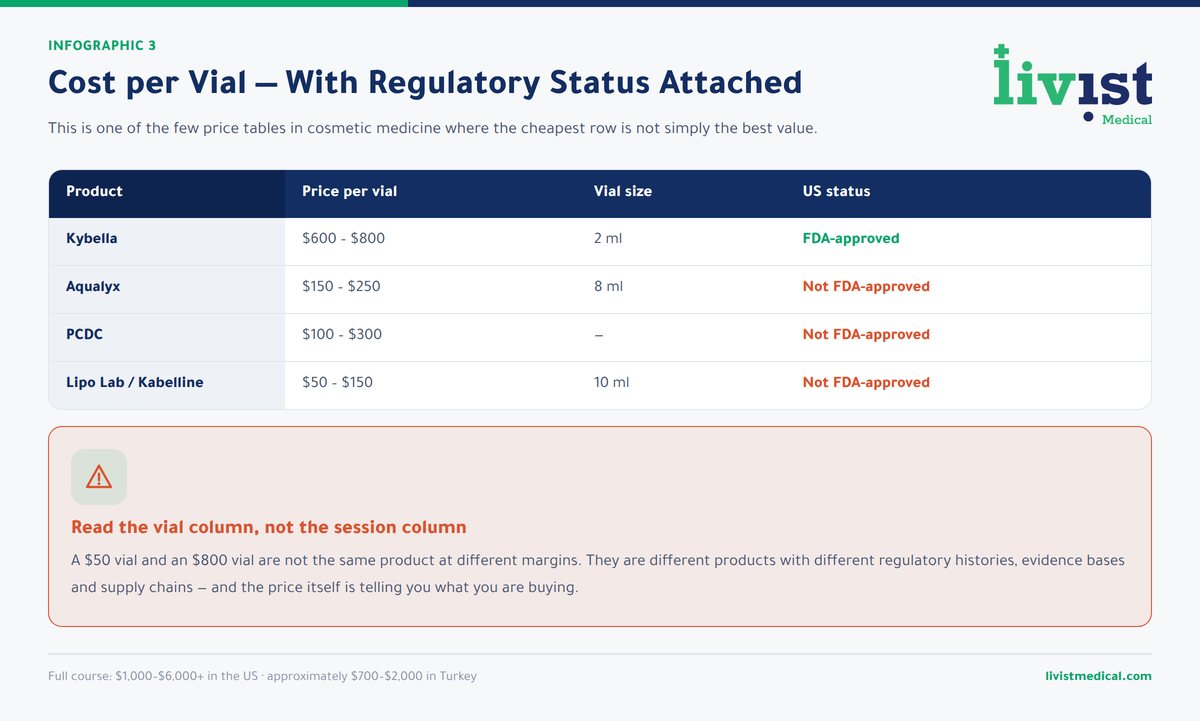
Per vial:
| Product | Price per vial | Vial size | US status |
|---|---|---|---|
| Kybella | $600 – $800 | 2 ml | FDA-approved |
| Aqualyx | $150 – $250 | 8 ml | Not FDA-approved |
| PCDC | $100 – $300 | — | Not FDA-approved |
| Lipo Lab / Kabelline | $50 – $150 | 10 ml | Not FDA-approved |
Per session:
| Brand | Turkey | USA | UK |
|---|---|---|---|
| Kybella | $500 – $1,500 | $600 – $1,800 | — |
| Aqualyx | $200 – $500 | $500 – $1,300 | $250 – $600 |
| PCDC | $150 – $400 | $250 – $500 | $250 – $500 |
| Lipo Lab | $75 – $250 | $200 – $600 | $150 – $400 |
Full course: roughly $1,000 to $6,000+ in the United States, and approximately $700 to $2,000 in Turkey, where per-session pricing runs 60–80% below US and UK levels.
⚠️ Read the vial column, not the session column.
A $50 vial and an $800 vial are not the same product at different margins. They are different products with different regulatory histories, different evidence bases, and different supply chains.
This is one of the few price tables in cosmetic medicine where the cheapest row is not simply the best value — and where the price itself is telling you what you are buying.
What drives the cost: which product · how many sessions · size of the area · the injector's medical qualification · and country.
Common and expected:
Less common but serious — named here because most pages omit them:
What genuinely lowers risk: a medically qualified injector who understands the regional anatomy · a named, traceable product · correct depth and dosing · and honest area selection.
The pattern behind the FDA's warning is not that injection lipolysis is inherently dangerous. The mechanism is sound and the approved product has been through review. The harm the warning describes comes from unverified products administered outside a regulated setting — a supply-chain and competence problem, not a chemistry one.
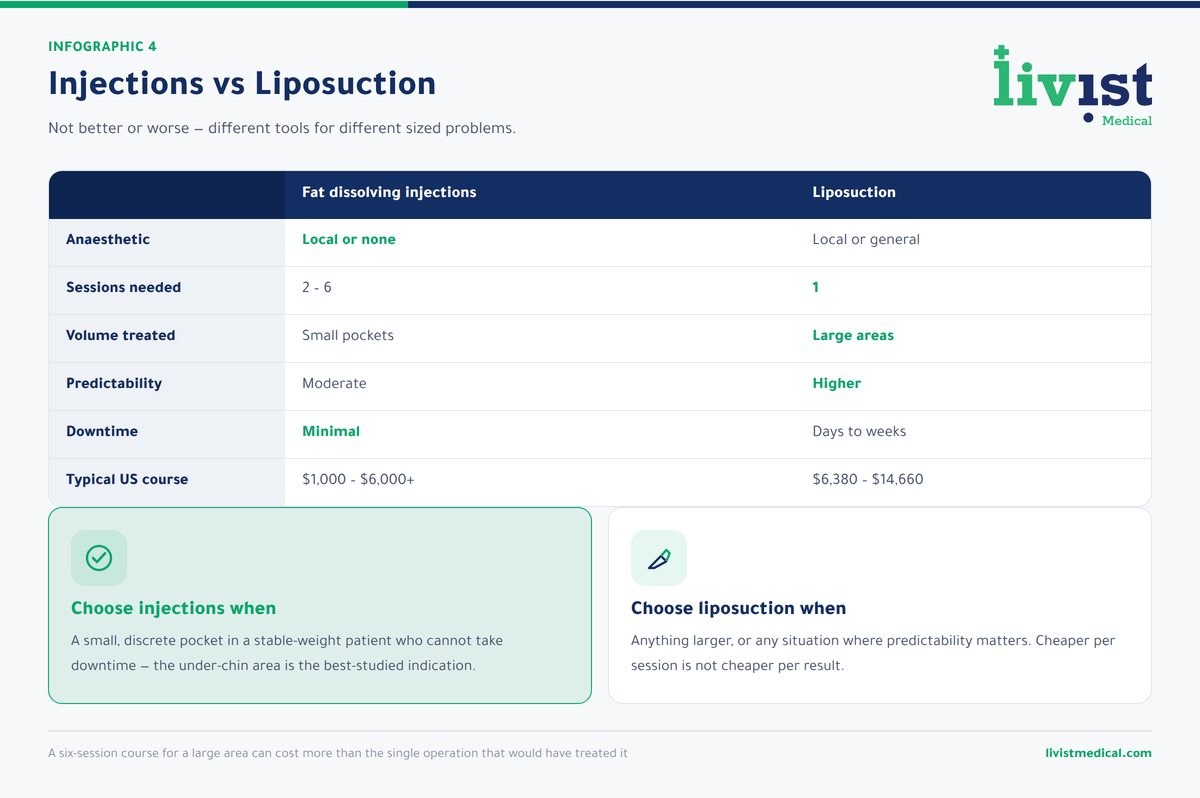
| Fat dissolving injections | Liposuction | |
|---|---|---|
| Anaesthetic | Local or none | Local or general |
| Sessions needed | 2 – 6 | 1 |
| Volume treated | Small pockets | Large areas |
| Predictability | Moderate | Higher |
| Downtime | Minimal | Days to weeks |
| Scars | None | Tiny incisions |
| Typical US course | $1,000 – $6,000+ | $6,380 – $14,660 (Lipo 360) |
How to choose: a small, discrete pocket in a stable-weight patient who cannot take downtime → injections. Anything larger, or any situation where predictability matters → liposuction.
And a point worth doing the arithmetic on: a six-session injection course for a large area can cost more than the single operation that would have treated it properly. Cheaper per session is not cheaper per result.
Knowing the sequence removes most of the anxiety, and it also tells you what a properly run appointment looks like.
Before: a consultation that assesses the area, checks your skin quality, and confirms you are a candidate. Photographs are taken. You should be told the product name, the number of vials planned, and the expected number of sessions before anything is injected.
During: the area is marked, usually with a grid so the product is distributed evenly. Topical or local anaesthetic may be used. A series of small injections is placed across the grid. The session itself typically takes 15 to 30 minutes.
Immediately after: stinging or burning for a few minutes is normal. Swelling begins within hours.
The first week: swelling peaks around days two to three and can be substantial — under the chin it is often visible enough that people plan around social commitments. Firm lumps in the area are expected and settle over weeks.
Weeks 2 to 6: swelling resolves, and the change begins to appear. The next session is normally scheduled at 4 to 6 weeks, which gives the tissue time to respond before more product is added.
A practical point on scheduling: book the first session well before any event you care about. The swelling phase surprises people, and the visible improvement arrives months later, not days.
The fat cells that are destroyed do not come back. But the fat cells remaining in the area can enlarge if you gain weight, so results are durable only alongside a stable weight.
There is a second factor people miss: injections do nothing about ageing or skin quality. A treated under-chin area can look softer several years later purely from skin laxity — with no fat regain at all. That is not the treatment failing; it is the passage of time doing something the treatment never addressed.
Injections and surgical fat removal sit at very different price tiers, and AirSculpt cost shows the top of that range.
The mechanism behind fat dissolving injections is real, and for a small pocket of fat in the right patient this is a perfectly reasonable treatment.
But one product is FDA-approved, and only for one area. Everything else is a legitimate question you are entitled to ask out loud — and the answer should come easily.
Ask what is being injected. Ask whether it is approved for that area where you are being treated. And if the pocket is not small, ask whether liposuction is the operation you actually need.
The clinics worth your money will welcome all three questions.
Livist Medical arranges consultations with contracted plastic surgeons who can tell you whether injections, liposuction or neither suits the area you want to treat. Book a free consultation and send photos of the area.
Sources:
Plastic SurgeryHow to tighten face skin by degree of sagging: retinol and SPF, radiofrequency and ultrasound, or a facelift. What works, what doesn't and what it costs.
 Plastic Surgery
Nose filler cost: $500–$3,000+ per session in the US (avg ~$1,456) and $200–$1,500 in Turkey. Per-syringe prices, how long it lasts and the real risks.
 Plastic Surgery
Forehead reduction surgery cost: $5,000–$15,000 in the US, £7,000–£9,000 in the UK, $2,500–$4,500 in Turkey. Results, risks and hair transplant option.