Gastric Botox vs Gastric Balloon: What the Trials Show
Gastric botox vs gastric balloon judged on trial data: 15.6 kg vs 9.3 kg head-to-head, 30% vs 9% complications, plus 2026 costs in four countries.
Reviewed by the Livist Medical Team · Last updated 22 August 2026
In the only published head-to-head study, patients who had a gastric balloon lost more weight than patients who had gastric botox — 15.6 kg against 9.3 kg over six months — while the botox group had far fewer complications, 9% against 30%. Those two sentences contain the entire trade-off, and almost every page you will read about these procedures quotes one of them and not the other.
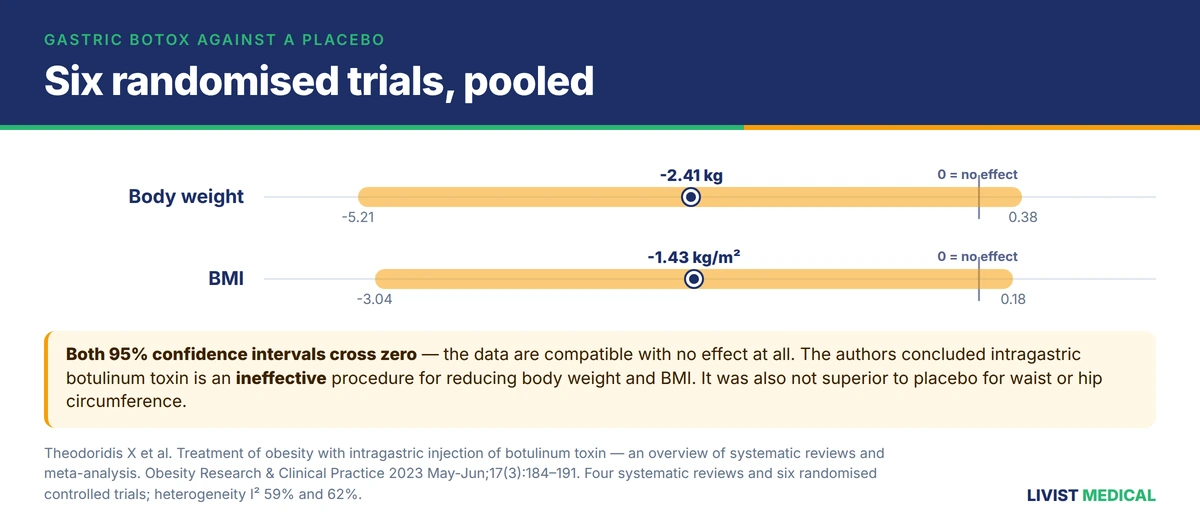
There is a third fact that matters more than both, and it is the one no clinic page wants to print: when gastric botox has been tested against a placebo in randomised trials, it has not been shown to work. A 2023 meta-analysis of six randomised controlled trials concluded it was ineffective at reducing body weight and BMI.
We offer both procedures. That is exactly why this comparison can be written honestly — a balloon manufacturer cannot publish it, and a gastric-botox brand certainly cannot. Below is what the trials found, what each costs in 2026, and the narrow case in which gastric botox is still a reasonable choice.
This article is information, not medical advice. Neither procedure is suitable for everyone, and no article can tell you which — if either — fits your BMI, your medical history, or your goals.
Gastric botox vs gastric balloon: the short answer
A gastric balloon is a silicone device placed in the stomach to physically reduce how much it holds, left in for 4 to 12 months. Gastric botox is an injection of botulinum toxin into the stomach wall that slows gastric emptying for 4 to 6 months. The balloon has stronger evidence and more side effects; botox is gentler, cheaper, and far less well supported by trials.
Table 1 — The comparison at a glance
Gastric balloon
Gastric botox
What it is
A silicone device placed endoscopically or swallowed as a capsule
Botulinum toxin injected into the stomach wall
How it works
Mechanically reduces stomach capacity
Slows gastric emptying, prolongs fullness
Duration
4 months (swallowable) · 6 months (traditional) · up to 12 months (adjustable)
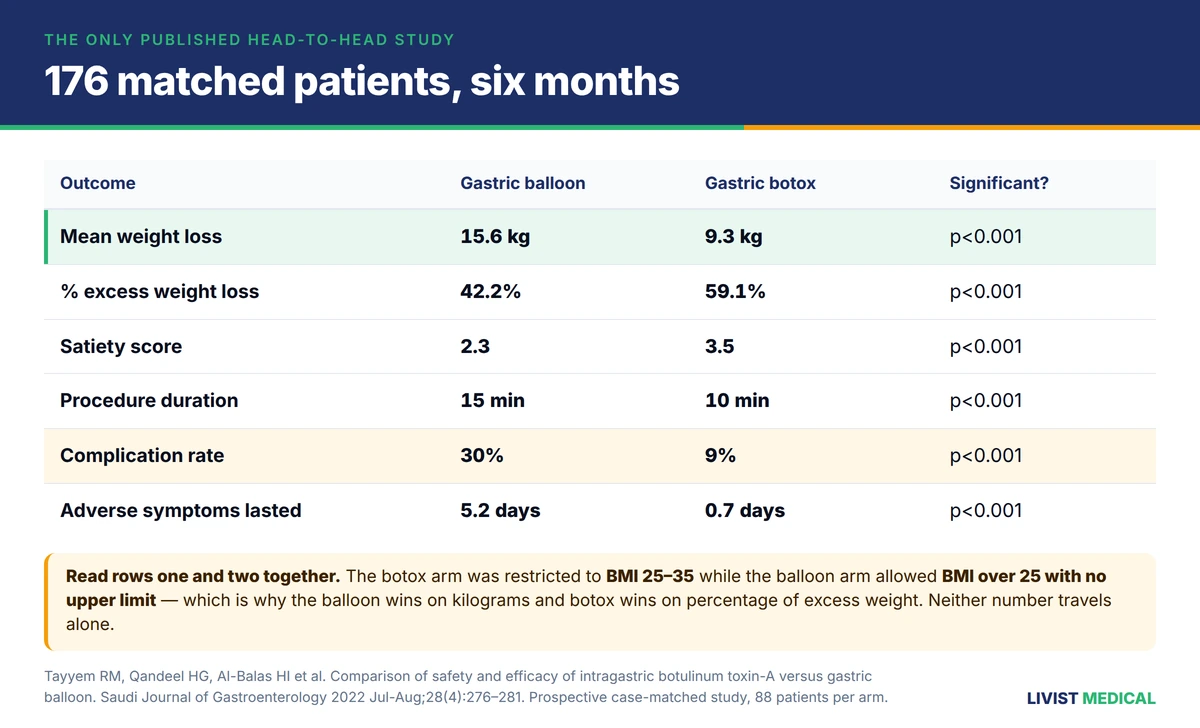
One published study has compared these two procedures directly in matched patients. It followed 176 people for six months — 88 who had endoscopic intragastric botulinum toxin and 88 who had an endoscopically placed gastric balloon — and found the balloon produced 15.6 kg of weight loss against 9.3 kg for botox, with a complication rate of 30% against 9%.
That study was published in the Saudi Journal of Gastroenterology in 2022. Here is the full result, not the half of it that suits either procedure.
⚠️ The caveat that changes how you read this table
Look at rows one and two. The balloon wins on kilograms; botox wins on percentage of excess weight lost. That looks contradictory until you read the study's eligibility criteria: the botox group was restricted to a BMI of 25 to 35, while the balloon group accepted any BMI above 25 with no upper limit.
Heavier patients have more excess weight to lose, so they lose more kilograms and a smaller share of their excess. The two headline numbers are measuring different populations.
What this means practically: any page quoting "59.1% excess weight loss with gastric botox" without that BMI restriction is quoting a number from a lighter group of patients. And any page quoting "15.6 kg with a balloon" without noting the group was heavier is doing the same thing in reverse. Both numbers are real. Neither travels alone.
Does gastric botox work at all? What placebo trials show
This is the most important question on the page, and the answer is uncomfortable. A 2023 overview of four systematic reviews plus a meta-analysis of six randomised controlled trials found that intragastric botulinum toxin was not superior to placebo for weight, BMI, waist circumference, or hip circumference. The authors concluded it is an ineffective procedure for reducing body weight and BMI.
The pooled figures: weight change of −2.41 kg (95% CI −5.21 to 0.38) and BMI change of −1.43 kg/m² (95% CI −3.04 to 0.18). Both confidence intervals cross zero — meaning the data are compatible with no effect at all. Heterogeneity between studies was high (I² of 59% and 62%), which is itself a sign that the underlying trials disagree with each other.
How can that sit alongside the head-to-head study above? Because they answer different questions. The head-to-head study compared botox against a balloon, both alongside a supervised diet. The meta-analysis compared botox against placebo injections — and when you remove the procedure but keep the diet, the supervision, and the patient's own motivation, most of the difference disappears.
That is the honest reading: the weight loss recorded after gastric botox is real, but the evidence does not show that the botox is what caused it. What patients get is four to six months of medical supervision, a structured diet, and the psychological commitment that comes from having paid for a procedure — which is a genuine intervention, just not a pharmacological one.
So who should still consider it? A specific and small group: patients with a BMI in the 25–35 range who have failed to sustain a diet unsupervised, who want a time-boxed window of assistance without a foreign object in the stomach, and who go in understanding that the injection may be the least active ingredient in the package. Anyone told they will lose 20 kg from an injection has been mis-sold.
How much weight can you lose with a gastric balloon?
Pooled data from six studies covering 2,013 patients with a swallowable balloon found 12.8% total body weight loss at the end of treatment, four to six months in, falling to 10.9% at twelve months. For a 100 kg patient that is roughly 13 kg during treatment and about 11 kg retained at a year.
Those figures come from a 2020 meta-analysis in Obesity Surgery, in patients whose baseline BMI ranged from 30.6 to 36.2. The same analysis found an early removal rate of 2.3% — patients who could not tolerate the balloon and had it taken out ahead of schedule — and three cases of small-bowel obstruction across all 2,013 patients.
Note the shape of that curve. Weight loss peaks while the balloon is in and partly reverses after it comes out. The device buys a window; it does not change what happens afterwards. Which is why the balloon is classified as an adjunct to lifestyle change rather than a treatment in its own right, and why any programme without structured dietary follow-up is selling you half of the intervention.
Balloon type changes the window: a swallowable capsule sits for about 4 months, a traditional balloon for 6, and an adjustable one for up to 12. If swallowing a capsule rather than having an endoscopy matters to you, the swallowable pill balloon is the version to ask about.
For readers at the earlier stage of this decision, what is realistic in two weeks sets the baseline these procedures are measured against.
Side effects and complications compared
In the head-to-head study, complications occurred in 30% of balloon patients and 9% of botox patients, and adverse symptoms lasted an average of 5.2 days after the balloon against 0.7 days after botox. The balloon's side effects are more common and more intense; botox's are milder and shorter.
Table 3 — What to expect after each
Gastric balloon
Gastric botox
Common, first week
Nausea, vomiting, cramping, reflux — the adjustment period
Mild bloating, transient nausea
How long symptoms last
~5.2 days on average, sometimes longer
~0.7 days on average
Overall complication rate
30%
9%
Needs early removal
2.3% in pooled data
Not applicable
Serious but rare
Balloon deflation and migration; small-bowel obstruction (3 cases in 2,013 patients); gastric ulceration
Reported cases of unintended spread of toxin effect; injection-site complications
Requires a second procedure
Yes — removal
No
Red flags after either procedure — seek care the same day: persistent vomiting that stops you keeping fluids down, severe or worsening abdominal pain, black or bloody vomit, difficulty swallowing or breathing, or a rapidly growing abdomen.
Who should avoid both: anyone with a large hiatal hernia, active peptic ulceration, previous gastric surgery, uncontrolled psychiatric illness or eating disorder, pregnancy, or a bleeding disorder. Assessment for that list is a gastroscopy and a consultation, not a form on a website.
How much does each cost in 2026?
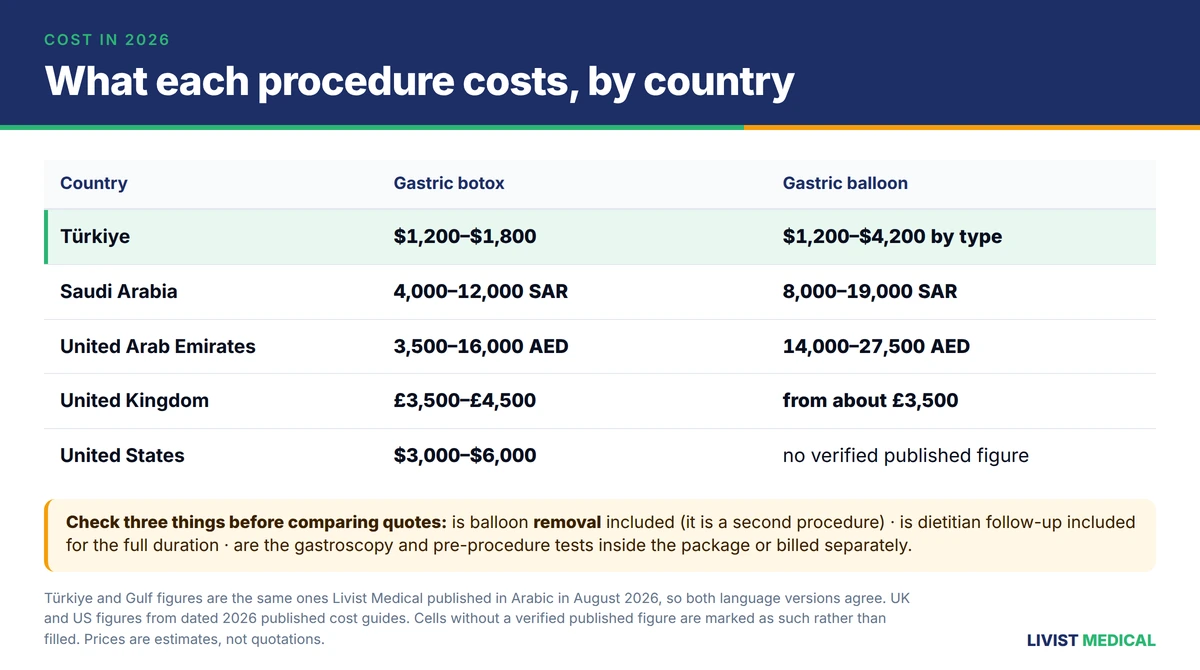
Gastric botox costs $1,200–$1,800 in Türkiye against £3,500–£4,500 in the UK and $3,000–$6,000 in the US. A gastric balloon in Türkiye runs $1,200–$4,200 depending on type, against roughly £3,500 and up in the UK. Both are usually paid privately; neither is typically covered by insurance for weight loss alone.
Table 4 — Gastric botox, per treatment
Country
Cost
Note
Türkiye
$1,200–$1,800
Often quoted as a package with consultation and transfers
Saudi Arabia
4,000–12,000 SAR
Wide range between providers
UAE
3,500–16,000 AED
Widest range of any market we track
United Kingdom
£3,500–£4,500
Procedure only; aftercare usually excluded
United States
$3,000–$6,000
Varies by state and clinic
Table 5 — Gastric balloon, by type and country
Cost
Türkiye — swallowable capsule (≈4 months)
$1,900–$4,200
Türkiye — traditional endoscopic (≈6 months)
$1,200–$2,800
Türkiye — adjustable (up to 12 months)
$1,600–$3,500
Saudi Arabia
8,000–19,000 SAR
UAE
14,000–27,500 AED
United Kingdom
from about £3,500
Türkiye and Gulf figures are the same ones Livist Medical published in Arabic in August 2026, so the two language versions of our pricing agree. UK and US figures come from dated 2026 published cost guides. We have deliberately left Germany out of the balloon table: no reliable published German figure could be verified, and an invented number is worse than an absent one.
What to check before comparing two quotes: whether removal is included in the balloon price (it is a second procedure), whether dietitian follow-up is included for the full duration, and whether the gastroscopy and pre-procedure tests are inside the package or billed separately. Our treatment packages list what is bundled.
Which one suits you?
Neither procedure is a treatment for severe obesity. Both are designed for the 27–40 BMI range, and both are adjuncts to a supervised diet rather than replacements for one. Above roughly BMI 40, the honest answer is that neither will deliver what you need.
A gastric balloon is the more reasonable choice if: your BMI is roughly 30–40, you want the option with real published outcome data, you can tolerate a difficult first week, and you are prepared for a second procedure to remove it.
Gastric botox is a reasonable choice if: your BMI is 25–35, you want a short supervised window without a device in your stomach, you cannot tolerate or do not want an implanted balloon — and you accept that the placebo-controlled evidence does not support the injection itself.
Neither is the right procedure if: your BMI is above 40, you have had previous gastric surgery, or you are looking for a permanent solution. At that point the conversation is about sleeve gastrectomy, gastric bypass, or in selected cases gastric banding — and our bariatric team will tell you plainly which category you fall into.
If you would like your own numbers assessed rather than a brochure, send us your BMI and history and we will tell you which of these — if either — is worth your money.
What happens after the window closes
Both procedures are temporary. The balloon comes out at 4 to 12 months and the botox wears off at 4 to 6, and pooled data shows some regain afterwards: 12.8% total weight loss at the end of balloon treatment falls to 10.9% at twelve months. What determines the final result is what was built during the window, not the device itself.
That is not a disclaimer, it is the mechanism. Both procedures work by making a calorie deficit easier to sustain for a fixed period. If the eating pattern, the activity, and the follow-up are in place when the window closes, the loss largely holds. If nothing changed except the stomach, it does not.
Two practical consequences. First, judge a programme by its dietitian follow-up, not by its device — a cheaper package with twelve months of structured support will beat a premium balloon with none. Second, if the loss is substantial, plan for the cosmetic aftermath early: what skin removal actually costs is a conversation better had before the weight comes off than after.
The bottom line
If you want the procedure with the better evidence and can tolerate a rough first week, that is the gastric balloon — 12.8% total body weight loss during treatment in pooled data, at the price of a 30% complication rate and a second procedure to remove it.
If you want the gentler, cheaper, device-free option and you understand what you are buying, gastric botox is defensible for a BMI of 25–35 — provided you go in knowing that six randomised trials have not shown it beats placebo, and that what you are really purchasing is a supervised window.
What is not defensible is being sold either one as a solution to severe obesity, or being quoted a weight-loss figure from a trial without the eligibility criteria that produced it.
This article is general information and not a diagnosis or a treatment recommendation. Suitability is determined by a gastroscopy, a medical history, and a consultation. Ask us to review your case before you book anything.
Frequently Asked Questions
Share Article :
Related Articles
Bariatric Surgery
10
Gastric Botox in Turkey: How It Works, Safety, Who It Suits
Gastric botox is an endoscopic injection into the stomach antrum. A 56-patient trial recorded a mean 9 kg loss peaking near 60 days, plus five exclusions.
Can You Lose 10 Pounds in 2 Weeks? The Honest Maths and What the Scale Is Actually Showing You
Ten pounds of fat is 35,000 calories — a 2,500 daily deficit for 14 days. What the scale can realistically do in two weeks, and how much of it is water.


 Bariatric Surgery