Skin Removal Surgery Cost in 2026: Price by Procedure and What Insurance Actually Covers
Skin removal surgery costs $4,000–$15,000 per area and $20,000–$40,000+ for a full body lift. See the price per procedure and when insurance covers it.
You did the hard part. You lost the weight — through surgery, through years of discipline, or both. And now there is a second bill nobody warned you about.
The numbers you find online do not help. One page says $1,500. A plastic surgeon's site says $24,000. On Reddit, people who actually had the surgery report paying $14,000 for one procedure and $22,000 for another, with quotes ranging from $17,000 to nearly $100,000.
Those figures are not contradictory. They describe completely different operations, at different facilities, with different things included — and almost nobody explains which is which.
This guide breaks the cost down by procedure, explains the four things that actually drive your quote, walks through the insurance process step by step, and adds the one dimension missing from nearly every result on this topic: what the same surgery costs outside the United States.
How Much Does Skin Removal Surgery Cost?
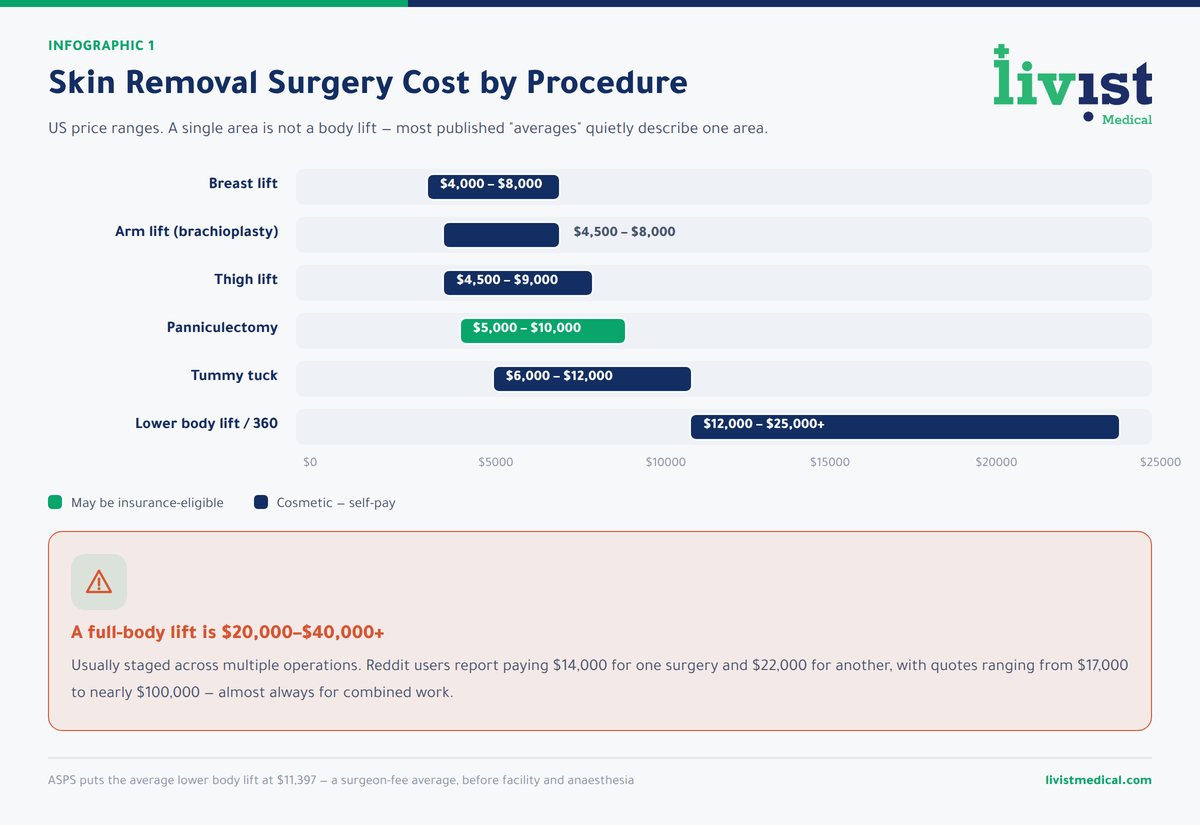
Skin removal surgery costs between $4,000 and $15,000 per body area in the United States, and $20,000 to $40,000 or more for a full-body lift after major weight loss. The final figure depends on how many areas are treated, whether the surgeries are staged, and what the quote actually includes.
| Procedure | US cost range | What it addresses |
|---|---|---|
| Breast lift | $4,000 – $8,000 | Sagging after volume loss |
| Arm lift (brachioplasty) | $4,500 – $8,000 | Loose upper-arm skin |
| Thigh lift | $4,500 – $9,000 | Inner and outer thigh |
| Panniculectomy | $5,000 – $10,000 | Hanging abdominal apron only |
| Tummy tuck (abdominoplasty) | $6,000 – $12,000 | Skin and muscle repair |
| Lower body lift / 360 lift | $12,000 – $25,000+ | Abdomen, flanks, back, buttocks |
| Full-body lift | $20,000 – $40,000+ | Multiple areas, usually staged |
For reference, the American Society of Plastic Surgeons puts the average lower body lift at $11,397 — a surgeon's-fee average that sits well below most all-in quotes, for reasons the next two sections explain.
Why Quotes Range From $1,500 to $100,000
Four things drive the number, in order of impact.
1. How many areas you're treating. This is the biggest single factor, and it is where most published "averages" mislead. A single arm lift is not a body lift. When a page quotes "$4,500," it is almost always describing one area on one part of the body.
2. Staged versus combined surgery. Combining procedures in one operation saves on facility and anaesthesia fees — you pay for one operating room booking instead of two. But it lengthens time under anaesthesia, raises complication risk, and makes recovery harder. Many surgeons will not combine beyond a certain point, and that limit is a safety decision, not a sales one.
3. Facility type. A hospital operating room with an overnight stay costs materially more than an accredited office-based surgical suite. For a long body-contouring case, the facility line can rival the surgeon's fee.
4. What the quote includes. This is the one that ambushes people — and it deserves its own section.
The Costs Nobody Quotes You Up Front
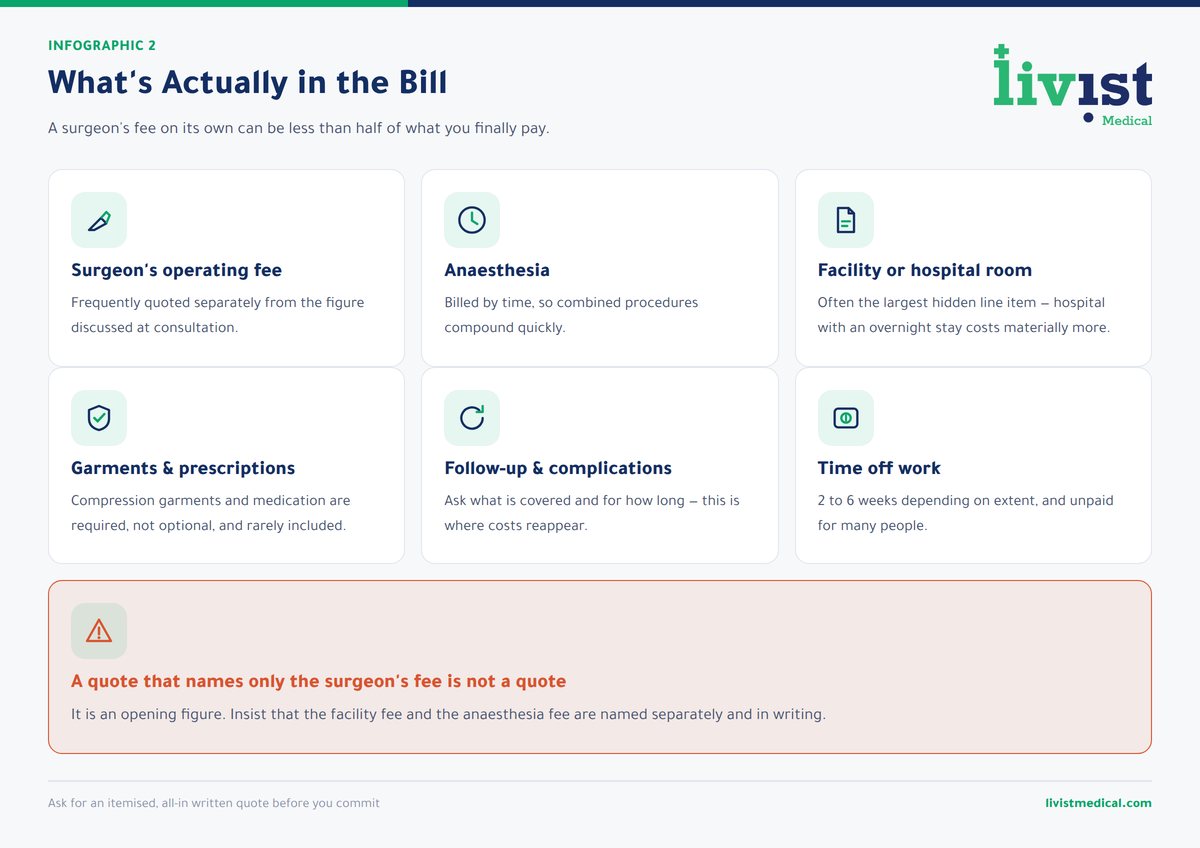
- Surgeon's operating fee — frequently quoted separately from the figure discussed at consultation
- Anaesthesia — billed by time, so combined procedures compound quickly
- Surgical facility or hospital room — often the largest hidden line item
- Compression garments and prescriptions — required, not optional, and rarely included
- Follow-up visits and complication management — ask what is covered and for how long
- Time off work — 2 to 6 weeks depending on extent, and unpaid for many people
Ask for an itemised, all-in written quote before you commit. A surgeon's fee on its own can be less than half of what you finally pay. A quote that does not name the facility fee and the anaesthesia fee is not a quote — it is an opening figure.
Panniculectomy vs Tummy Tuck vs Body Lift
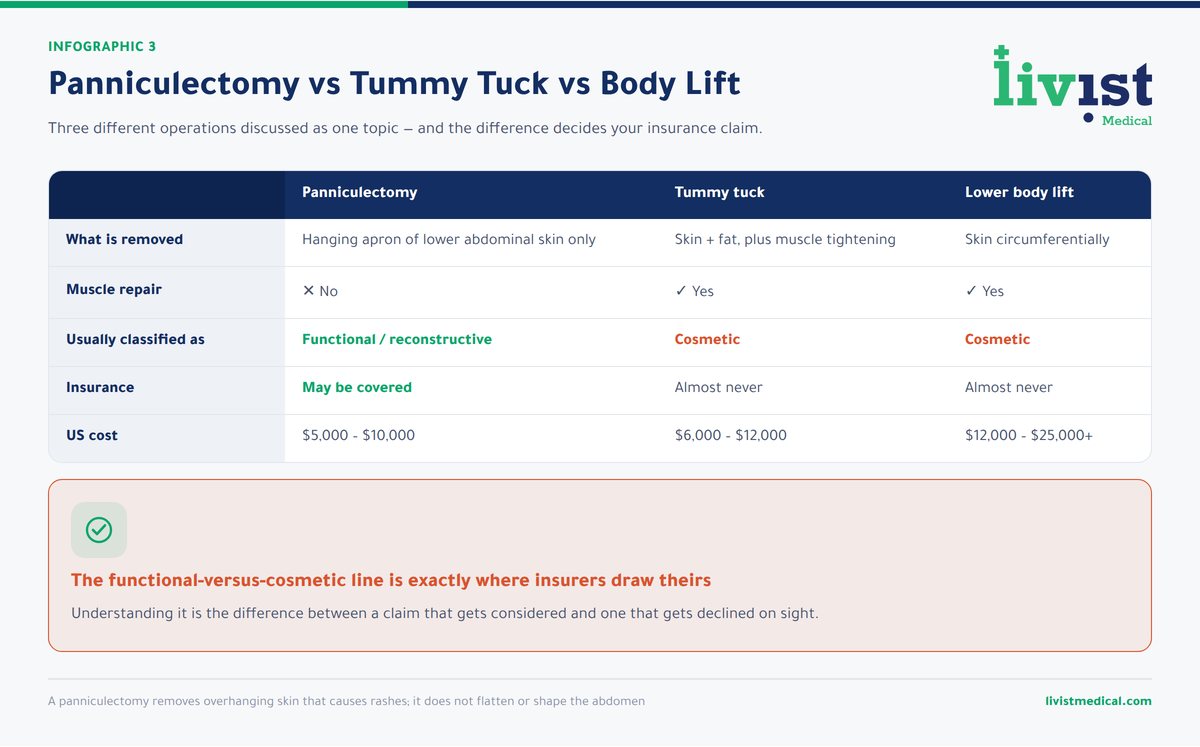
These three get discussed as one topic and priced as one topic. They are three different operations — and the difference between them decides whether your insurer will pay.
| Panniculectomy | Tummy tuck | Lower body lift | |
|---|---|---|---|
| What is removed | Hanging apron of lower abdominal skin only | Skin and fat, plus muscle tightening | Skin circumferentially: abdomen, flanks, back, buttocks |
| Muscle repair | ❌ No | ✅ Yes | ✅ Yes |
| Cosmetic contouring | Minimal | Yes | Extensive |
| Usually classified as | Functional / reconstructive | Cosmetic | Cosmetic |
| Insurance | May be covered | Almost never | Almost never |
| US cost | $5,000 – $10,000 | $6,000 – $12,000 | $12,000 – $25,000+ |
Here is the sentence that matters: a panniculectomy removes the overhanging skin that causes rashes, infections and hygiene problems. It does not flatten your stomach, tighten your abdominal muscles, or reshape your waist.
That functional-versus-cosmetic line is exactly where insurers draw theirs. Understanding it is the difference between a claim that gets considered and one that gets declined on sight.
One more variant worth knowing: the fleur-de-lis tummy tuck adds a vertical incision to the standard horizontal one. It is designed specifically for massive-weight-loss patients who have horizontal and vertical laxity — the standard tummy tuck cannot address both. It leaves a more visible scar, and for the right patient it is the only operation that actually works.
Will Insurance Cover Loose Skin Surgery?
Cosmetic body contouring is rarely covered. A panniculectomy may be partially or fully covered when it is documented as medically necessary — but coverage is decided case by case, and it turns almost entirely on the quality of your medical record.
What insurers typically want to see
- A documented medical problem caused by the skin — recurring rashes (intertrigo), skin infections, ulceration, back pain, or difficulty walking
- Failed conservative treatment — records showing topical treatments, antifungals and hygiene measures were tried and did not resolve it, usually over a documented period of several months
- Photographic documentation taken by your physician, not by you
- Weight stability — a sustained plateau, frequently documented over 6 to 12 months
- Prior authorisation obtained before surgery, never after
What you can actually do about it
- See your primary physician every time the rash recurs. A problem that is not in your chart did not happen, as far as an insurer is concerned. This is the single highest-value thing you can do, and it has to start months before you apply.
- Ask your insurer for their medical-necessity criteria in writing. They exist, they are specific, and they differ between plans.
- Request prior authorisation before booking anything.
- Ask the surgeon's office who handles appeals — an experienced practice has done this many times and a first denial is not the end.
⚠️ No article can promise you coverage. Criteria vary by insurer and by plan, and identical documentation can be approved by one and declined by another. What is within your control is the record — and that record is built over months, not in the week before you apply.
If you're paying out of pocket
Three levers: stage the surgery across two years to spread the cost, choose an accredited office-based facility over a hospital where your surgeon considers it appropriate, and look at medical financing. And there is a fourth, which the next section covers.
International Cost Comparison
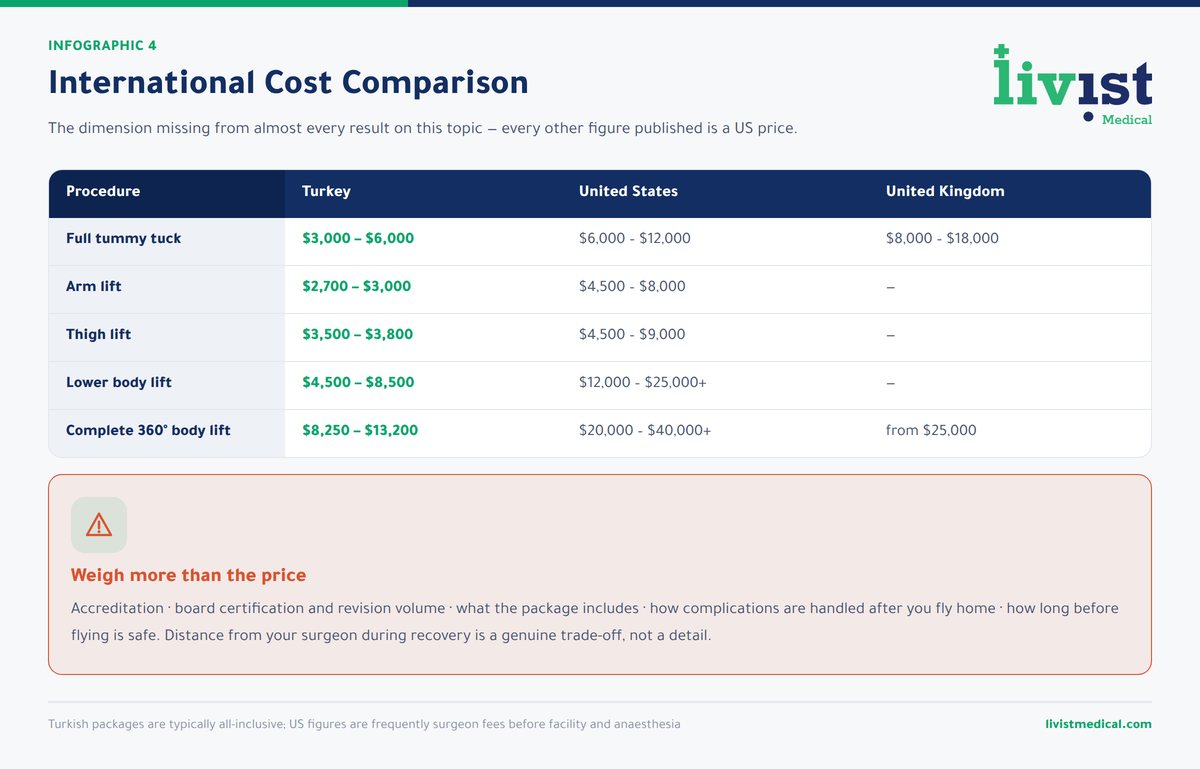
This is the dimension missing from almost every result on this topic — every figure published in the sections above is a US price.
| Procedure | Turkey | United States | United Kingdom |
|---|---|---|---|
| Full tummy tuck | $3,000 – $6,000 | $6,000 – $12,000 | $8,000 – $18,000 |
| Mini tummy tuck | $2,500 – $4,000 | — | — |
| Extended tummy tuck | $4,000 – $7,000 | — | — |
| Fleur-de-lis tummy tuck | $4,500 – $7,500 | — | — |
| Arm lift (brachioplasty) | $2,700 – $3,000 | $4,500 – $8,000 | — |
| Thigh lift | $3,500 – $3,800 | $4,500 – $9,000 | — |
| Lower body lift | $4,500 – $8,500 | $12,000 – $25,000+ | — |
| Upper body lift | $4,000 – $7,500 | — | — |
| Complete 360° body lift | $8,250 – $13,200 | $20,000 – $40,000+ | from $25,000 |
| Buttock lift | $3,300 – $5,200 | — | from $8,500 |
Figures compiled from clinic and medical-platform pricing pages published in 2026. Ranges are indicative and vary by surgeon, facility and package. Dashes mark procedures for which no reliable published figure was found — they are left blank rather than estimated.
Turkish packages are typically all-inclusive, covering surgery, hospital fees, accommodation, airport transfers and post-operative care. That structure is a large part of why the comparison looks the way it does: the US figures above are frequently surgeon's fees before facility and anaesthesia are added, while the Turkish figures usually are the total.
What to weigh besides price
- Accreditation of the hospital or surgical facility
- The surgeon's board certification and how many body-contouring cases they do per year
- Exactly what the package covers — and what happens if you need a revision
- How complications are handled after you fly home — this is the question that matters most
- How long before it is safe to fly, which for major body contouring is longer than most people plan for
Being straight about this: body contouring involves long incisions, drains, and a genuine complication rate — seromas and wound-healing problems are not rare. Being thousands of miles from your surgeon during the weeks when those problems appear is a real trade-off, not a footnote. Some people make that trade sensibly, with a clear plan for follow-up care at home. Others find out the hard way. Ask the question before you book, not after.
Am I a Candidate for Skin Removal Surgery?
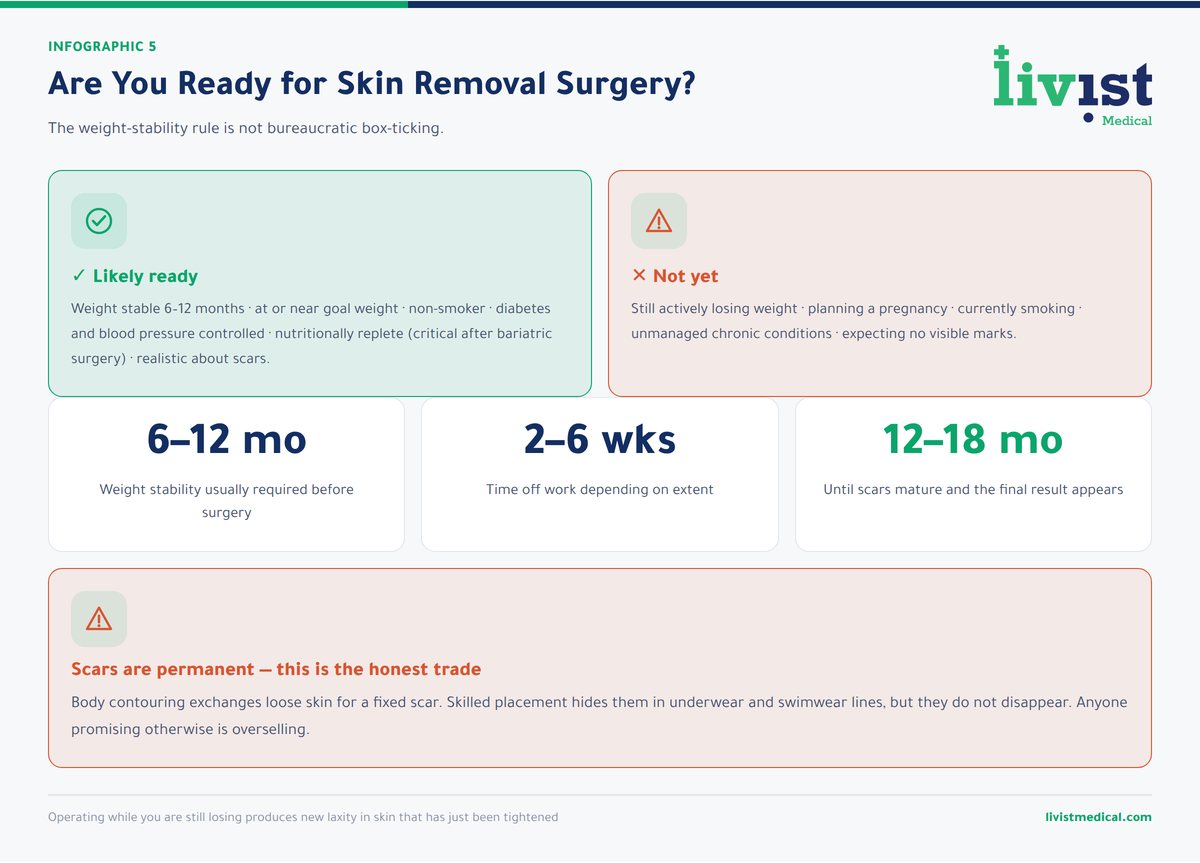
You are likely ready if:
- Your weight has been stable for 6 to 12 months
- You are at or near your goal weight
- You do not smoke, or stopped well in advance
- Diabetes and blood pressure are well controlled
- You are nutritionally replete — particularly important after bariatric surgery, where protein and micronutrient deficiencies impair wound healing
- You have realistic expectations about scars
Not yet if:
- You are still actively losing weight
- You are planning a pregnancy
- You currently smoke
- You have unmanaged chronic conditions
- You expect the result to leave no visible marks
The weight-stability rule is not bureaucratic box-ticking. Operating while you are still losing produces new laxity in skin that has just been tightened — you pay for the same operation twice. And gaining significant weight afterwards does the same thing in reverse.
Recovery and Scars: What to Expect
| Stage | What happens |
|---|---|
| Days 1–7 | Drains often in place · compression garment worn continuously · limited mobility |
| Weeks 2–4 | Drains removed · desk work often possible · no lifting |
| Weeks 4–6 | Gradual return to normal activity |
| Months 3–6 | Swelling resolves · scars at their reddest and most raised |
| Months 12–18 | Scars mature and fade — this is the final result |
Scars are permanent — this is the honest trade
Body contouring exchanges loose skin for a fixed scar. A skilled surgeon places incisions where underwear and swimwear will cover them, and mature scars fade substantially over 12 to 18 months. But they do not disappear, and on a full body lift they are long.
Anyone who tells you otherwise is selling. The people who are happiest with these operations are the ones who understood the trade before they made it.
One thing worth knowing: judging your result at three months is judging unfinished work. Swelling is still resolving and scars are at their worst point. The result you will live with is the one you see at a year.
The Bottom Line
Build your own estimate rather than trusting an average. Work out how many areas you need, whether you will stage or combine, and insist on a written quote that names the surgeon's fee, the facility fee and the anaesthesia fee separately.
Then work the insurance angle properly. If your loose skin causes recurring rashes or infections, a panniculectomy is the procedure that can be covered — and the record you build over the next six months matters more than anything you say in the application.
Two things are non-negotiable regardless of route: your weight has to be stable first, and the scars are permanent. Every good outcome in this surgery starts with someone who accepted both before they booked.
This content is for general health education and does not replace consultation with a qualified plastic surgeon. Determining whether a procedure is appropriate for you requires individual medical assessment.
Sources for pricing figures: