How Many Calories Should I Eat a Day? Chart by Age (2026)
Bariatric Surgery

How Many Calories Should I Eat a Day? Chart by Age (2026)

October 25, 2026
6
Share Article :

How Many Calories Should I Eat a Day? Chart by Age (2026)

How many calories should I eat? Women need 1,600–2,400 a day and men 2,000–3,000. Chart by age and activity, the Mifflin formula and weight-loss targets.

How many calories you should eat depends on your age, sex, size and how active you are. The Dietary Guidelines for Americans estimate 1,600 to 2,400 calories a day for adult women and 2,000 to 3,000 for adult men, and the NHS uses averages of 2,000 and 2,500. To lose weight, most dietitians advise cutting no more than about 500 calories a day.

Written and medically reviewed by Op. Dr. Mehmet Mehdi Deniz — bariatric and metabolic surgery · Last updated: 25 October 2026

Quick summary:

  • Adult women: about 1,600–2,000 calories a day if sedentary and 2,200–2,400 if active (ages 19–60).
  • Adult men: about 2,200–2,600 calories if sedentary and 2,600–3,000 if active (ages 19–60).
  • Needs fall with age: from 61, about 1,600–2,000 for women and 2,000–2,600 for men.
  • To lose weight: cut no more than about 500 calories a day; women generally should not go below 1,200 and men below 1,500 without medical supervision.
  • Your exact number starts with your resting energy expenditure, calculated with the Mifflin–St Jeor equation.
How many calories should I eat a day by age and sex for sedentary and active adults

How Many Calories Should I Eat a Day? By Age, Sex and Activity

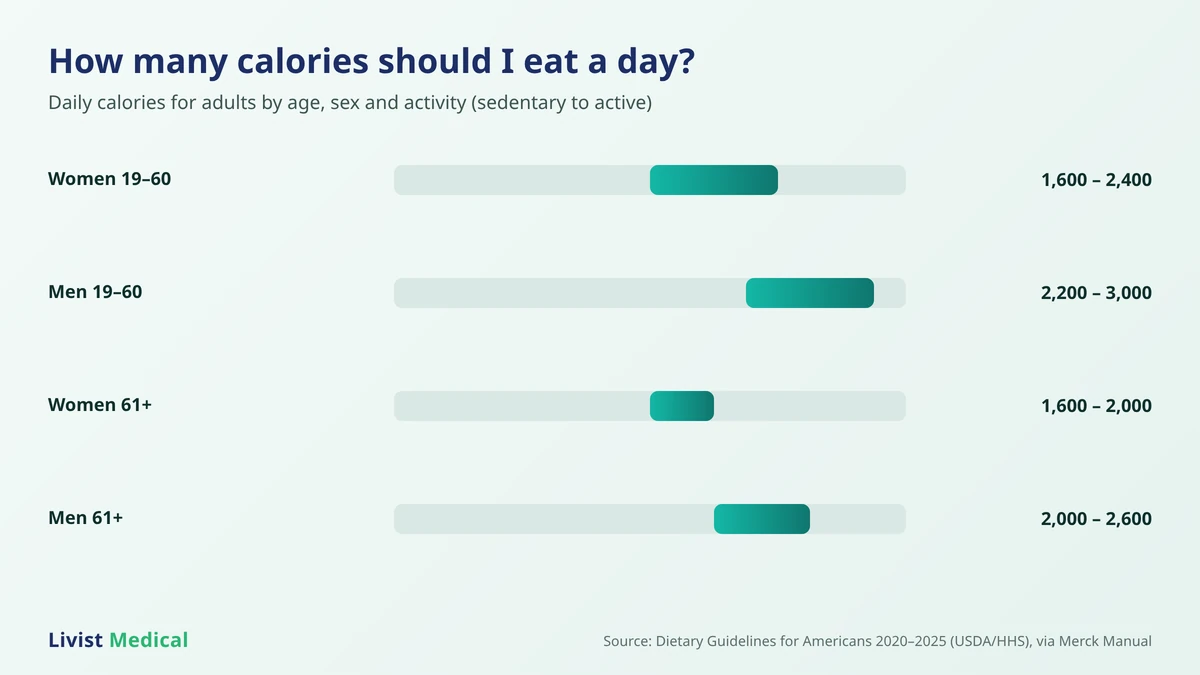
The table below shows how many calories adults need per day according to the Dietary Guidelines for Americans 2020–2025.

Age groupSexCalories a day — sedentaryCalories a day — active
Adults 19–60Women1,600 – 2,0002,200 – 2,400
Adults 19–60Men2,200 – 2,6002,600 – 3,000
Adults 61+Women1,6002,000
Adults 61+Men2,0002,400 – 2,600
Children and teens 7–18Girls1,200 – 1,8001,800 – 2,400
Children and teens 7–18Boys1,400 – 2,4001,800 – 3,200

Source: U.S. Department of Agriculture and Department of Health and Human Services, Dietary Guidelines for Americans 2020–2025, as tabulated in the Merck Manual. The NHS gives a simpler rule: an average man needs about 2,500 calories a day and an average woman about 2,000.

How Many Calories Should I Eat for My Age?

Calorie needs are highest in the late teens and twenties and fall gradually with age. A sedentary woman over 60 needs about 1,600 calories a day, while the same woman in her twenties and active may need 2,400. Pregnancy and breastfeeding raise needs; Mayo Clinic notes that standard calculators can over- or underestimate in those cases and in athletes.

How to Calculate How Many Calories You Need

To calculate how many calories you need, start with your resting energy expenditure (REE): the calories your body burns at rest. The Mifflin–St Jeor equation, derived from 498 healthy adults aged 19–78 and published in the American Journal of Clinical Nutrition in 1990, is a widely used formula for estimating resting needs:

  • Men: REE = 10 × weight (kg) + 6.25 × height (cm) − 5 × age (years) + 5
  • Women: REE = 10 × weight (kg) + 6.25 × height (cm) − 5 × age (years) − 161

Worked example: a 35-year-old woman who weighs 70 kg and is 165 cm tall has an REE of 10 × 70 + 6.25 × 165 − 5 × 35 − 161 ≈ 1,395 calories. That is the floor; daily movement adds to it. For a sedentary woman of her age, the Dietary Guidelines estimate 1,600–2,000 calories a day.

How Many Calories to Eat for Maintenance

Maintenance calories are the amount that keeps your weight stable: REE plus everything you burn moving. Mayo Clinic's calculator asks for age, height, weight, sex and one of four activity levels, from inactive to very active, and advises treating the result as a starting point. If your weight holds steady over a few weeks at a given intake, that intake is your real maintenance level.
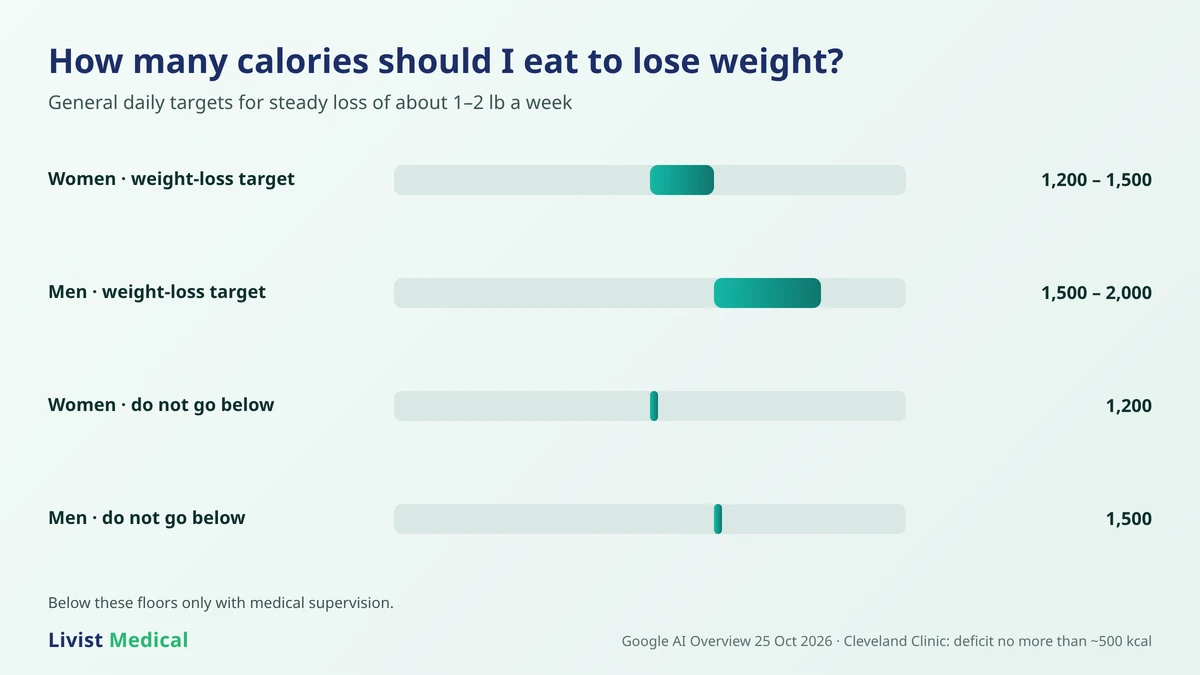
How many calories should I eat to lose weight: daily targets for women and men and safety minimums

How Many Calories Should I Eat to Lose Weight?

To lose weight you need a calorie deficit: eating fewer calories than you burn. Cleveland Clinic dietitian Julia Zumpano notes that Most dietitians recommend cutting no more than about 500 calories from your resting metabolic rate. For steady loss of about 1 to 2 pounds a week, Google's AI Overview summarises general targets as follows:

GoalWomen — calories a dayMen — calories a day
Steady weight loss (about 1–2 lb a week)About 1,200 – 1,500About 1,500 – 2,000
Do not go below without medical supervision1,2001,500
Daily deficit dietitians generally adviseNo more than about 500 calories below your needs

Targets: Google's AI Overview for "how many calories should i eat to lose weight", 25 October 2026; deficit guidance: Cleveland Clinic. A target this general can be too low for tall or very active people, so calculate your own number first.

Is 1,200 Calories Enough? When Calorie Intake Is Too Low

For most adults, 1,200 calories a day is too low to sustain. Cleveland Clinic says some people can eat that amount, lose weight and still meet their nutrient needs, but only when it has been judged appropriate for them. A severe cut can lead to nutritional deficiencies, fatigue and irritability, and can slow metabolism.

  • Short, older or very sedentary women may fit 1,200 calories; most men and active women will not.
  • Very low calorie intake makes it harder to get enough key nutrients.
  • If you are not losing weight on 1,200 calories, intake is often under-counted or needs are lower than estimated — see a dietitian rather than cutting further.

How Many Calories to Gain Weight or Build Muscle

To gain weight, eat a few hundred nutrient-dense calories above your maintenance level each day, rather than a large surplus. Pair the extra calories with strength training so more of the gain is muscle. Recheck your weight regularly and adjust in small steps.

Not Losing Weight Despite Counting Calories? When Medical Weight Loss Helps

Counting calories works for many people, but not everyone with obesity can reach a healthy weight through diet alone. If your weight has not moved after a serious, supervised attempt, a doctor may discuss medical options. Start with where your weight sits on our ideal body weight and BMI chart, then compare:

For short-term tips that stay within safe calorie limits, read how to lose weight fast.

Livist Medical Instagram reel card about doctor consultation and interpreter support for weight-loss patients
Watch on Instagram: how @livist.medical.turkey supports international patients from the first doctor consultation, with an interpreter in their own language.

Plan Your Calories and Weight Loss in Turkey with Livist Medical

Tell us your height, weight, age and what you have already tried. A bariatric team at one of our contracted healthcare institutions holding a health tourism authorization certificate will review whether diet, a non-surgical treatment or surgery fits your case, and Livist Medical coordinates the consultation, travel and stay.

Request your free weight-loss consultation.

Sources: U.S. Department of Agriculture and U.S. Department of Health and Human Services, Dietary Guidelines for Americans 2020–2025 (via Merck Manual). NHS — Understanding calories. Mayo Clinic — Calorie calculator. Cleveland Clinic Health Essentials — Is eating 1,200 calories a day healthy? Mifflin MD et al. A new predictive equation for resting energy expenditure in healthy individuals. Am J Clin Nutr. 1990;51(2):241-7 (PMID 2305711).

How Many Calories Should I Eat? FAQ

Share Article :
Related Articles
Gastric Botox in Turkey: How It Works, Safety, Who It Suits
Bariatric Surgery
10
Gastric Botox in Turkey: How It Works, Safety, Who It Suits

Gastric botox is an endoscopic injection into the stomach antrum. A 56-patient trial recorded a mean 9 kg loss peaking near 60 days, plus five exclusions.

September 5, 2026Read More
Gastric Botox vs Gastric Balloon: What the Trials Show
Bariatric Surgery
12
Gastric Botox vs Gastric Balloon: What the Trials Show

Gastric botox vs gastric balloon judged on trial data: 15.6 kg vs 9.3 kg head-to-head, 30% vs 9% complications, plus 2026 costs in four countries.

August 23, 2026Read More
Ideal Body Weight Chart & the BMI That Qualifies You
Bariatric Surgery
11
Ideal Body Weight Chart & the BMI That Qualifies You

Ideal body weight chart by height, the four formulas behind it, and the 2022 BMI thresholds for weight-loss surgery that most pages still have wrong.

August 23, 2026Read More
Chat on WhatsApp