 Dentistry
8
Do Fillings Hurt Without an Injection? Dentist AnswersDo fillings hurt without an injection? Shallow enamel cavities often don't; deeper ones do. Needle-free numbing, kids' options and 2026 filling costs.
October 25, 2026Read More
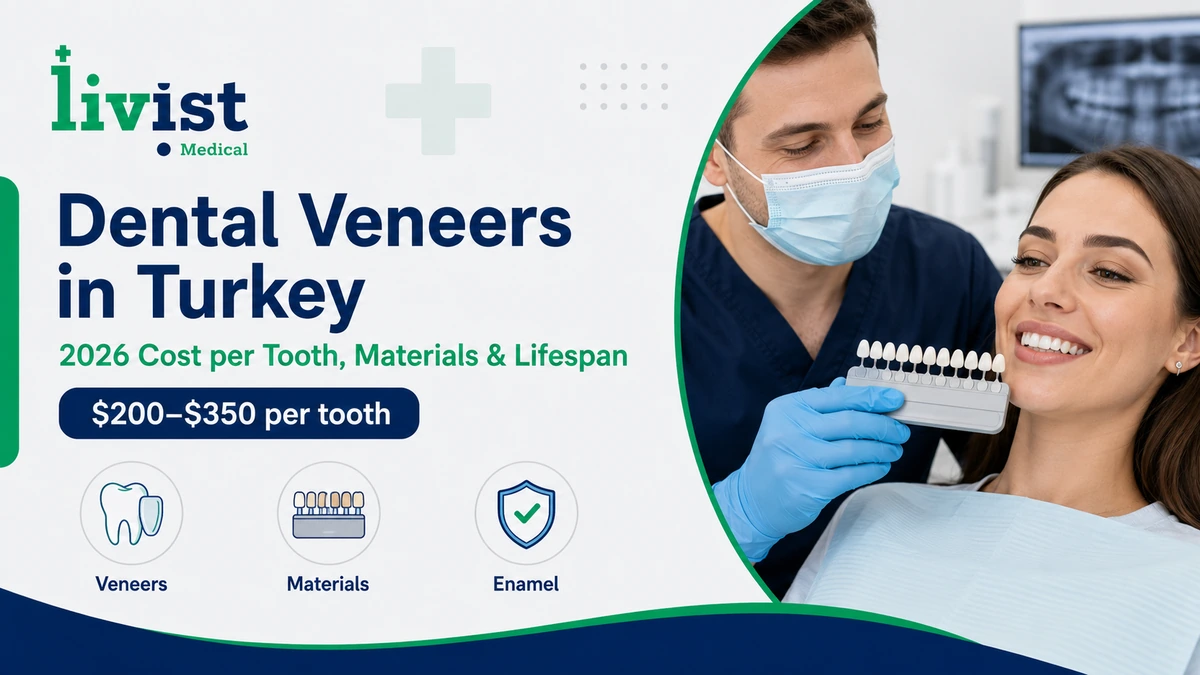
Dental veneers in Turkey cost £150–£265 ($200–$350) per tooth in 2026, a third of UK prices: the official minimum, 4 countries, and crowns sold as veneers.
Written and medically reviewed by: Prof. Dr. Funda Öztürk Bozkurt — Restorative and Aesthetic Dentistry, Istanbul Medipol University, dentist profile · Last updated: 27 September 2026
Dental veneers in Turkey cost about £150–£265 ($200–$350) per tooth for porcelain or E-max at a credentialed clinic in 2026, so a full set of 16–20 veneers comes to roughly £2,400–£5,300, roughly a third of UK private prices and a fifth of US ones. The saving is real. So are the horror stories. And both come from the same place: not the country, but whether the clinic bonds a thin veneer to your enamel or files the tooth into a peg and fits a crown.
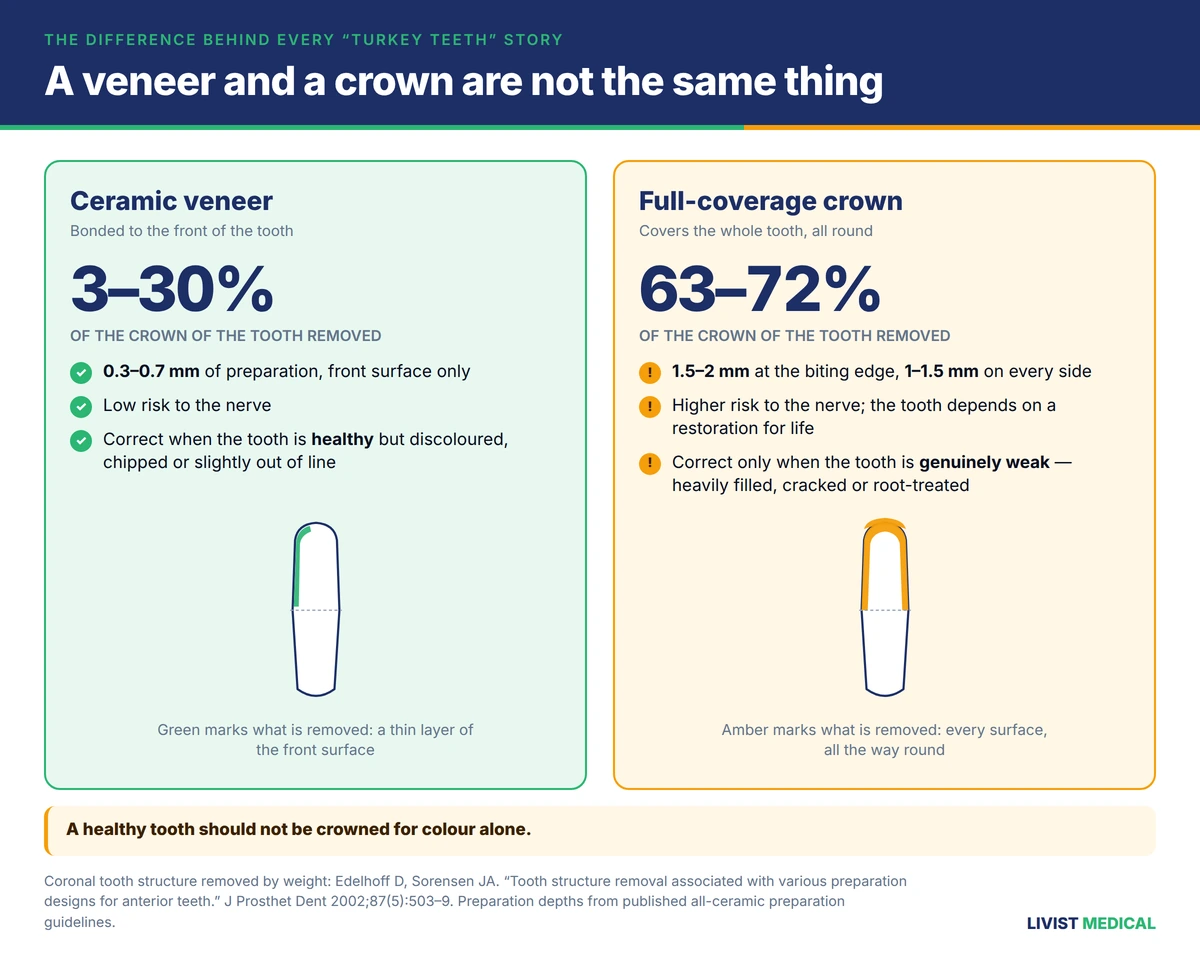
That distinction is the whole subject. A peer-reviewed study measured it precisely: a ceramic veneer removes 3–30% of the crown of a tooth. A full-coverage crown removes 63–72%. If you are quoted for "veneers" and you come home with crowns, you have paid for the cheaper procedure and lost two thirds of your teeth doing it.
This guide gives you the 2026 price in four countries, the questions that separate a good clinic from a bad one, and the numbers behind the risk — including what a repair costs if it goes wrong. If you want a sense of how the same treatment is discussed when it happens to someone famous, our breakdown of a widely reported celebrity veneer case covers the same ground from the other end.
This article is information, not a diagnosis or a treatment plan. Whether veneers suit your teeth can only be decided by a dentist who has examined you and taken X-rays.
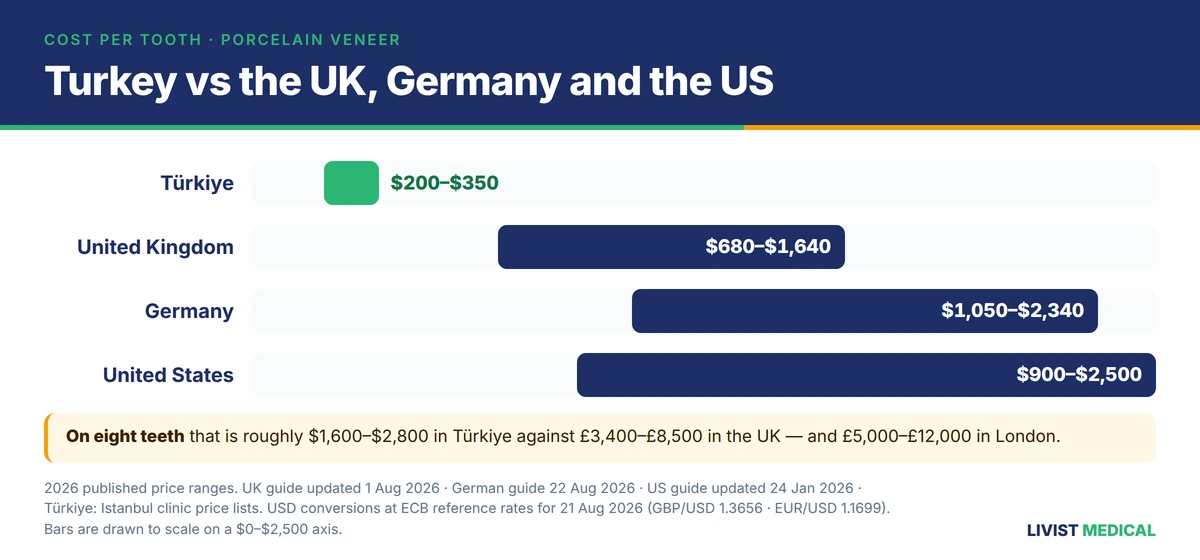
Dental veneers in Turkey cost $200–$350 per tooth for porcelain or E-max in 2026. Eight upper teeth run about $1,600–$2,800 and a 20-tooth smile about $4,000–$7,000, usually including hotel and airport transfers. UK private practices charge £500–£1,200 per tooth for the same restoration.
Here is the comparison that most price pages leave out, because it takes four sources to build rather than one.
| Country | Local currency | Approx. USD | Source date |
|---|---|---|---|
| Türkiye | $200–$350 | $200–$350 | Istanbul clinic price lists, 2026 |
| United Kingdom | £500–£1,200 | $680–$1,640 | UK cost guide, updated 1 Aug 2026 |
| Germany | €900–€2,000 | $1,050–$2,340 | German cost guide, 22 Aug 2026 |
| United States | $900–$2,500 (avg $1,500) | $900–$2,500 | US cost guide, updated 24 Jan 2026 |
USD conversions use European Central Bank reference rates for 21 August 2026 (GBP/USD 1.3656 · EUR/USD 1.1699). Rates move; the local-currency column is the stable one.
The saving on a single tooth is roughly $480–$1,290 against the UK and $700–$2,150 against the US. On eight teeth that is the difference between a $2,400 trip and a $12,000 one — a UK 8-tooth porcelain package runs £3,400–£8,500 nationally and £5,000–£12,000 in London, and a German eight-veneer smile design runs €7,200–€16,000.
| Material | Cost per tooth (Türkiye) | Typical lifespan | Note |
|---|---|---|---|
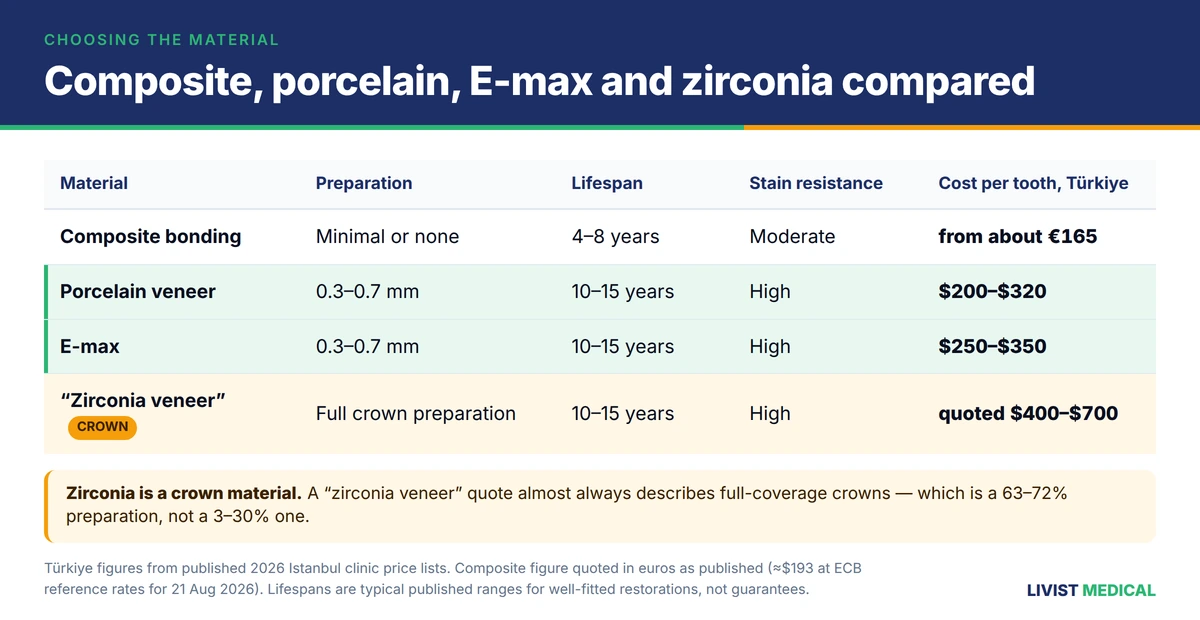
| Composite bonding | from about €165 (≈$193) | 4–8 years | Applied directly, usually no lab stage |
| Porcelain veneer | $200–$320 | 10–15 years | The standard aesthetic veneer |
| E-max (lithium disilicate) | $250–$350 | 10–15 years | Strongest of the thin veneer materials |
| "Zirconia veneer" | quoted $400–$700 | 10–15 years | ⚠️ Usually a crown, not a veneer — see the next section |
Turkey's Ministry of Health tariff for international patients sets the minimum fee for a ceramic laminate veneer at 8,812.5 lira per tooth (code S404460), about £137 or $181, and 1,897.5 lira (about £29) for a composite laminate veneer (code S404390). Source: Annex EK-2, Health Services Price Tariff, converted at the Central Bank of Türkiye buying rate of 25 September 2026. A porcelain quote below that figure is below the official floor.
A veneer has real fixed costs: a laboratory, a ceramist's time, an impression or scan, and a try-in appointment. When a full 20-tooth smile is offered for less than the cost of the ceramic alone, something has been removed from the process — usually the lab work, the try-in, or the distinction between a veneer and a crown. Compare full dental veneer treatment in Istanbul on what is included, not on the headline number, and read how Turkish dental packages are priced before you compare two quotes side by side.
"Turkey teeth" is not a procedure and not a material. It is the visible result of fitting full crowns where thin veneers were the correct treatment. A ceramic veneer removes 3–30% of the crown of a tooth. A full-coverage crown removes 63–72%. That single difference explains almost every complaint in the online horror stories.
Those percentages come from a 2002 study in The Journal of Prosthetic Dentistry by Edelhoff and Sorensen, who prepared standardised teeth to each design and weighed what was left. It remains the clearest measurement of the difference, and it is worth knowing before anyone picks up a drill.
| Ceramic veneer | Full-coverage crown | |
|---|---|---|
| Coronal tooth structure removed | 3–30% | 63–72% |
| Depth of preparation | 0.3–0.7 mm, front surface only | 1.5–2 mm at the biting edge, 1–1.5 mm on every side |
| Covers | the front of the tooth | the whole tooth, all round |
| Reversible | no — but most of the tooth remains | no — and the tooth is now dependent on a restoration for life |
| Nerve risk | low | higher; deep preparation can cost the tooth its vitality |
| Correct when | the tooth is healthy but discoloured, chipped, or slightly out of line | the tooth is genuinely weak: heavily filled, cracked, or root-treated |
It is faster. A crown hides more, so shade and alignment problems disappear without careful ceramic work. It is more forgiving of a rushed preparation, and it produces fewer remakes. None of those reasons is about your teeth.
The line that matters: a healthy tooth should not be crowned for colour alone. If a clinic proposes full crowns across a smile of sound teeth because you want them whiter, that is the moment to get a second opinion — not after the temporaries are on.
The 4-8-10 rule is a smile-design guideline for how many upper front teeth to veneer: 4 covers the two central and two lateral incisors; 8 covers the teeth visible in a moderate smile; 10 covers the teeth visible in a full, wide smile. The right number is set by your own smile line, not by a package price.
The commercial value of knowing this rule is simple: if your smile shows eight teeth and a clinic quotes you for twenty, you are being sold ten to twelve unnecessary preparations. Every one of them is an irreversible cut into a healthy tooth. A proper digital smile design session shows you your own smile line on screen and settles the number before anyone quotes a price.
Porcelain and E-max are the two genuine thin-veneer materials, lasting 10–15 years with 0.3–0.7 mm of preparation. Composite is cheaper and faster but stains and lasts 4–8 years. Zirconia is a crown material — a "zirconia veneer" quote almost always describes full-coverage crowns.
| Composite | Porcelain | E-max | Zirconia | |
|---|---|---|---|---|
| Preparation | minimal or none | 0.3–0.7 mm | 0.3–0.7 mm | full crown preparation |
| Lifespan | 4–8 years | 10–15 years | 10–15 years | 10–15 years |
| Stain resistance | moderate — will pick up coffee and tobacco | high | high | high |
| Strength | lowest | high | highest of the thin materials | highest overall |
| Best for | small chips, gaps, a reversible trial | the standard aesthetic case | thin cases needing strength | teeth that are genuinely damaged |
| Repairable in the chair | yes | no — remake | no — remake | no — remake |
If your teeth are healthy and the complaint is mild, you may not need veneers at all. Composite bonding can close a small gap without touching the enamel, no-prep options such as Lumineers sit over the tooth rather than into it, and if the only issue is colour, professional whitening costs a fraction of any of them. Choosing a shade matters more than most patients expect — our guide to choosing between A1 and B1 shades explains why the whitest option is rarely the most natural.
Most veneer cases in Türkiye are completed in 5–7 days on a single trip. Published timelines vary from 3 days to two visits spread over several weeks, and the difference is real: it reflects how much laboratory and try-in time the clinic builds in, not how fast the dentist works.
Three days is possible. It is possible because the try-in appointment — the stage where shade, shape, and bite are checked before the ceramic is bonded permanently — has been compressed or skipped. That is the appointment that prevents a remake.
| Day | What happens |
|---|---|
| 1 | Examination, X-rays, photographs, shade selection, digital smile design |
| 2 | Preparation of the teeth, impressions or intraoral scan, temporaries fitted |
| 3–4 | Laboratory fabrication — no appointment; the temporaries are being road-tested |
| 5 | Try-in: the veneers are placed unbonded. Shade, length, and bite are adjusted |
| 6 | Final bonding and polishing |
| 7 | Review, bite check, aftercare instructions, night guard impression if needed |
Some restorations can be milled chairside — same-day CEREC crowns exist for exactly that reason — but a full aesthetic case across eight or ten front teeth benefits from the lab stage and the try-in.
Most Turkish veneer packages include the treatment, hotel nights, and airport transfers. What they usually exclude is the night guard, the remake policy, and any follow-up once you are home — and those three exclusions are where the later costs sit.
Typically included ✅
Frequently excluded ❌
A full Hollywood smile is a larger case again, and the same three exclusions apply to it. Compare what is written into the treatment packages, not what is said on a call.
Veneers are a safe, well-established treatment. The risk in dental tourism is not the flight and not the country — it is over-preparation. The British Dental Association surveyed 1,000 UK dentists and 86% had treated a patient with problems following dental work abroad. Crowns were the treatment most likely to need follow-up, at 87%.
In the same survey, implants accounted for 85% of follow-up cases, and 98% of dentists said cheaper cost was what drove patients abroad in the first place. Eddie Crouch, the BDA's Chair, framed it as a consequence of access rather than of foreign dentistry: dentists are aware that many people struggle to get care at home and may be tempted by cut-price treatment overseas.
Read that alongside the repair cost. Fixing failed overseas work privately in the UK commonly runs £500–£1,000 or more per tooth. Put the two figures together and the arithmetic is unforgiving: on an eight-tooth case, a saving of roughly £4,000 against UK prices is erased by four teeth needing private repair.
That is not an argument against treatment in Türkiye. It is an argument against the cheapest quote.
The clinical risks, stated plainly:
Who should not have veneers at all: anyone with active gum disease or untreated decay until it is resolved; heavy grinders without a night guard; teenagers whose teeth are still maturing; anyone whose only complaint is colour, for whom whitening is the smaller and reversible answer.
If you already have a quote in hand, our team will read the treatment plan with you and tell you which teeth on it are being crowned rather than veneered — send it for a treatment-plan review before you book anything.
Again: this is general information. No article can tell you whether your enamel is thick enough for a veneer. Only an examination and X-rays can.
A good clinic will answer all seven of these in writing before you send a deposit. A clinic that will not answer the first one — veneer or crown, tooth by tooth — has told you what you need to know.
The single clearest red flag: a quote for twenty crowns on healthy teeth, issued before any X-ray has been taken. It is fast, it is cheap, and it is the exact procedure behind every "Turkey teeth" story you have read. You can review the credentials of our dental team as a benchmark for what points 3 and 4 should look like.
Yes — for a healthy mouth, a correctly scoped case, and a clinic that puts the plan in writing. No, for anyone chasing the lowest quote, anyone with untreated gum disease, and anyone being offered twenty crowns for a colour problem. The saving is genuine and so is the downside, and one failed crown repaired privately at home cancels the saving on roughly three teeth.
It suits you if: your teeth are sound but discoloured, chipped, or slightly uneven; you can commit to 5–7 days; you have a written plan naming veneers tooth by tooth; and you have a dentist at home willing to see you afterwards.
Stay home if: your only complaint is shade — whitening is cheaper and reversible; you grind heavily and no guard is included; you have active decay or gum disease; or the quote you are comparing is the cheapest one you found.
Everything above is why we publish the failure modes alongside the prices. If you want to know what your case would actually involve, dental veneers in Istanbul sets out the treatment as we do it.
Before choosing veneers, check which of the six perfect teeth features your smile actually lacks — some flaws need whitening or aligners instead.
For a full side-by-side, read veneers vs crowns.
Small cavities found during a veneer check-up are often fixed first; read do fillings hurt without an injection.
Dental veneers in Turkey are not a gamble, and they are not a bargain either — they are a normal dental treatment at a normal Turkish price, with a specific way of going wrong that is easy to spot in advance. The country is not the risk. The treatment plan is.
Get the plan in writing, check the word beside each tooth, ask for the preparation depth in millimetres, and make sure a try-in appointment exists. Do those four things and you are buying the same treatment a London practice would charge you four times as much for. Skip them and you may be buying the most expensive dentistry of your life on the instalment plan.
Livist Medical arranges dental veneers in Istanbul with contracted dentists who write the plan tooth by tooth, including the preparation depth and a try-in appointment. Book a free consultation and send your X-rays or an existing quote to have it reviewed before you decide.
DentistryDo fillings hurt without an injection? Shallow enamel cavities often don't; deeper ones do. Needle-free numbing, kids' options and 2026 filling costs.
 Dentistry
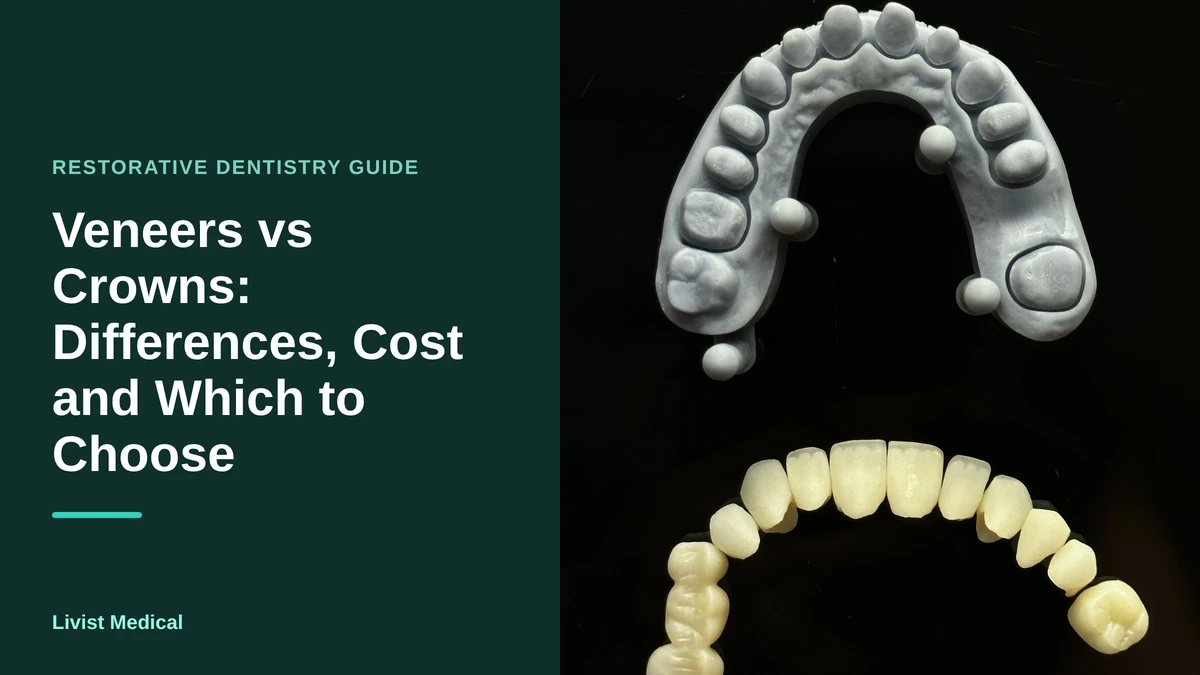
Veneers vs crowns: coverage, how much tooth is removed, lifespan and cost in the US and Turkey, plus when each one is the right choice for your teeth.
 Dentistry
Perfect teeth explained: the 6 features dentists measure, how rare naturally straight teeth are, what people really notice, and how to get a perfect smile.