 Dentistry
12
Braces & Invisalign in Turkey: What It Really CostsInvisalign and braces in Turkey cost $800–$4,500 — yet Türkiye's own 2026 dental tariff prices the same treatment far lower. Here is what the gap buys.
August 23, 2026Read More

A1 vs B1 tooth color: B1 is the lightest natural VITA shade, A1 is next with a warmer tone. Full shade chart in value order and which suits you.
In A1 vs B1 tooth color, B1 is the whitest and brightest natural shade on the VITA Classical shade guide, and A1 sits right behind it. The difference is less about brightness than undertone: A1 is warm and reddish-brown, B1 is cooler and reddish-yellow. A1 reads as natural enamel; B1 reads as a clearly brightened smile.
Written and medically reviewed by: Prof. Dr. Funda Öztürk Bozkurt — Restorative and Aesthetic Dentistry, Istanbul Medipol University, doctor profile · Last updated: September 27, 2026
Neither shade is better in itself. Warm or olive skin and anyone who wants an undetectable result usually suit A1; fair skin and patients who want a visible upgrade usually suit B1.
Dentists and dental labs describe tooth color with the VITA Classical A1–D4 shade guide. The letter is the hue family and the number is how light or saturated the tab is: 1 is the lightest and least saturated, 4 the darkest. VITA, the manufacturer, defines the four families like this:
"A1 - A4 (reddish-brownish), B1 - B4 (reddish-yellowish), C1 - C4 (greyish shades), D2 - D4 (reddish-grey)"
— VITA Zahnfabrik, VITA classical A1-D4 shade guide (checked September 27, 2026)
So A1 is the lightest tab of the warm A family and B1 is the lightest tab of the B family. Because they belong to different families, comparing A1 and B1 tooth color is a question of undertone as much as brightness.
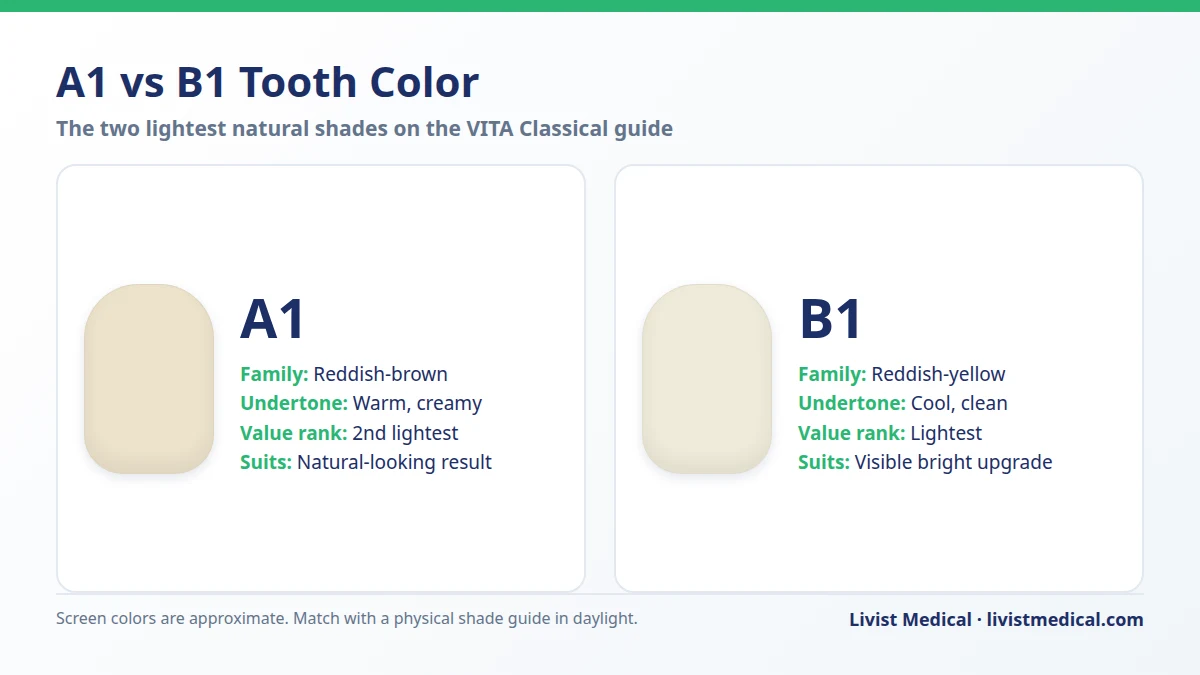
Lightest on the guide and whitest-looking in real life are not always the same thing:
B1 is marginally lighter on the guide, but A1 often looks more natural on camera and in daylight. Side by side the gap is visible; on their own, most people cannot name which one they are looking at.
The classical guide ships sorted by letter, but dentists usually re-sort it by value, which is lightness. This is the order people mean by a teeth whitening scale, and it explains why B1 comes before A1:
"B1 (lightest), followed by A1, B2, D2, A2, C1, C2, D4, A3, D3, B3, A3.5, B4, C3, A4, and lastly C4 (darkest)"
— dentalcare.com CE course 690, Shade Selection Using the VITA Classical Shade Guide (checked September 27, 2026)
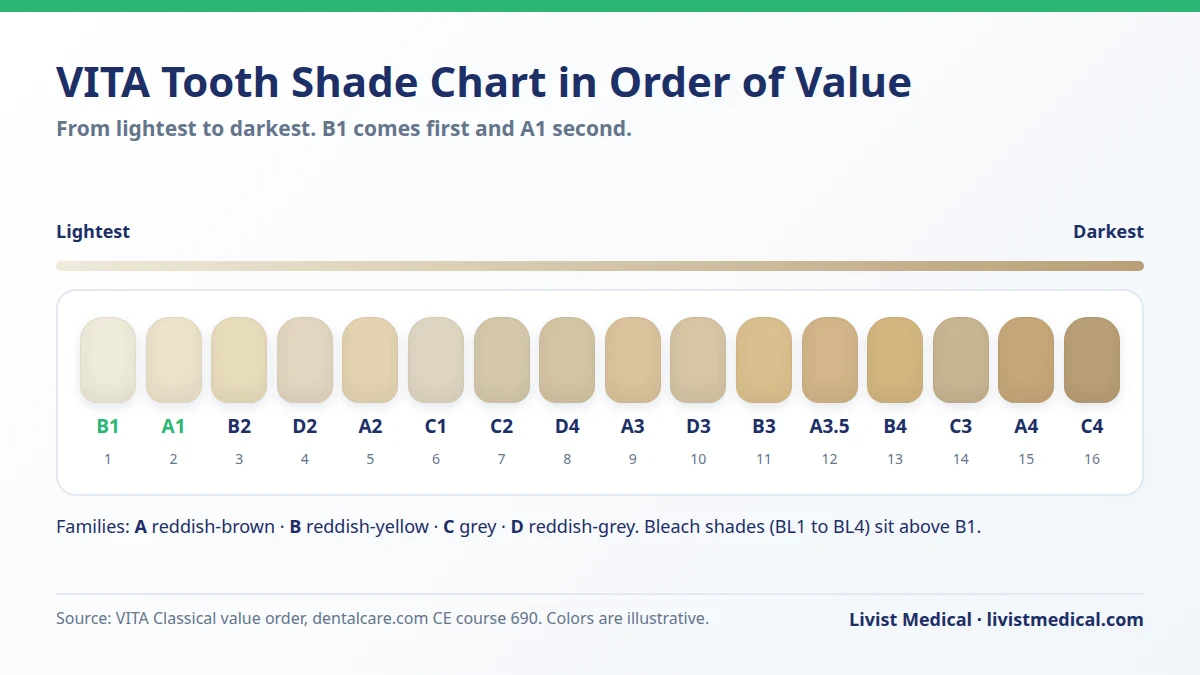
Whitening progress is often counted in steps along this order. Moving from A3 to A1, for example, is several steps up the value scale. The colors on any screen are approximate, so the final shade is always matched with a physical guide in daylight.
| Shade | Hue family | Undertone | Relative brightness | Best for |
|---|---|---|---|---|
| BL1 | Bleach scale | Bright, cool | Whiter than any natural shade | Maximum-white Hollywood smile |
| B1 | Reddish-yellow | Cool, clean | Lightest natural shade | Bright but believable white |
| A1 | Reddish-brown | Warm, creamy | Second lightest, just after B1 | The most natural-looking bright smile |
| B2 | Reddish-yellow | Warm-neutral | Third lightest | Subtle brightening |
| A2 | Reddish-brown | Warm | Fifth lightest | A natural everyday adult shade |
Tip: shades look different under clinic lights, phone flash and daylight, so judge the tab next to your face near a window before you decide.
For most people B1 is not too white. It is the lightest shade still inside the natural range, so it stays believable. It starts to look unnatural when it is paired with an overly uniform, opaque finish, when every tooth is exactly the same color, or when it clashes with a warm skin tone. If you want maximum brightness, the BL shades are whiter than B1 but cross into the obviously done look, which is why many cosmetic dentists steer warm complexions toward A1.
BL1 is the whitest tooth shade. BL shades (BL1–BL4) sit on a separate bleach scale that is whiter than B1,, and many whitening and composite systems add their own extra-white shades on top of the classical guide. That is why calling B1 the whitest tooth shade is only true inside the natural range: bleach shades are brighter, but on most faces they look visibly artificial.
Searches for A1 vs B1 tooth color pictures and before and after photos are useful, but they mislead more often than they help:
The reliable test is a physical shade tab held against your own teeth and face, which is what a digital smile design consultation is built around.
There are two main routes, and they differ a lot in scope and permanence.
If your teeth are healthy and reasonably aligned, professional teeth whitening is the least invasive option. It lightens your natural enamel by several steps on the value scale and can reach the A1–B1 range for patients who start a few shades darker. Whitening changes your own color, so it cannot reshape teeth, and existing crowns or fillings do not whiten with it. Shade selection only matters once alignment is settled; if yours is not, start with braces versus Invisalign and what each costs in Türkiye.
For a fixed, chosen shade that also corrects shape, gaps or chips, porcelain dental veneers let you pick A1, B1 or a bleach shade before treatment begins. A full Hollywood Smile applies that shade across all the visible teeth. For a single chipped or discolored tooth, composite bonding can be matched to your chosen shade in one visit. Shade is one step inside a larger decision, and the full picture is in the dental veneers cost guide for Türkiye.
Related reading: Dental Implant Packages in Turkey: 2026 Prices & Inclusions, Cheapest Place to Get All-on-4 Dental Implants (2026 Country Guide), Miley Cyrus Veneers: Before & After and Her 2026 Smile.
Tooth shade is a cosmetic choice, but it is still a clinical one: enamel health, gums, bite and existing restorations come first. Livist Medical arranges an assessment with contracted dentists in partner hospitals, including a digital smile design so you can compare A1 and B1 on your own face before any work starts. Book a free consultation and send a smile photo in daylight to get a recommended shade and a personalized plan.
DentistryInvisalign and braces in Turkey cost $800–$4,500 — yet Türkiye's own 2026 dental tariff prices the same treatment far lower. Here is what the gap buys.
 Dentistry
Dental veneers in Turkey cost £150–£265 ($200–$350) per tooth in 2026, a third of UK prices: the official minimum, 4 countries, and crowns sold as veneers.
 Dentistry
A factual look at the veneers experts believe Miley Cyrus has, the 2026 update, and what a similar smile costs.