Bariatric SurgeryGastric botox is an endoscopic injection into the stomach antrum. A 56-patient trial recorded a mean 9 kg loss peaking near 60 days, plus five exclusions.

Ideal body weight chart by height, the four formulas behind it, and the 2022 BMI thresholds for weight-loss surgery that most pages still have wrong.
Reviewed by the Livist Medical Team · Last updated 22 August 2026
A 170 cm man has an "ideal body weight" of 66 kg by the Devine formula and a healthy weight range of 53 to 72 kg by BMI. Both numbers are correct, they disagree by up to 19 kg, and neither was designed to tell you what to weigh.
The formulas behind every ideal-weight calculator were built for pharmacy, not for health goals. The Devine formula — the one most calculators run — was created in 1974 to work out aminoglycoside antibiotic doses. It estimates lean body mass so a drug can be dosed safely. It was never a lifestyle target, and it was derived empirically rather than from large population studies.
So this guide does two things. It gives you the chart, computed rather than copied. Then it answers the question the chart cannot: at what number does your weight stop being a personal target and become a clinical threshold? That answer changed in 2022 — and most pages you will read still quote the 1991 version.
This article is information, not medical advice. No chart and no calculator can tell you whether a treatment is appropriate for you. That takes a consultation and a medical history.

Four formulas produce almost every ideal-weight figure online, and all four were developed between 1964 and 1983 for clinical dosing and nutrition counselling rather than for setting personal goals. They differ from each other by several kilograms at the same height.
| Formula | Year | Men | Women | Originally built for |
|---|---|---|---|---|
| Hamwi | 1964 | 48 kg + 2.7 kg per inch over 5 ft | 45.4 kg + 2.2 kg | Diabetes management and nutrition counselling |
| Devine | 1974 | 50 kg + 2.3 kg per inch over 5 ft | 45.5 kg + 2.3 kg | Aminoglycoside antibiotic dosing |
| Robinson | 1983 | 52 kg + 1.9 kg | 49 kg + 1.7 kg | Pharmacokinetics |
| Miller | 1983 | 56.2 kg + 1.41 kg | 53.1 kg + 1.36 kg | Pharmacokinetics |
Run a 180 cm man through all four and you get roughly 75 kg by Devine, 76 kg by Robinson, 71 kg by Miller and 78 kg by Hamwi. A seven-kilogram spread, from four formulas that are all considered valid. That spread is the first clue that "ideal body weight" is a clinical estimate, not a measurement of you.
None of this makes the formulas useless. It makes them the wrong tool for the job most people use them for.

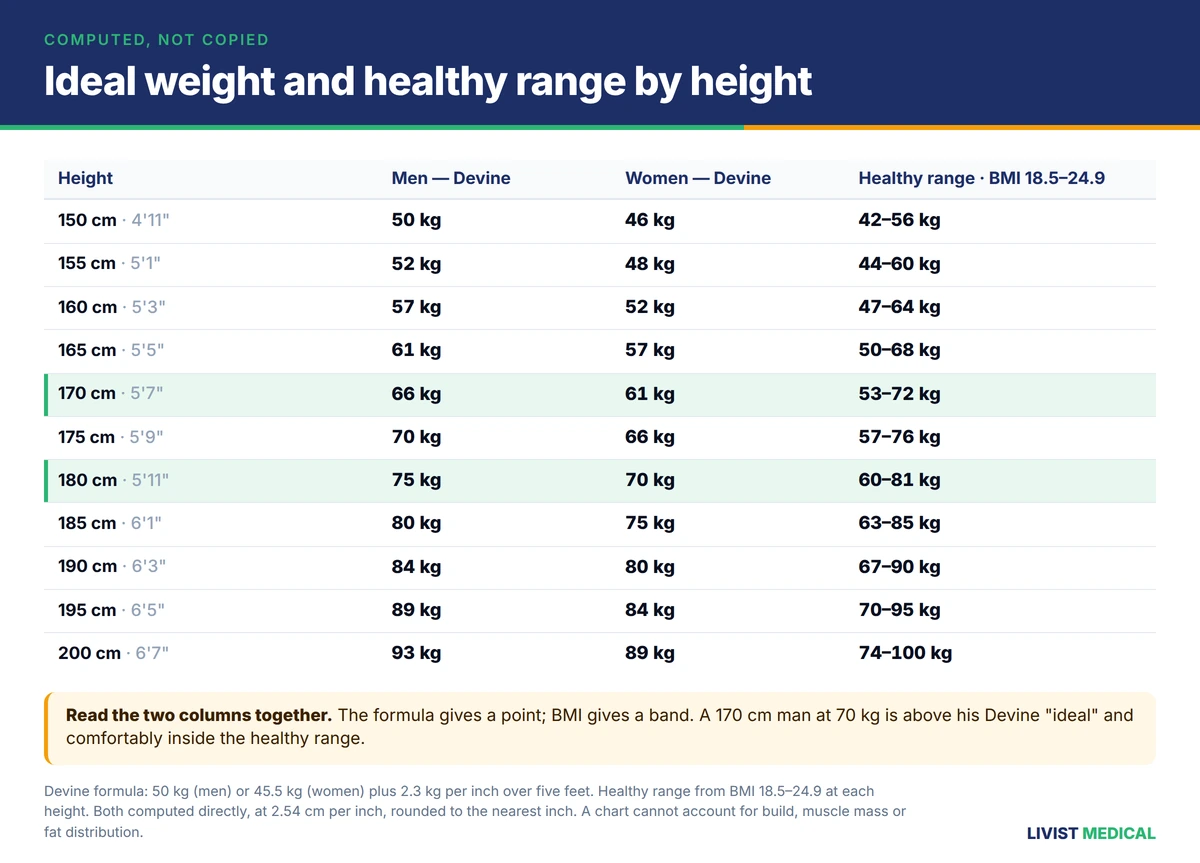
The chart below gives the Devine ideal weight for men and women at each height, alongside the healthy weight range defined by a BMI of 18.5 to 24.9. Read them together: the formula gives a single point, the BMI band gives a range, and a healthy weight is almost always a range.
| Height | Men — Devine | Women — Devine | Healthy range (BMI 18.5–24.9) | |
|---|---|---|---|---|
| 150 cm | 4'11" | 50 kg | 46 kg | 42–56 kg |
| 155 cm | 5'1" | 52 kg | 48 kg | 44–60 kg |
| 160 cm | 5'3" | 57 kg | 52 kg | 47–64 kg |
| 165 cm | 5'5" | 61 kg | 57 kg | 50–68 kg |
| 170 cm | 5'7" | 66 kg | 61 kg | 53–72 kg |
| 175 cm | 5'9" | 70 kg | 66 kg | 57–76 kg |
| 180 cm | 5'11" | 75 kg | 70 kg | 60–81 kg |
| 185 cm | 6'1" | 80 kg | 75 kg | 63–85 kg |
| 190 cm | 6'3" | 84 kg | 80 kg | 67–90 kg |
| 195 cm | 6'5" | 89 kg | 84 kg | 70–95 kg |
| 200 cm | 6'7" | 93 kg | 89 kg | 74–100 kg |
Devine values and BMI bands computed directly from the formulas. Heights converted at 2.54 cm per inch and rounded to the nearest inch.
Worked example, because this is the question people actually ask: is 75 kg overweight at 5'7"? That is 170 cm, so BMI is 25.9 — just inside the overweight band, and 9 kg above the Devine ideal. For a sedentary person that is a fair signal. For someone carrying visible muscle it means very little, because the scale cannot tell muscle from fat.

BMI is weight in kilograms divided by height in metres squared. It replaced ideal-weight formulas in clinical practice because it produces a band rather than a point, it applies to both sexes with one equation, and — critically — the thresholds that trigger treatment decisions are defined in BMI, not in kilograms.
| BMI | Category |
|---|---|
| Below 18.5 | Underweight |
| 18.5–24.9 | Healthy weight |
| 25.0–29.9 | Overweight |
| 30.0–34.9 | Obesity, class I |
| 35.0–39.9 | Obesity, class II |
| 40.0 and above | Obesity, class III |
Those class numbers are not academic labels. They are the exact language in which surgical eligibility is written — which is why the next section is the one that matters.

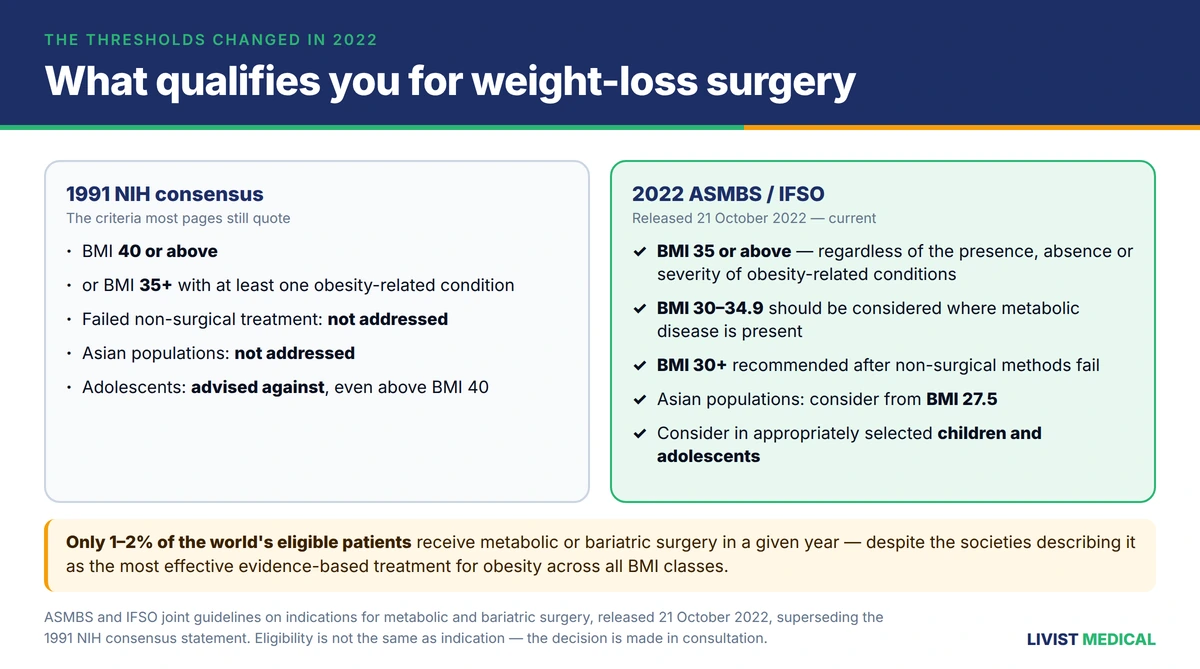
Under the 2022 ASMBS and IFSO guidelines, metabolic and bariatric surgery is recommended at a BMI of 35 or above regardless of whether any obesity-related condition is present, and should be considered from a BMI of 30 to 34.9 where metabolic disease exists. For Asian populations the guidelines suggest considering surgery from a BMI of 27.5.
Those thresholds were published on 21 October 2022 by the American Society for Metabolic and Bariatric Surgery together with the International Federation for the Surgery of Obesity and Metabolic Disorders. They replaced criteria that had stood since 1991.
| 1991 NIH consensus | 2022 ASMBS / IFSO | |
|---|---|---|
| Primary threshold | BMI 40 or above | BMI 35 or above — regardless of the presence, absence or severity of obesity-related conditions |
| With a related condition | BMI 35+ with at least one condition such as hypertension or heart disease | BMI 30–34.9 should be considered where metabolic disease is present |
| After failed non-surgical treatment | not addressed | BMI 30 or above recommended |
| Asian populations | not addressed | consider from BMI 27.5 |
| Adolescents | advised against, even above BMI 40 | consider in appropriately selected children and adolescents |
Why this matters practically: if you have a BMI of 36 and no diabetes, a page written to the 1991 criteria will tell you that you do not qualify. Under the current guidelines you do. And if your BMI is 32 with type 2 diabetes, the 1991 criteria excluded you outright; the 2022 guidelines say you should be considered.
The same guideline release carried a number worth sitting with: only 1 to 2 percent of the world's eligible patients receive metabolic or bariatric surgery in a given year — despite the societies describing it as the most effective evidence-based treatment for obesity across all BMI classes.
If your number falls in these bands, the procedures in question are sleeve gastrectomy and gastric bypass, with gastric banding in selected cases.

BMI is a population screening tool applied to individuals, and it fails in four predictable ways: it cannot distinguish muscle from fat, it ignores where fat is stored, it is not calibrated identically across ethnic groups, and it shifts in meaning with age. None of these make it useless — they make it a starting point rather than a verdict.
What to measure alongside it: waist circumference, blood pressure, fasting glucose or HbA1c, and lipids. Those four turn a number on a scale into a clinical picture — and they are what a bariatric assessment looks at before anyone discusses a procedure.
Eligibility is not the same as indication. Meeting a BMI threshold means surgery can be discussed; which procedure — if any — depends on your metabolic profile, your history, and what you can commit to afterwards.
| Your situation | What is usually discussed |
|---|---|
| BMI 40+, or 35+ | Sleeve gastrectomy or gastric bypass |
| BMI 35+ with type 2 diabetes | Bypass is often favoured for its metabolic effect |
| BMI 30–35 with metabolic disease | Surgery considered under the 2022 guidelines; also where weight-loss injections enter the conversation |
| BMI 27–35, wanting a non-surgical step | Intragastric balloon or gastric botox — temporary, and much weaker in effect |
| BMI below 27 | Neither surgery nor an endoscopic device is appropriate |
One thing worth planning for early: substantial weight loss frequently leaves loose skin, and what skin removal costs is a better conversation to have before the weight comes off than after. Our bariatric team will tell you which band you are actually in — and will say so plainly if the answer is none of the above.
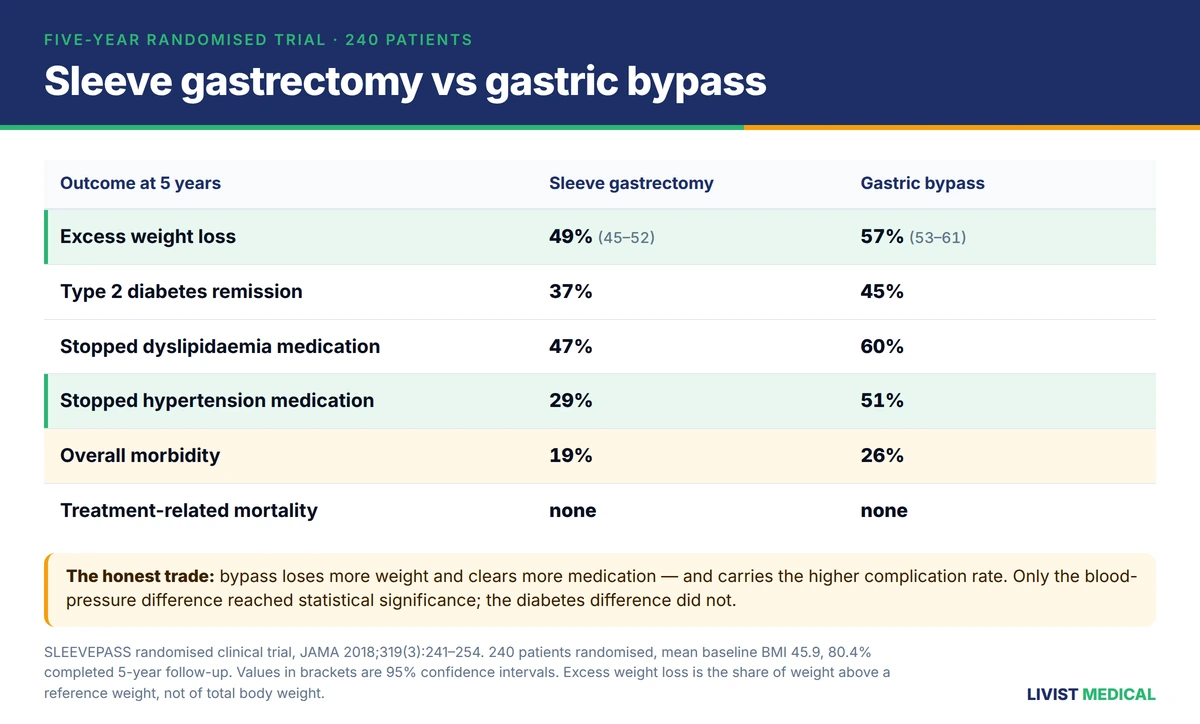
In a randomised trial that followed 240 patients for five years, sleeve gastrectomy produced 49% excess weight loss and gastric bypass 57% — a real 8-point difference in favour of bypass. Both figures are five-year results, not first-year results, which is the number that actually matters.
That trial, SLEEVEPASS, was published in JAMA in 2018. Its patients had a mean baseline BMI of 45.9, and 80.4% completed the full five years.
| Outcome at 5 years | Sleeve gastrectomy | Gastric bypass |
|---|---|---|
| Excess weight loss | 49% (95% CI 45–52) | 57% (95% CI 53–61) |
| Type 2 diabetes remission, complete or partial | 37% | 45% |
| Stopped dyslipidaemia medication | 47% | 60% |
| Stopped hypertension medication | 29% | 51% (statistically significant) |
| Overall morbidity | 19% | 26% |
| Treatment-related mortality | none | none |
How to read this honestly. Bypass loses more weight and clears more medication — and carries a higher overall complication rate, 26% against 19%. The diabetes difference did not reach statistical significance in this trial; the blood-pressure difference did. That is the actual trade, and any clinic presenting one procedure as simply "better" has skipped it.
And note what these numbers are not. Excess weight loss of 49% does not mean losing half your body weight — it means losing about half of the weight above your reference weight. For a 120 kg patient whose reference is around 70 kg, 49% of that 50 kg excess is roughly 25 kg. Percentages of excess weight always sound larger than the kilograms they represent, which is why they are the figure most often quoted in advertising.
Below the surgical thresholds, the evidence points to the unglamorous combination: a sustained calorie deficit, resistance training to protect muscle while losing fat, and enough protein and sleep to make the deficit tolerable. Nothing on this list is proprietary, and nothing works quickly.
The reason this section exists is that the gap between "I want to lose weight" and "I meet a surgical threshold" is where most people actually live — and it is also where most money gets wasted on procedures that were never going to help.
What the numbers realistically look like: a deficit of 500 kcal a day corresponds to roughly 0.5 kg a week. Faster than about 1 kg a week and an increasing share of what you lose is muscle and water rather than fat. Our guide to what is realistic in two weeks puts numbers on that.
And protect the muscle. Losing weight without resistance training lowers the number on the scale and worsens body composition — which is exactly the outcome BMI is blind to and the mirror is not.
Your ideal body weight by Devine is a pharmacy estimate wearing a health-goal costume. Your BMI band is more useful, and your BMI class is the number that actually decides anything — because eligibility for treatment is written in those classes and nowhere else.
If your BMI is under 30, no procedure on this site is the answer and the chart above is simply context. If it is 30 to 35 with a metabolic condition, or 35 and over, the 2022 guidelines say you are in a conversation that most pages — still quoting 1991 — would have told you that you were not.
This article is general information and not a diagnosis, a treatment recommendation, or a substitute for an examination. If you want your own numbers read properly, send us your height, weight and history and our team will tell you which band you are in and what — if anything — is worth considering. Our treatment packages set out what an assessment includes.
Bariatric SurgeryGastric botox is an endoscopic injection into the stomach antrum. A 56-patient trial recorded a mean 9 kg loss peaking near 60 days, plus five exclusions.
Bariatric SurgeryGastric botox vs gastric balloon judged on trial data: 15.6 kg vs 9.3 kg head-to-head, 30% vs 9% complications, plus 2026 costs in four countries.
Bariatric SurgeryTen pounds of fat is 35,000 calories — a 2,500 daily deficit for 14 days. What the scale can realistically do in two weeks, and how much of it is water.