 Dentistry
8
Do Fillings Hurt Without an Injection? Dentist AnswersDo fillings hurt without an injection? Shallow enamel cavities often don't; deeper ones do. Needle-free numbing, kids' options and 2026 filling costs.
October 25, 2026Read More
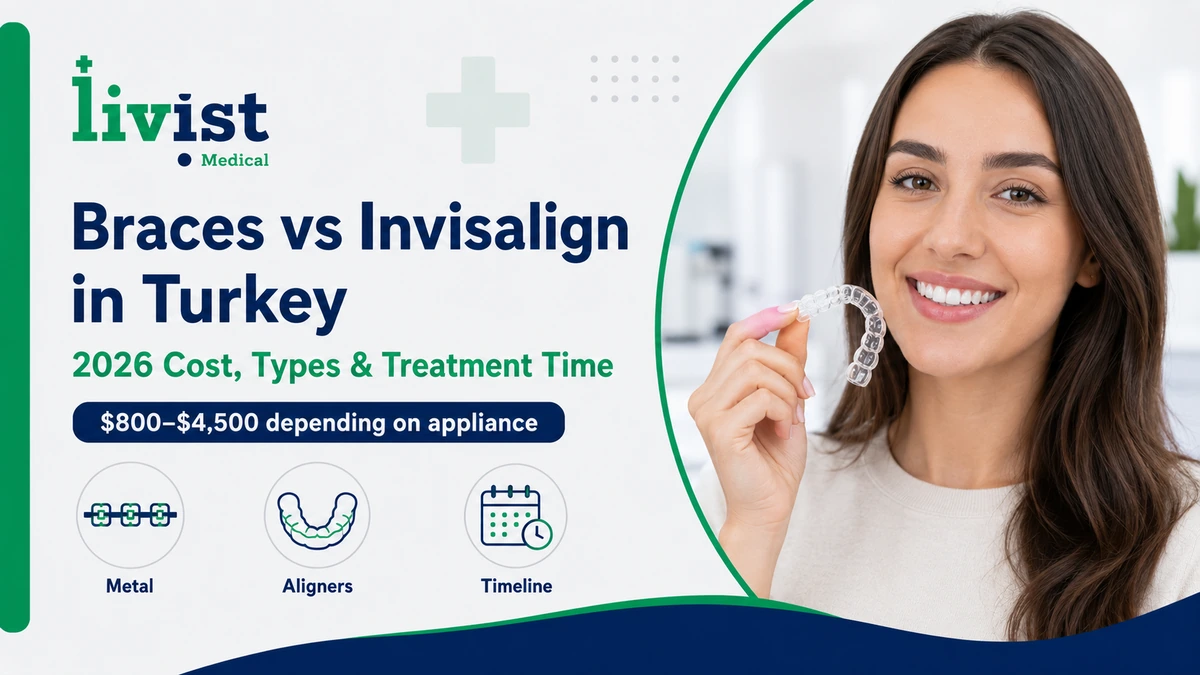
Braces in Turkey cost £600–£4,300 and Invisalign £1,200–£3,000 in 2026. Types compared with UK prices, overbite fixes, treatment time and retainers.
Braces in Turkey cost £600–£4,300 for a full course, depending on the appliance: metal braces £600–£1,700, ceramic £1,300–£2,200 and lingual £1,300–£2,600. A comprehensive Invisalign course costs £1,200–£3,000 ($2,000–$4,500). These are the clinic prices shown in Google's results for UK searchers in October 2026.
Written and medically reviewed by: Prof. Dr. Alev Özsoy — Dentistry and Oral Health, Medipol University Dental Hospital · Last updated: 26 October 2026
Quick summary:
Here is the number nobody puts next to them. Türkiye's official 2026 dental fee tariff — the schedule the Turkish Dental Association publishes for dentists in every province — prices a full course of Class I orthodontic treatment at 40,910 lira, about $851.
That gap is the most interesting thing about this subject, and this guide is mostly about reading it honestly: what the difference is buying, when it is worth paying, and the three clinical facts that matter more than any price — because the appliance you are being upsold to is not faster, is not always better, and the part of treatment that decides whether it works happens after you have flown home.
This guide is information, not medical advice. Orthodontic treatment is planned from radiographs and measurements, never from a price table.
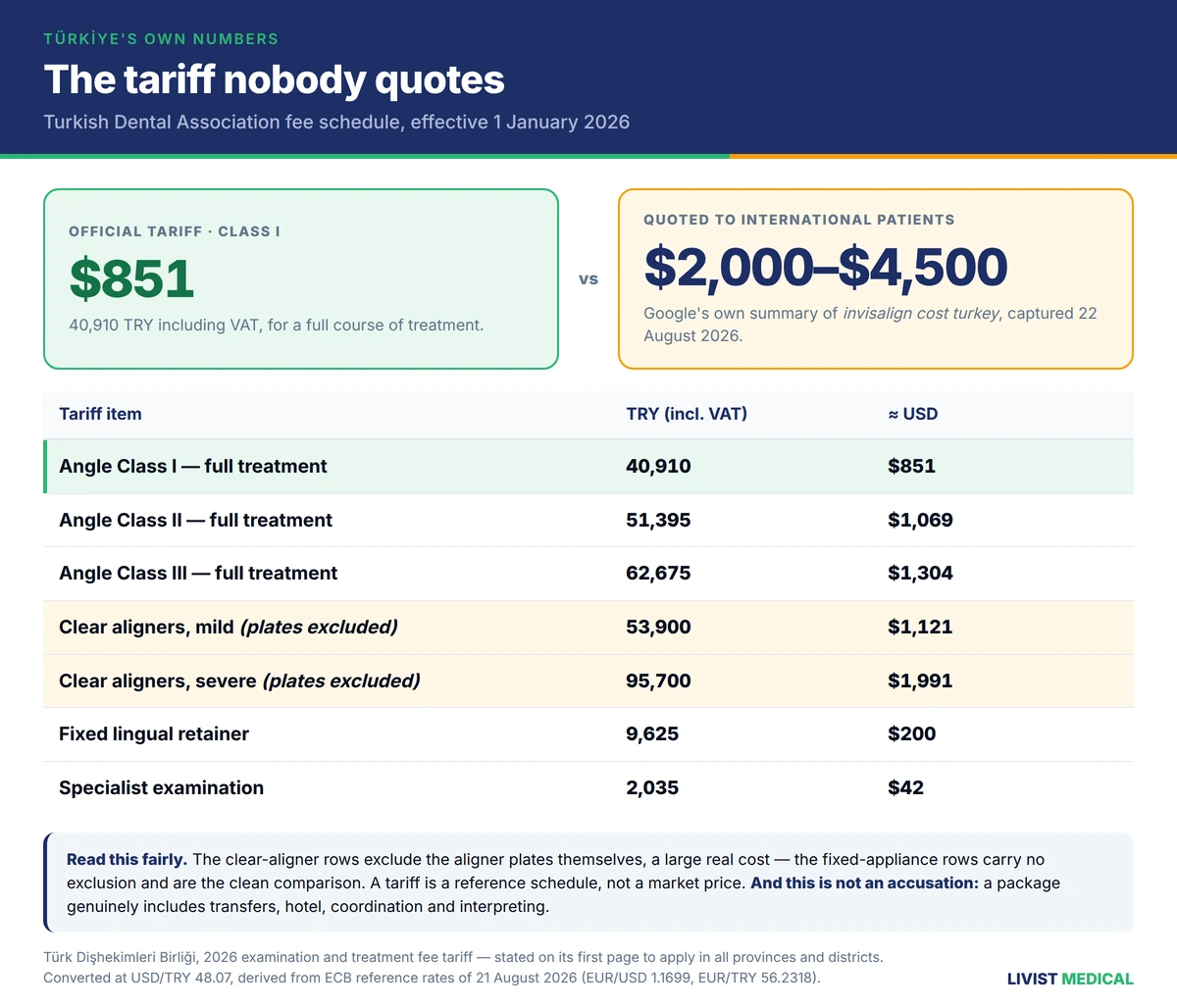
Braces in Turkey cost £600–£4,300 depending on the system, and a comprehensive Invisalign course costs £1,200–£3,000. The width of those ranges is itself the signal: there is no standard price, so a quote tells you about a clinic, not about a treatment.
| Braces or aligner type | Price in Turkey (GBP) | Note |
|---|---|---|
| Traditional metal braces | £600 – £1,700 | Most mechanically efficient, least discreet |
| Ceramic braces | £1,300 – £2,200 | Same mechanics with tooth-coloured brackets |
| Lingual braces (hidden) | £1,300 – £2,600 | Invisible from the front, harder to clean |
| Invisalign — comprehensive | £1,200 – £3,000 ($2,000 – $4,500) | Removable — results depend on wear time |
| Other clear aligner brands | £1,000 – £2,000 ($1,300 – $2,500) | Lower price, same compliance rule |
Prices are those shown in Google's results for UK searchers in October 2026. The clear aligner full-treatment package at Livist Medical starts at €3,150.
Orthodontics prices in Turkey are set mainly by the appliance and the complexity of the bite. Metal braces are the cheapest at £600–£1,700, ceramic and lingual braces sit in the middle, and Invisalign carries a brand premium over other clear aligners. Ask whether a quote covers both arches, retainers and every adjustment visit.
Clear aligners from other brands cost £1,000–£2,000 in Turkey, against £1,200–£3,000 for a comprehensive Invisalign course. The mechanics are similar; the difference is the brand, the planning software and how many refinement trays are included.
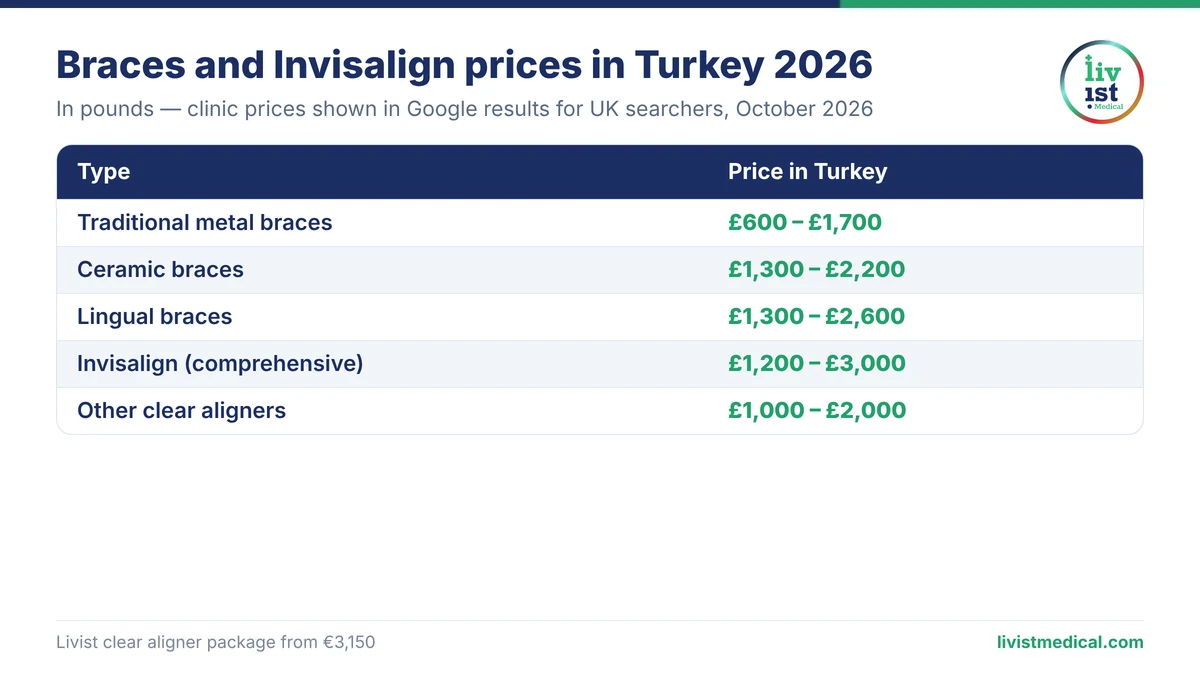
The Turkish Dental Association publishes an annual fee tariff for examination and treatment, stated on its own first page to apply in every province and district. The 2026 edition took effect on 1 January 2026. Converted at the European Central Bank's 21 August 2026 reference rate of 48.07 lira to the dollar, it prices Class I orthodontic treatment at $851 and Class III at $1,304.
| Tariff item | Lira (incl. 10% VAT) | ≈ USD |
|---|---|---|
| Angle Class I — full orthodontic treatment | 40,910 | $851 |
| Angle Class II — full orthodontic treatment | 51,395 | $1,069 |
| Angle Class III — full orthodontic treatment | 62,675 | $1,304 |
| Lingual technique, Class I | 41,965 | $873 |
| Clear aligners — mild (plates excluded) | 53,900 | $1,121 |
| Clear aligners — moderate (plates excluded) | 69,300 | $1,442 |
| Clear aligners — severe (plates excluded) | 95,700 | $1,991 |
| Fixed lingual retainer | 9,625 | $200 |
| Removable retainer (Hawley type) | 6,765 | $141 |
| Specialist examination | 2,035 | $42 |
| Panoramic radiograph | 2,040 | $42 |
Three things must be said in the same breath as those numbers, or the comparison is dishonest.
First, the clear-aligner rows exclude the aligner plates themselves. The tariff says so explicitly. For an Invisalign case the laboratory fee for the aligner series is a large, unavoidable cost, so those three rows are not comparable to a clinic's all-in quote. The fixed-appliance rows carry no such exclusion, which is why Class I, II and III are the clean comparison.
Second, a tariff is a reference schedule, not a market price. It is what the profession publishes as a guide, not what any given practice charges or what the market clears at.
Third, none of this is an accusation. A package quoted to an international patient covers things the tariff never contemplated.
The honest answer is: coordination, and a different tier of practice. Airport transfers, hotel nights, interpreting, a patient coordinator, evening and weekend scheduling, imaging bundled rather than itemised, and a clinic set up to compress a workflow into a three-to-five-day visit. Those are real costs and real value.
But they are worth naming, because once you can see the two numbers you can ask a question that changes the conversation: which parts of this quote are treatment, and which parts are logistics I could arrange more cheaply or do not need?
Some patients want the whole package and should buy it. Others already have somewhere to stay in Istanbul, or would rather book their own hotel, and are paying for a bundle they will not use. Neither is wrong. What is wrong is not knowing the split — and no clinic that itemises honestly will mind being asked. If you want ours itemised, ask our team and we will send it broken out.
There is a second reason to know the tariff exists: it prices the parts everyone forgets. A fixed retainer is $200 on the tariff. A specialist examination is $42. If a quote is silent on retainers and follow-ups, those items have not vanished — they have simply been left for you to pay later, at home, in a more expensive market.
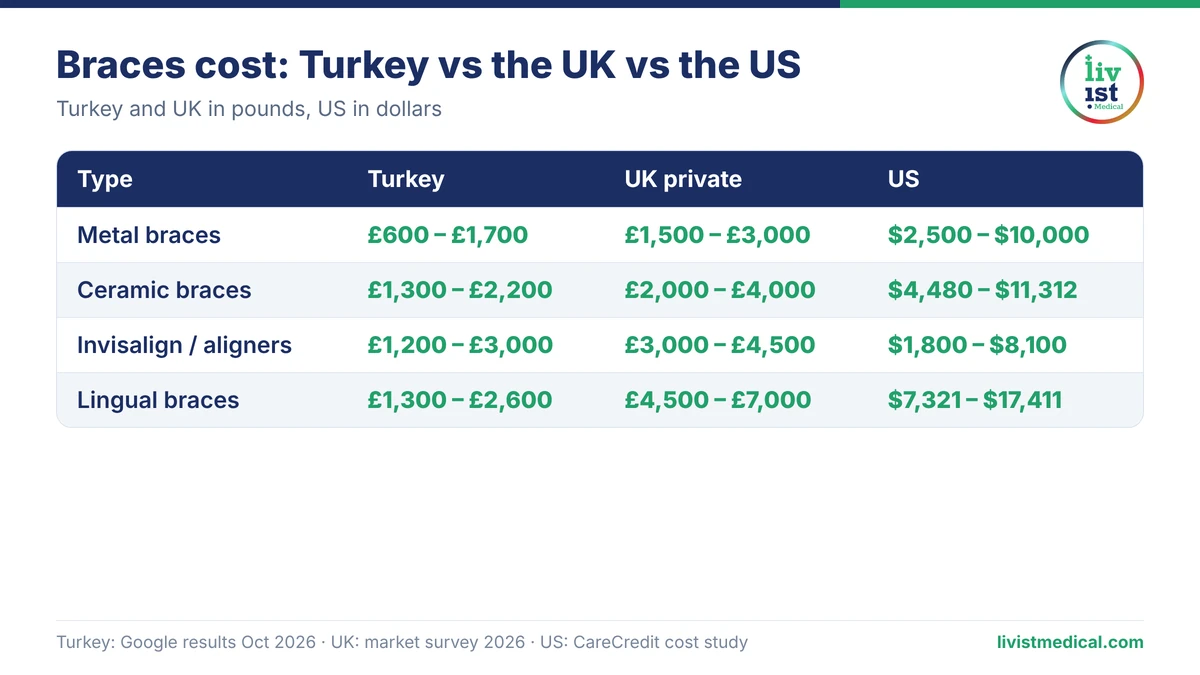
Against the UK's private market, the Turkish saving is real: metal braces cost £600–£1,700 in Turkey against £1,500–£3,000 privately in the UK, and Invisalign £1,200–£3,000 against £3,000–£4,500. The saving narrows once travel, accommodation and repeat visits are added, and narrows further if follow-up has to be bought again at home.
| Braces type | Turkey (GBP) | UK private (GBP) | US (USD) |
|---|---|---|---|
| Traditional metal braces | £600 – £1,700 | £1,500 – £3,000 | $2,500 – $10,000 |
| Ceramic braces | £1,300 – £2,200 | £2,000 – £4,000 | $4,480 – $11,312 |
| Invisalign / clear aligners | £1,200 – £3,000 | £3,000 – £4,500 | $1,800 – $8,100 |
| Lingual braces | £1,300 – £2,600 | £4,500 – £7,000 | $7,321 – $17,411 |
Where these come from: Turkey is the clinic pricing shown in Google's results for UK searchers in October 2026. The UK figures are a published market survey updated April 2026 — typical market ranges, not an official schedule. The US figures come from the Average Procedural Cost Study conducted by ASQ360° Market Research for Synchrony's CareCredit, covering all fifty states and DC, using 2023–2024 cost tables; being two years old, they understate today's prices rather than overstate them.
One structural point the tables hide: in England, orthodontic treatment remains free on the NHS for under-18s who meet the clinical criteria. The private prices above are what adults, and children who do not qualify, actually face. That is why the medical-tourism market in orthodontics is overwhelmingly adult.
No — not according to the evidence. A systematic review published in Clinical Oral Investigations in April 2024 screened 3,537 articles, included ten studies, and found no significant difference in treatment duration between clear aligners and fixed appliances in mild to moderate crowding. The authors graded the certainty of that evidence as low and did not pool it, because the studies were too inconsistent.
A larger review agrees. Published in the European Journal of Orthodontics in October 2025 and covering 15 trials and 1,084 patients, it found no significant difference in either quality or duration for non-extraction cases. Its sensitivity analyses hinted at shorter treatment with aligners — a hint, not a finding.
So when a quote presents clear aligners as the faster option and prices them accordingly, that premium is buying discretion and comfort, which are legitimate things to want. It is not buying time. Your treatment length is set by how complex your case is and how well you comply, not by the appliance and not by the country. Any clinic that promises you a duration before reading your radiographs is selling a promise, not a plan.
In extraction cases specifically, the 2025 European Journal of Orthodontics review found that fixed appliances delivered better treatment quality, attributed to their more precise control of tooth movement. That is the opposite of how the two options are usually sold.
The reason is mechanical. When a tooth is extracted to create space, the roots — not just the crowns — have to move bodily to close that space in parallel. Generating that force and moment through a removable plastic tray is difficult, however well designed the tray is.
The practical rule: if your plan involves extractions and the clinic still recommends clear aligners, ask for the reasoning in writing. There may be a perfectly good case-specific answer. It should be stated, not assumed because aligners are the premium product. This is exactly the conversation our orthodontics page is built around.
Yes, Invisalign can correct a mild to moderate overbite when the cause is the position of the teeth rather than the jaw. For deep bites the evidence is weaker: a 2026 systematic review in the Journal of Orofacial Orthopedics found aligners viable for mild to moderate open bite but described their efficacy for deep bite as still limited.
A 2026 scoping review of 119 studies in Frontiers in Dental Medicine puts a number on it: early-generation aligner studies achieved only 28%–55% of the planned overbite reduction, and refinements were often needed. If your overbite is skeletal or severe, ask the orthodontist whether fixed braces would give more predictable control, and get the answer in writing.
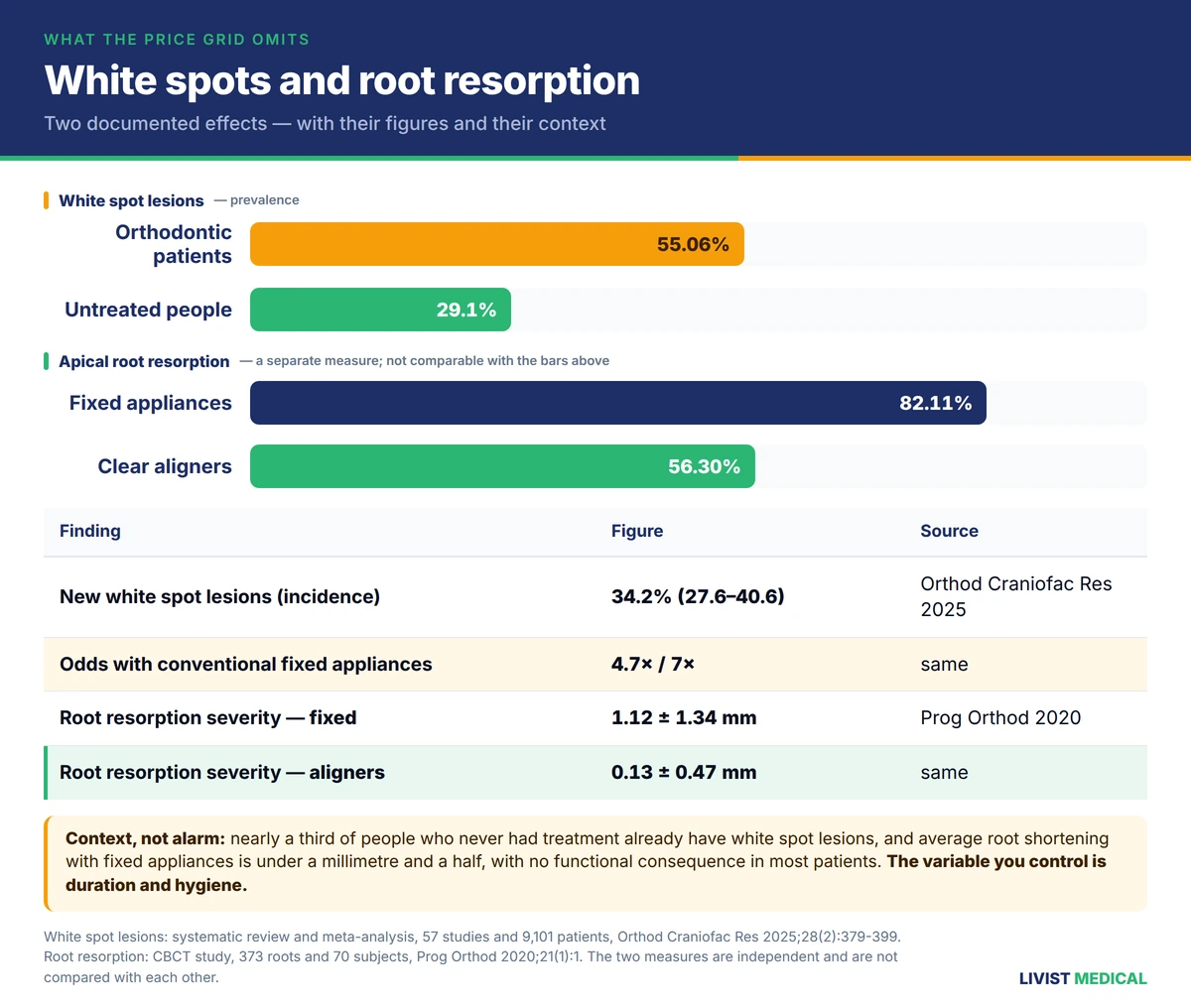
Orthodontic treatment is safe and effective, and it also has two well-documented costs that no price page in this market mentions: demineralisation of enamel around the brackets, and shortening of the root tips. Both are measured, both are reducible, and knowing they exist is the first condition for reducing them.
| Finding | Figure | Source |
|---|---|---|
| White spot lesions — prevalence | 55.06% in orthodontic patients (95% CI 47.7–63.6) vs 29.1% in untreated people | SR + meta-analysis, 57 studies, 9,101 patients, Orthod Craniofac Res 2025 |
| White spot lesions — new incidence | 34.2% (27.6–40.6) | same |
| Odds with conventional fixed appliances | 4.7× vs other appliances · 7× vs no treatment | same |
| Relationship with duration | prevalence rises the longer treatment runs (p<0.001) | same |
| Apical root resorption — prevalence | 82.11% with fixed vs 56.30% with aligners (P<0.001) | CBCT study, 373 roots, 70 subjects, Prog Orthod 2020 |
| Root resorption — severity, fixed appliances | 1.12 ± 1.34 mm | same |
| Root resorption — severity, clear aligners | 0.13 ± 0.47 mm | same |
Read these in context rather than in alarm. Nearly a third of people who never had orthodontic treatment already have white spot lesions, so not all of that 55% is caused by braces. Average root shortening with fixed appliances is under a millimetre and a half, and in the great majority of patients has no functional consequence.
And note which variable you actually control. It is not the appliance — it is duration and hygiene, and both improve with regular, competent supervision. Which brings us to the part of this subject that decides everything.
When the appliance comes off, retention begins, and it is neither optional nor short. A Cochrane review updated in May 2023 covering 47 studies and 4,377 participants could not recommend any one retention approach over another, because the evidence is low or very low certainty. The practical conclusion is not that retention does not matter — it is that no retainer is proven best, so what matters is that a retainer plan exists and someone can service it.
The head-to-head differences the review did find were small and offsetting. Part-time removable retainers allowed 0.92 mm more relapse than bonded fixed retainers (95% CI 0.23–1.61) — a difference the reviewers judged not clinically significant. Removable retainers caused more discomfort (RR 12.22) but failed less often (RR 0.44) and were better for gingival health (GI −0.34).
Here is why this is the decisive section for anyone treating abroad. A bonded retainer is a thin wire glued behind your front teeth, and over the following years it detaches, breaks and needs re-bonding. A removable retainer gets lost, warps and needs remaking. Neither can be handled over WhatsApp from Istanbul.
So before you pay any deposit, settle three questions. Who removes the appliance? Who makes the retainer and hands it to you? And who, in your own city, fixes it when it fails? If those three answers are not clear and in writing, you are not buying a complete treatment — you are buying the first part of one and improvising the rest.
None of this is an argument against treatment in Türkiye. It is an argument for planning it as a two-year commitment rather than a holiday. Send us your existing plan and this is the first thing we will look at.
The NHS, in guidance reviewed on 29 June 2026, states that fixed braces are usually worn for one to two years. That range is set by case complexity and patient compliance, and no appliance type has been shown to compress it meaningfully.
In practice that means roughly twelve to twenty-four adjustment visits, one every four to eight weeks. That is the number to calculate before you calculate the price of the appliance: how many trips, and who supervises you between them?
Some clinics address this with a hybrid model — fitting and initial adjustment in Türkiye, shared supervision with a clinician at home, and a small number of return visits for the critical stages. That is an entirely legitimate arrangement, provided it is written into the plan from the start and both clinicians agree to it, rather than improvised after the brackets are on.
This is where orthodontics differs from most dental tourism. Dental implant packages work well across two spaced visits because osseointegration happens on its own. Restorative work like veneers, crowns or a Hollywood smile is delivered inside a single trip. Composite bonding, whitening and same-day CEREC restorations are shorter still. Orthodontics is the exception: it needs repeated human intervention for the entire duration. Do not reason from one to the other.
These are not price-negotiation questions. They are the questions that reveal whether you are looking at a treatment plan or a sales quote. A serious clinic answers all nine in writing, within a working day.
Ask for the answers in writing. A clinic that answers all nine on paper is a clinic that has actually read your case — which is where our orthodontic assessment starts, and why our clinicians review radiographs before quoting anything. If you want to compare what is inside different offers, our treatment packages are itemised for the same reason.
Cavities are usually filled before braces or aligners go on; here is what a filling feels like without an injection.
Braces and Invisalign in Türkiye genuinely cost less — £600 to £4,300 for braces and £1,200 to £3,000 for Invisalign, against UK and US prices several times higher. The saving is real, and Türkiye's own 2026 dental tariff, which prices Class I treatment at about $851, shows there is room in it. What you pay above that is buying logistics and a tier of practice, and it is a fair thing to buy once you can see what it is.
But three clinical facts should move your decision more than any of those numbers. Clear aligners are not faster. Fixed appliances are better in extraction cases, not worse. And more than half of orthodontic patients develop white spot lesions, with the risk rising the longer treatment runs.
Above all: the decisive question in treating orthodontics abroad is not the fitting — it is everything after it. Who removes the appliance, who makes the retainer, and who repairs it in your own city over the years that follow. Treatment planned around those three answers works as well in Istanbul as anywhere. Treatment that ignores them fails anywhere, at any price.
This article is general information, not medical advice, and not a substitute for an orthodontic examination. Everything above is published market data and study findings, not a quotation for your case. If you have a treatment plan or radiographs, send them to us and we will review them with you before you decide.
Medical sources opened for this update: NHS — Orthodontics. Cochrane Database Syst Rev 2023 — Retention procedures after orthodontic braces (PMID 37219527). Effectiveness of aligners to correct vertical malocclusions in adult patients: systematic review. J Orofac Orthop. 2026 (PMID 42635677). Clear aligner therapy: a scoping review. Front Dent Med. 2026 (PMID 42516363).
Related reading: Dental implant packages in Turkey · A1 vs B1 tooth colour · Digital smile design · Dental veneers
DentistryDo fillings hurt without an injection? Shallow enamel cavities often don't; deeper ones do. Needle-free numbing, kids' options and 2026 filling costs.
 Dentistry
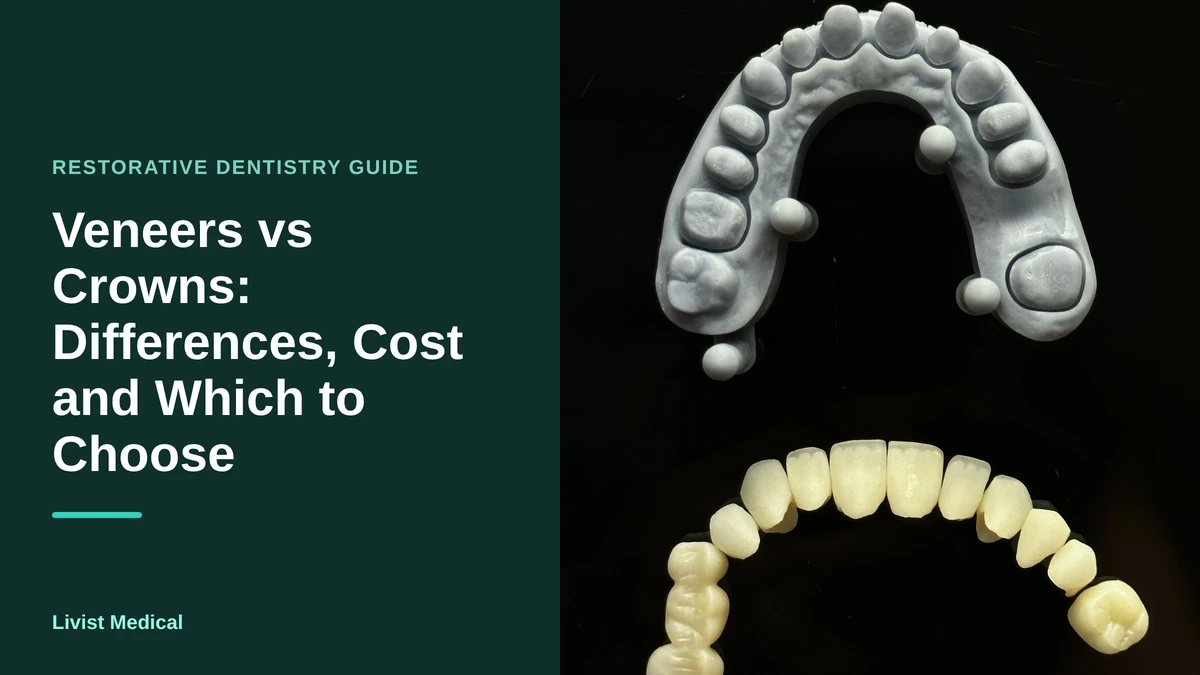
Veneers vs crowns: coverage, how much tooth is removed, lifespan and cost in the US and Turkey, plus when each one is the right choice for your teeth.
 Dentistry
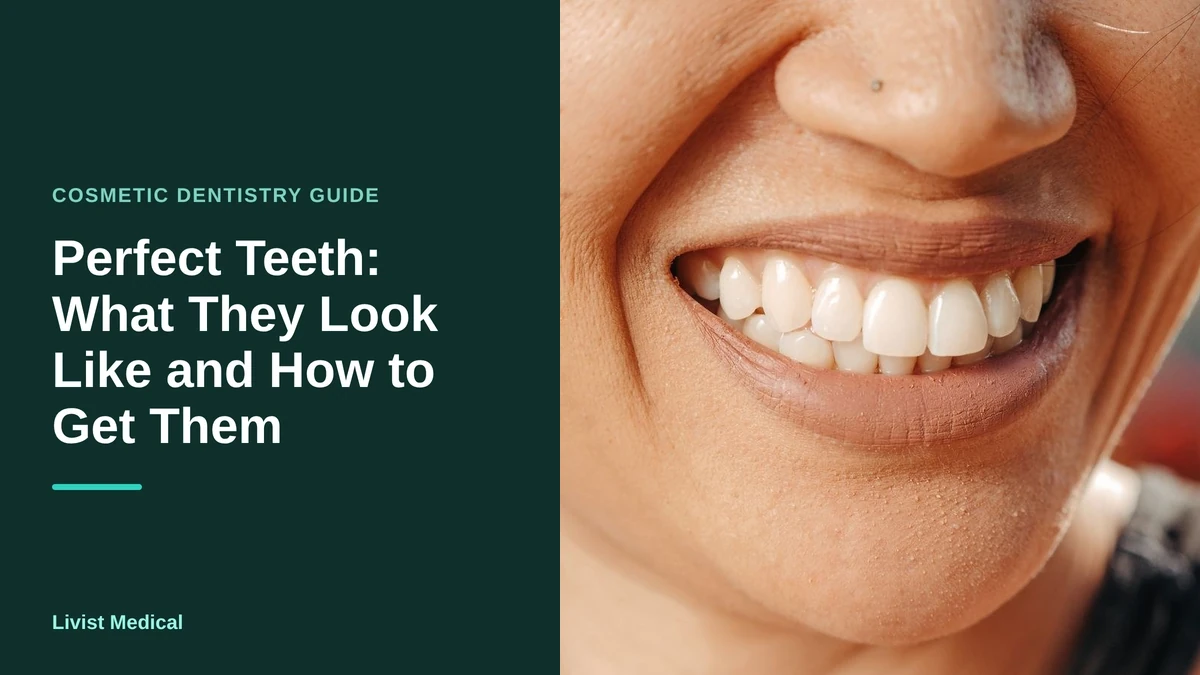
Perfect teeth explained: the 6 features dentists measure, how rare naturally straight teeth are, what people really notice, and how to get a perfect smile.