Matt Rife Before and After: What Actually Changed
Plastic Surgery

Matt Rife Before and After: What Actually Changed

August 18, 2026
9
Share Article :

Matt Rife Before and After: What Actually Changed

Matt Rife before and after: what the photos show about his teeth and jaw, what he has actually said, and what puberty alone can explain.

Side-by-side photos of Matt Rife between 2015 and 2026 show two changes most people notice: a straighter, brighter, more uniform smile, and a more defined jawline and cheekbones. The smile change is consistent with cosmetic dental work such as veneers. The facial change has more than one possible explanation, including normal male facial development, body-fat loss and muscle gain through his twenties.

Matt Rife before and after: what the photos show

Photographs taken a decade apart show three visible differences: teeth that are whiter, straighter and more even; a jawline and chin that read as sharper; and a leaner, more muscular frame. None of that confirms a procedure. Matt Rife has not publicly confirmed any cosmetic treatment, and this page separates image from claim.

Almost every page ranking for matt rife before and after blurs four categories together. This one keeps them apart, because the difference matters medically and legally:

  • What the photographs show — evidence of appearance, not of intervention.
  • What he has confirmed publicly — on cosmetic procedures, nothing.
  • What clinicians with no connection to him have speculated — commentary, not diagnosis.
  • What normal male facial development does between 19 and 29 — the alternative explanation half the online discussion demands and almost nobody explains.

One technical caveat gets ignored throughout: a 2015 broadcast clip and a 2026 studio portrait are not comparable images. Focal length alone changes how a jaw reads — a wide lens close to the face broadens the lower third, a longer lens narrows it. Add lighting and retouching, and an unchanged face can look like two people.

A timeline of his appearance

Matt Rife was born in September 1995, making him 19 when he began appearing on Wild 'N Out in 2015 and 30 at the time of writing. The visible change is not one jump between two photographs. It is spread across roughly eight years, which is itself an important clue about what caused it.

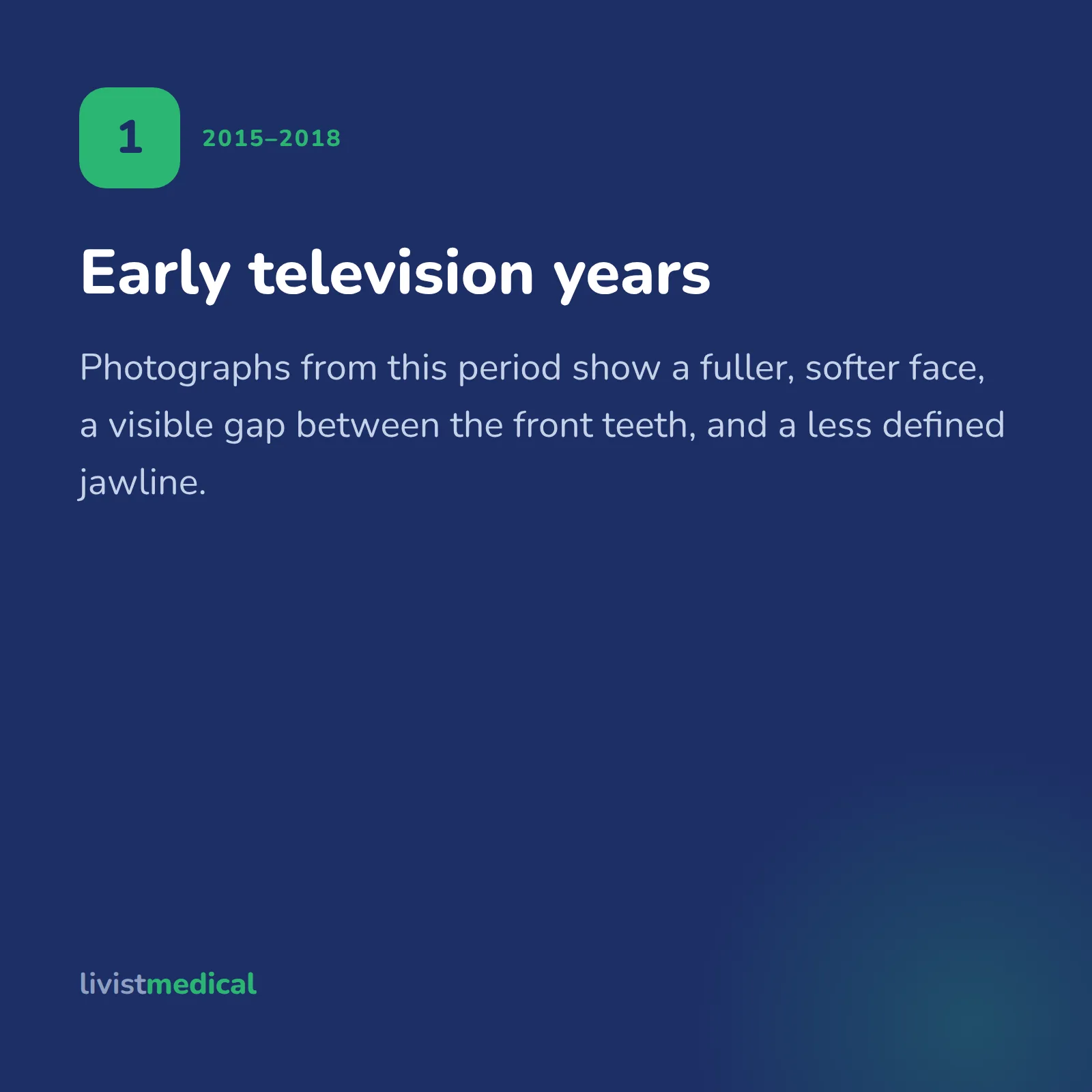
2015–2018: the Wild 'N Out years

This period supplies almost every image used in before comparisons and in searches for matt rife before fame: fuller cheeks, softer definition through the lower face, and a smile with visible irregularity in shade, alignment and edge shape. Most are broadcast stills lit flat and frontally — the lighting least likely to show structure.

2019–2022

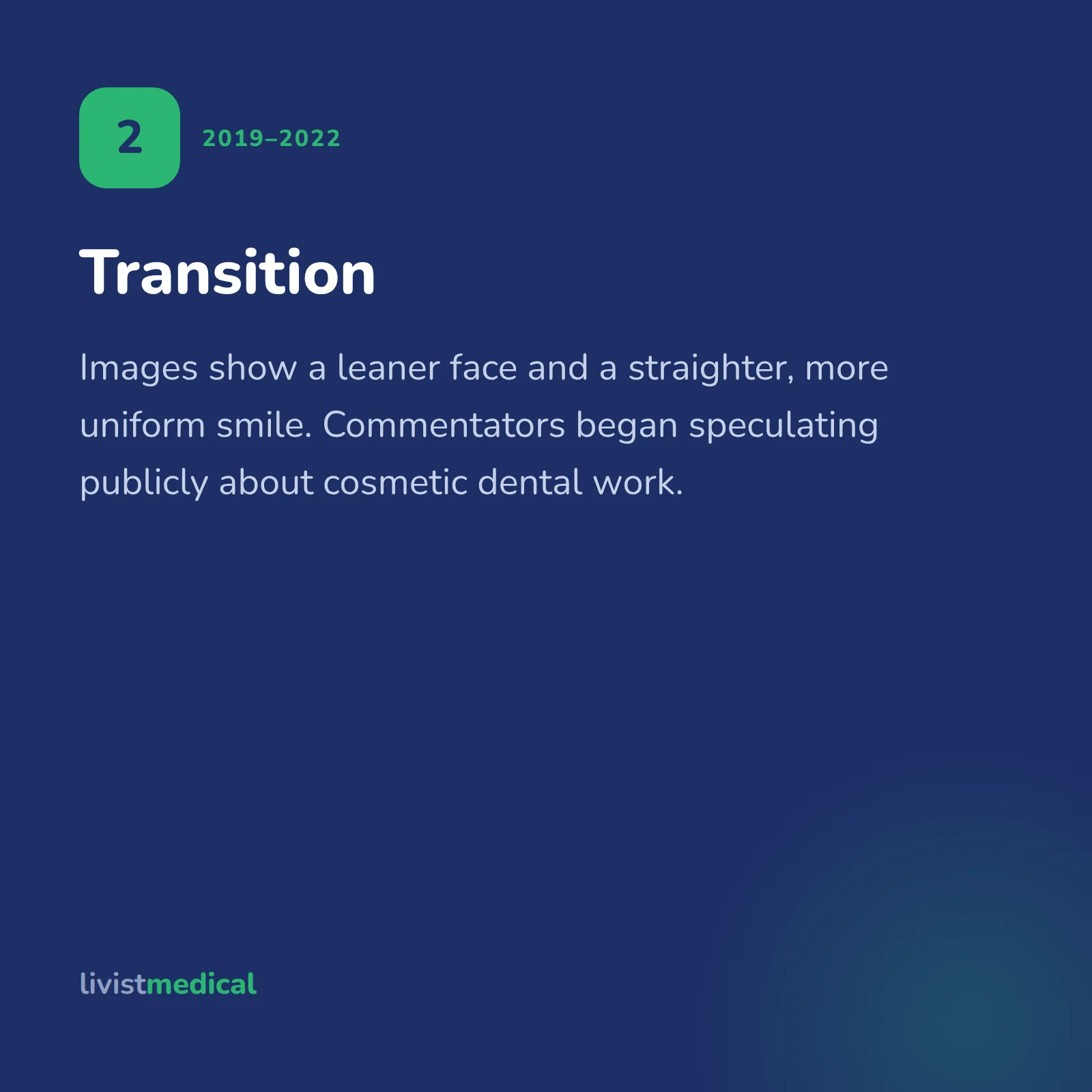
The quieter stretch, and the one competitors skip. Public images show a gradual shift: reduced fullness through the cheeks and under the chin, alongside a clear change in body composition. This is also the window in which any dental work would most plausibly sit, because the later smile differs from the 2015 smile in ways no weight change can produce.

2023–2026

A Netflix special in late 2023 made him a mainstream name, and the matt rife glow up conversation exploded across TikTok, Instagram and Reddit. Notice what changed versus what merely became visible: grooming, styling and high-end photography arrived at once. That is a production change, not a facial change, and the two are constantly confused.

Timeline card one: 2015 to 2018, the early television years

Timeline card two: 2019 to 2022, a leaner face and a more uniform smile

Timeline card three: 2023 to 2024, wider attention and public discussion

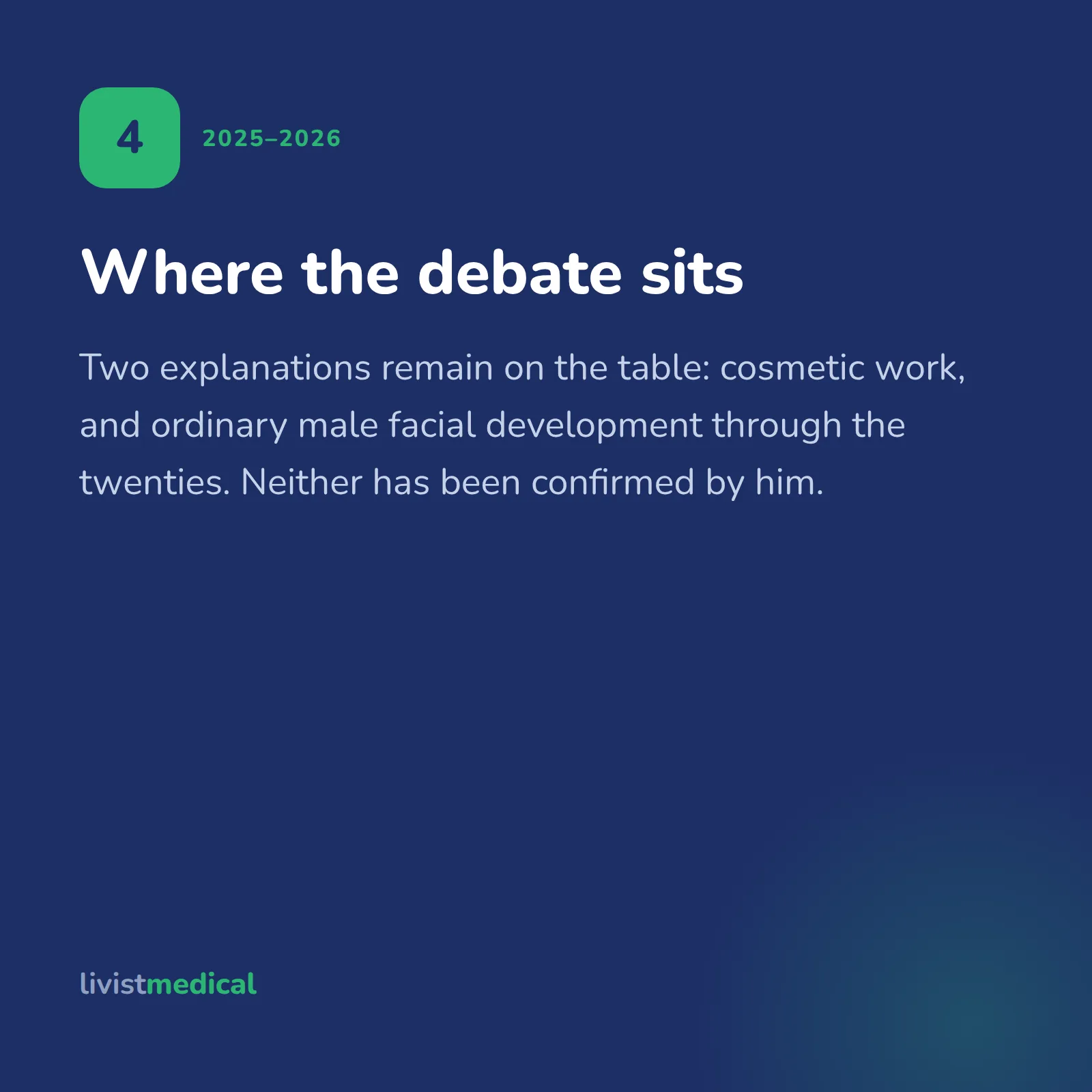
Timeline card four: 2025 to 2026, where the debate currently stands

The teeth: the most visible change

The dental difference is the clearest thing in any Matt Rife comparison and the hardest to explain otherwise. Teeth do not straighten, lengthen or become uniform in shape and shade through weight loss, training or ageing. Photographs show a smile that differs from earlier images in alignment, colour and edge geometry.

The later smile has the characteristics dentists associate with restorative work: even tooth-to-tooth width, a consistent shade with little natural variation, a regular incisal edge line and symmetrical proportions. Those cannot identify which treatment produced them — whitening plus orthodontics can look similar to veneers in photographs. The same veneer questions came up with Miley Cyrus, where a decade of images produced confident public conclusions that were never confirmed.

What veneers actually do

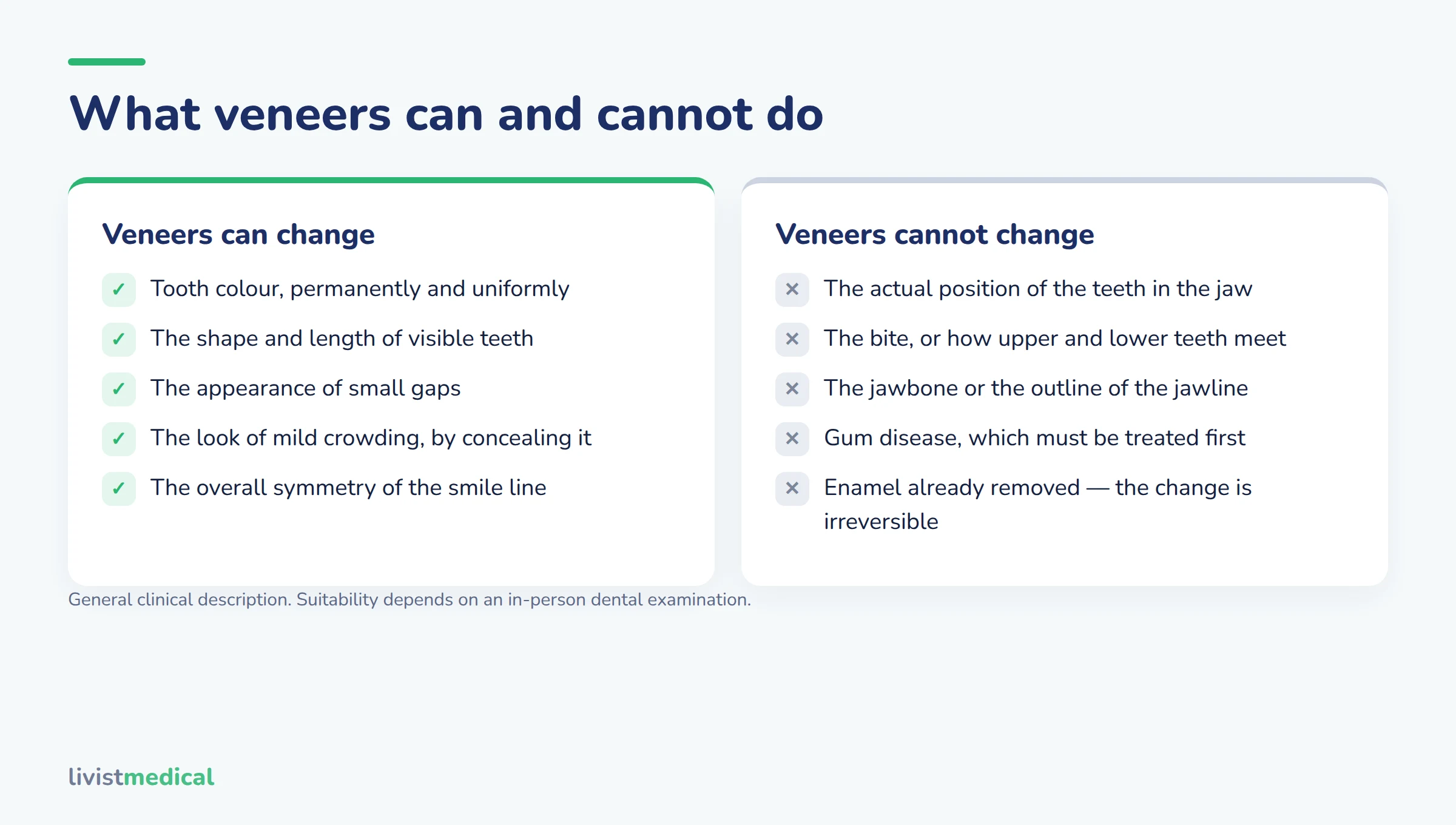
A veneer is a thin shell of porcelain or composite resin bonded to the front of a tooth. It changes colour, shape, length and apparent alignment. It is a covering, not a correction: the tooth underneath keeps its position and root.

The detail celebrity coverage never mentions is that porcelain veneers usually require irreversible preparation. Roughly 0.3 mm to 0.7 mm of enamel is reduced from each tooth so the shell sits flush. That enamel does not regenerate, so the tooth needs a veneer or crown permanently. Porcelain is commonly cited as lasting ten to fifteen years, composite less.

The limits matter too. Veneers cannot treat gum disease or decay beneath the surface, cannot move a misplaced tooth without over-contouring, and cannot compensate for a bite problem. Placed over a skeletal or orthodontic issue, they fail early or look artificial.

What veneers cost in 2026

Our live price research, carried out on 14 August 2026, did not locate a dated, published 2026 veneer price from a primary clinical or professional source. Rather than estimate, we state that openly.

What can be described is what drives the price: material, the number of teeth treated (a smile makeover is usually eight to ten upper teeth, not two), whether a diagnostic wax-up is included, and whether temporaries and follow-up adjustments sit inside the quote. Teeth count and material make published figures non-comparable.

What dental veneers can and cannot change

The jaw: surgery, filler, or puberty?

The jawline is where the argument is unresolved, and where search demand concentrates. Photographs show more definition along the mandible and under the chin. Three explanations fit — a cosmetic intervention, normal maturation of the male face, or a change in body composition — and none can be confirmed from images.

They are not mutually exclusive; across a decade, more than one is usually operating at once. Zac Efron is a comparable case where the jaw was the talking point, and instructive because years of confident speculation there ran in a direction that later proved to have a non-cosmetic explanation.

What male facial development does between 19 and 29

The male face does not finish developing at 18. Three biological processes continue through the twenties, and together they can produce a substantial jawline change with no intervention.

Bone maturation. The mandible is the last major facial bone to finish growing, and remodelling of the jaw angle and chin continues into the early-to-mid twenties in men, driven partly by androgen exposure. Longitudinal cephalometric studies show measurable mandibular change well beyond age 18 in males — small in millimetres, but the lower face is where millimetres show.

Body-fat loss. The buccal fat pad and the submental compartment sit directly over the structures people read as jawline. Facial fat distribution shifts through the twenties independently of body weight, and fat reduction thins those compartments disproportionately. Losing ten to twenty pounds of fat in the mid-twenties frequently sharpens the mandibular border on its own.

Muscle gain. Resistance training changes the face indirectly, through neck development altering the head-to-neck outline, and directly, because masseter bulk affects apparent jaw width. Habitual clenching or heavy chewing increases masseter volume over years, and the effects compound.

Stacked across ten years, these three routinely produce before-and-after pairs that look surgical and are not. That is not proof nothing was done — it is proof that photographs alone cannot settle the question.

What jaw contouring procedures exist

For readers evaluating options rather than a celebrity, the field divides cleanly. Non-surgical: hyaluronic acid filler along the mandibular border and chin, lasting twelve to eighteen months; injectable deoxycholic acid for submental fat; and botulinum toxin into the masseter, which slims a wide jaw rather than sharpening a soft one. Surgical: submental liposuction, chin implants, sliding genioplasty and orthognathic surgery.

The distinction that matters is fat versus bone. Filler and fat reduction change the soft-tissue envelope; only implants, genioplasty and orthognathic surgery change the skeleton. Choosing the wrong category is the commonest reason jawline treatment disappoints. Our guide to non-surgical options for the jaw and chin area covers where soft-tissue treatment works. If you are unsure which applies to your own face, ask what would actually change your profile first.
What Matt Rife has said himself

On the record, Matt Rife has not publicly confirmed any cosmetic dental or facial procedure. That absence is the most important fact on this page, and it is why every observation above is framed as observation rather than conclusion. No statement attributed to him is reproduced here.

What circulates widely is a body-composition claim: social posts credit him with a transformation of around 25 pounds. We could not verify that against a primary interview, so it is reported as what it is — a repeated social media claim, not a confirmed number, and one about body weight rather than his face or teeth.

What surgeons who have not treated him have suggested

Several clinicians with no professional relationship to Matt Rife have offered public commentary on his photographs. Commentators have speculated about dental veneers, and surgeons who have never examined him have suggested that cheek or jawline volume may have been augmented. None of this is a diagnosis, and no clinician is named here.

Such commentary reads shadow patterns, light break points along the mandibular border, midface transition and tooth proportion. Those are genuine skills — applied to compressed, retouched images of someone never examined, with no bite analysis or imaging. The failure rate runs both ways. Our piece on how surgeons read celebrity before-and-afters explains when those cues stop being reliable.

Procedures and costs mentioned in this discussion

The procedures named in this discussion split into two groups: dental treatments that change the smile, and soft-tissue or skeletal treatments that change the jawline. The table below states what each one actually does and what it costs, with the source and its date named in every row. Prices are converted at 1 GBP = 1.35 USD and 1 USD = 47.763 TRY, the rate published by Exchange-Rates.org for 12 August 2026.

Two cautions before reading it. Figures published by the American Society of Plastic Surgeons are surgeon's fee only and carry no year on the page. The Turkish Dental Association guide tariff is a recommended domestic fee schedule and sits well above what international patients are actually quoted, so both numbers appear side by side rather than merged.

Procedure What it actually does 2026 price range Source
Porcelain veneers (per tooth) Bonds porcelain shells to prepared teeth, changing colour, shape, length and apparent alignment. Requires irreversible enamel reduction. Turkey $173–$405; official Turkish guide tariff $553. UK $675–$1,350. US national average $1,765 Turkish Dental Association 2026 guide tariff; TreatCompare UK survey of 1,622 practices, May 2026; CareCredit, from a 2023–24 procedural cost study
Full upper arch of veneers Six to ten veneers across the visible upper teeth — the treatment usually meant by a “smile makeover”. UK $4,050–$13,500 depending on tooth count. US average $15,486 for six to eight teeth, range $5,700–$24,500. No published Turkish package figure found from an acceptable source TreatCompare, May 2026; CareCredit, 2023–24 study data
Composite bonding (per tooth) Sculpts tooth-coloured resin onto the tooth in one visit. Usually reversible; stains sooner than porcelain. Turkey $63–$405; official guide tariff $195. UK $270–$675. US average $431 Turkish Dental Association 2026 guide tariff; TreatCompare, May 2026; CareCredit, 2023–24 study data
Professional whitening (per course) Changes tooth shade only. Does not alter shape, length or alignment, and does not affect existing restorations. Turkey $105–$519; official guide tariff $250 per arch. UK median $513, range $203–$940. US $583–$792 depending on technique Turkish Dental Association 2026 guide tariff; TreatCompare survey of 2,000+ UK practices, March 2026; CareCredit, 2023–24 study data
Clear aligner orthodontics Physically moves teeth over months. Corrects alignment rather than concealing it, and preserves enamel. Turkey $923–$4,269; official guide tariff $2,004. UK median $3,915, range $1,883–$6,068. US average $5,108 Turkish Dental Association 2026 guide tariff; TreatCompare, March 2026; CareCredit, 2023–24 study data
Masseter botulinum toxin Partially relaxes the chewing muscle so it reduces in bulk over weeks, narrowing the lower face. Temporary, and repeated to maintain. Turkey $75–$151. UK from $533 standalone. US $400–$900 per session WhatClinic aggregate of 47 Turkish clinics, August 2026; UK clinic-group list price, June 2026; Drugs.com, reviewed December 2025
Dermal filler for jawline definition Adds volume along the jawline to sharpen its outline. Temporary, and does not change bone. Typically one to two millilitres per side. UK $473–$743 per millilitre. US average $715 per hyaluronic-acid treatment. No jawline-specific Turkish or US figure is published — the available numbers cover all facial filler TreatCompare survey of 990+ UK clinics, April 2026; American Society of Plastic Surgeons, undated page
Chin implant or genioplasty Adds projection to the chin with an implant, or repositions the chin bone itself. Changes the jawline permanently. Turkey $2,190–$3,457. UK $4,050–$9,450. US surgeon's fee average $4,000–$6,000, excluding anaesthesia and facility WhatClinic aggregate of 169 Turkish clinics, August 2026; UK private hospital published prices, 2025–26; ASPS 2024 Plastic Surgery Statistics Report
Orthognathic (jaw) surgery Repositions one or both jaws, usually to correct how the teeth meet. Major surgery, normally combined with orthodontics before and after. Turkey $6,339–$15,847. UK from $18,090 single-jaw and from $19,710 two-jaw, excluding orthodontics. US patient-reported average $30,623 across a very wide spread WhatClinic aggregate of 140 Turkish clinics, August 2026; UK specialist practice published fees, June 2026; RealSelf patient-reported data, October 2024

Two rows deserve a health warning. The US orthognathic figure comes from patient-reported reviews spanning $3,000 to $150,000, because insured cases sit at the bottom of that range and self-pay cases at the top — it is the weakest number in the table. And no acceptable source publishes a Turkish full-arch veneer package price, so none appears above; multiplying the per-tooth figure by ten would be a guess, not a quotation.

For the jaw and neck group, see what jaw and neck definition procedures cost, where published and sourced numbers do exist.

Thinking about veneers or jaw definition yourself?

If this comparison made you look at your own smile or jawline, the useful question is not which celebrity procedure to copy. It is which layer of your face produces the effect you dislike — enamel, tooth position, fat, muscle or bone — because each layer has a different treatment.

Three principles decide most outcomes. Treat the layer actually responsible: filler over a skeletal deficiency, or veneers over an untreated bite problem, gives short-lived and unnatural results. Understand what is reversible: bonding, filler and toxin wear off, while porcelain veneers, implants and genioplasty do not. Get the sequence right: gum health and decay come before any cosmetic dentistry, and orthodontics before restorative work.

A proper assessment means an examination, clinical photographs, a bite analysis for dental cases and imaging where the skeleton is in question. That is the difference between a plan and a guess, and the reason nobody can tell you what you need from a photograph alone. Review the materials, preparation and aftercare involved on our page for dental veneers in Istanbul, and read the credentials of our plastic surgeons and dentists.

When you want a real answer about your own face rather than someone else's, book a consultation and ask which layer is driving what you see. A clinic that answers honestly — including by saying a procedure will not achieve what you want — is worth more than the entire matt rife before and after discussion.

Frequently asked questions

#celebrity#dental veneers#jawline#before and after
Share Article :
Chat on WhatsApp