Can You Lose 10 Pounds in 2 Weeks? The Honest Maths and What the Scale Is Actually Showing You
Bariatric Surgery

Can You Lose 10 Pounds in 2 Weeks? The Honest Maths and What the Scale Is Actually Showing You

By
August 8, 2026
9
Share Article :

Can You Lose 10 Pounds in 2 Weeks? The Honest Maths and What the Scale Is Actually Showing You

Ten pounds of fat is 35,000 calories — a 2,500 daily deficit for 14 days. What the scale can realistically do in two weeks, and how much of it is water.

There is usually an event behind this search. A wedding, a holiday, a reunion — fourteen days away, and a dress or a suit that does not sit the way you want it to.

So let us take the question seriously rather than waving it away, and answer it with a number instead of an opinion.

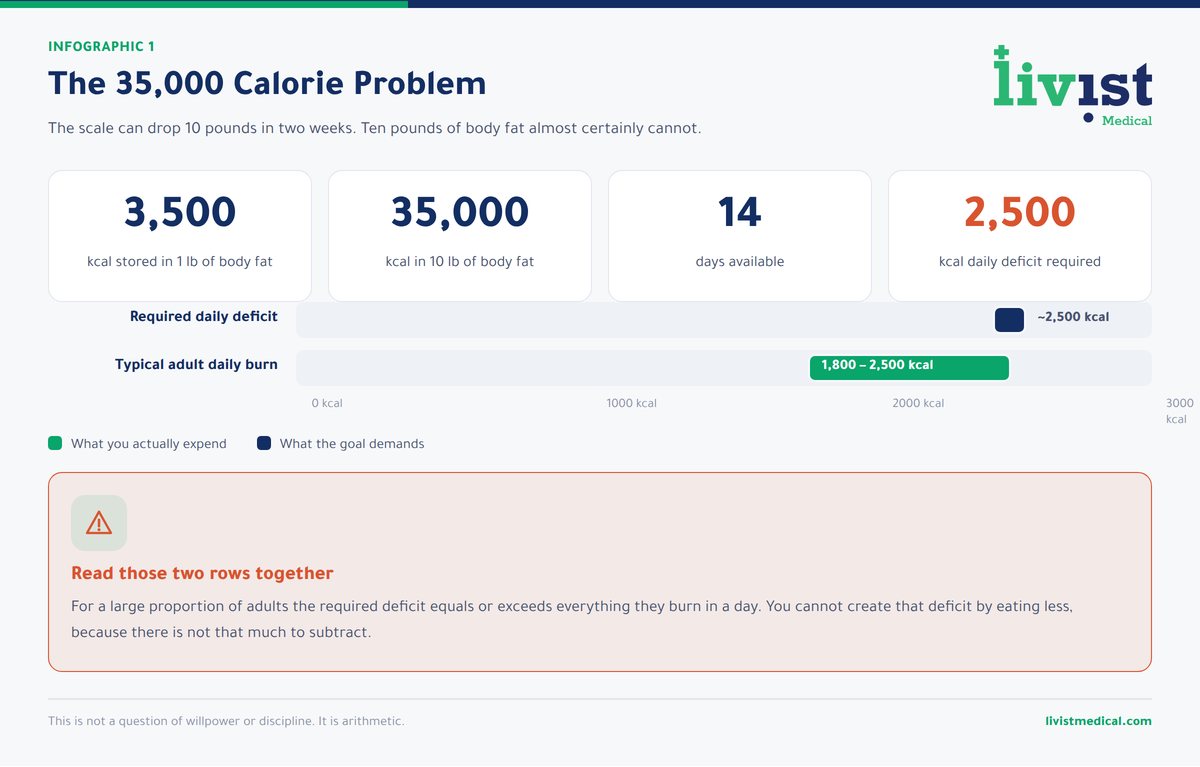
One pound of body fat holds roughly 3,500 calories. Ten pounds is therefore about 35,000 calories. Spread over fourteen days, that means a deficit of 2,500 calories every single day — which is more than many adults burn in total across a whole day.

For most people, losing ten pounds of pure fat in two weeks would require burning more energy than they expend while eating absolutely nothing.

And yet the scale genuinely can drop ten pounds in two weeks. Both of those things are true at once, and the gap between them is what this article is about.
Can You Lose 10 Pounds in 2 Weeks?

The scale can drop 10 pounds in two weeks. Ten pounds of body fat almost certainly cannot.

Here is the arithmetic laid out so you can check it yourself:

Energy stored in 1 lb of body fat ~3,500 kcal
Energy stored in 10 lb of body fat ~35,000 kcal
Days available 14
Required daily deficit ~2,500 kcal
Typical adult total daily energy expenditure ~1,800 – 2,500 kcal

Look at the last two rows together. For a large proportion of adults, the deficit required is equal to or greater than everything they burn in a day. You cannot create that deficit by eating less, because there is not that much to subtract.

This is not a question of willpower or discipline. It is arithmetic.

The one honest exception

Someone starting at a substantially higher weight burns considerably more energy each day simply existing — a person at 300 lb has a much higher daily expenditure than a person at 160 lb. Their two-week loss will genuinely be larger, and rapid early loss at higher starting weights is real and well documented.

But it is still not ten pounds of fat in fourteen days, and it is still driven mostly by the mechanism in the next section.

The calorie arithmetic behind losing 10 pounds of fat in two weeks, showing the 35,000 calorie deficit required
The 35,000 calorie problem

What the Scale Is Actually Showing You

If the scale drops eight pounds in ten days and only two or three of those can be fat, what is the rest?

1. Glycogen and its bound water — the biggest single component.

Your body stores carbohydrate as glycogen in the muscles and liver, and each gram of glycogen is stored alongside roughly three grams of water. When you cut carbohydrates, you deplete those glycogen stores — and the water bound to them leaves too.

This is the entire explanation for why low-carbohydrate diets produce spectacular first-week results and then appear to stall in week two. Nothing has gone wrong in week two. Week one was simply not what it looked like.

2. Digestive contents.

Eating less food, and particularly less fibre, means less material in transit through your digestive system at any given moment. That is genuine weight on the scale. It is not body tissue.

3. Reduced fluid retention.

Cutting processed food cuts sodium, and sodium influences how much fluid your body holds.

4. Actual body fat — the smallest part.

For most people on a sustainable deficit, this is 2 to 4 pounds over two weeks.

A ten-pound drop, broken down

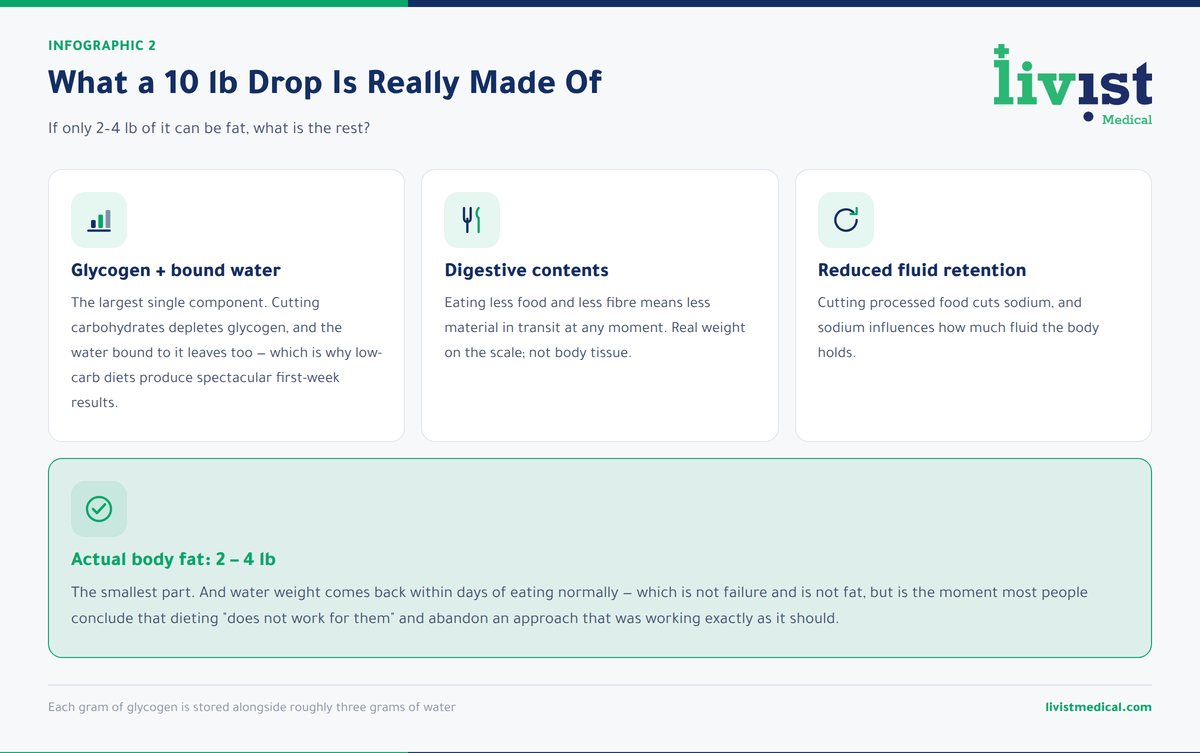
Component Approximate share
Glycogen and its bound water The largest single component
Digestive contents A meaningful share
Reduced fluid retention Variable
Body fat 2 – 4 lb

Why this matters more than the number itself: water weight comes back within days of eating normally. That is not failure, and it is not fat returning — but it is the moment when most people conclude that dieting "does not work for them" and abandon an approach that was, in fact, working exactly as it should.

Breakdown of what a 10 pound scale drop is actually made of: glycogen water, digestive contents, fluid and body fat
What a 10 lb drop is really made of

What You Can Realistically Achieve in Two Weeks

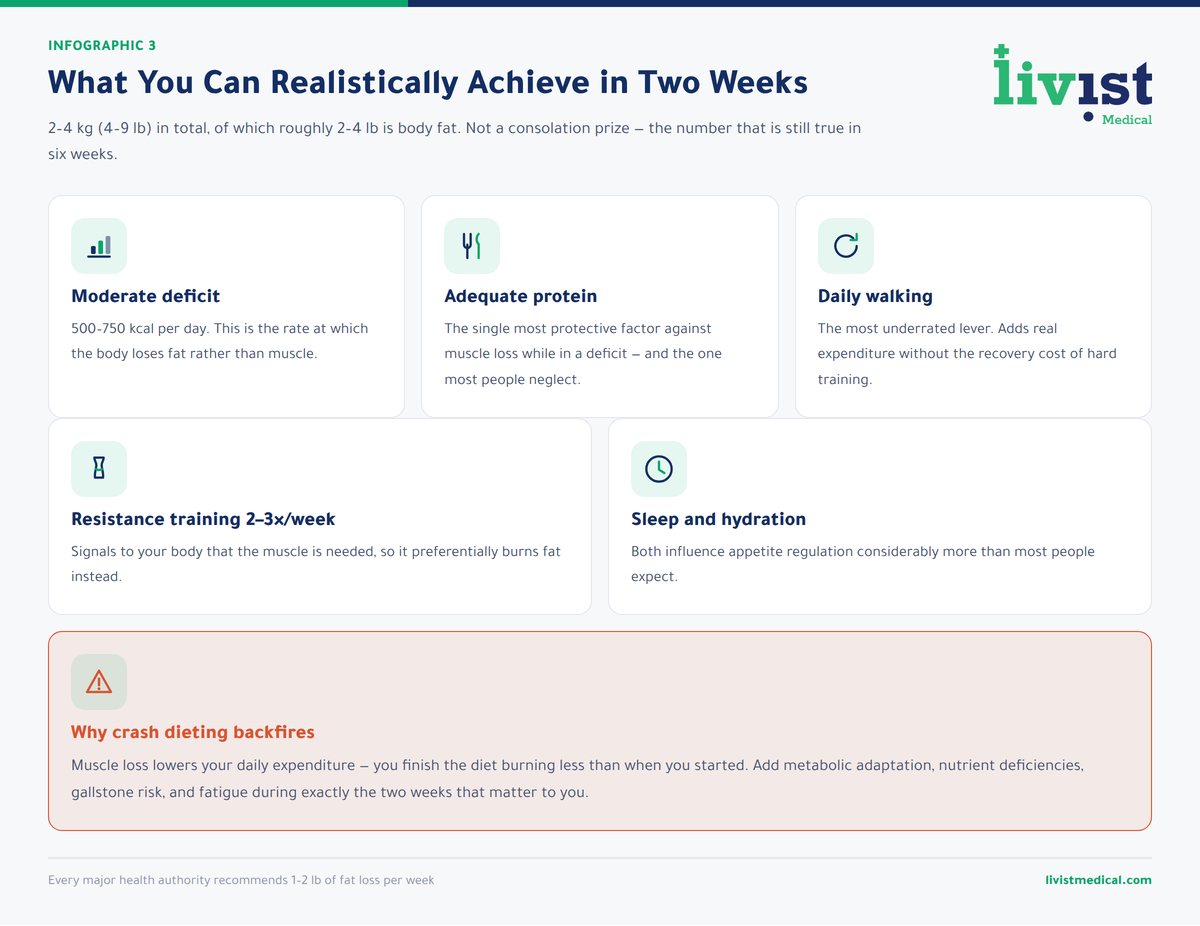
A realistic and sustainable target is 2–4 kg (4–9 lb) in total over 14 days, of which roughly 2–4 lb is body fat and the remainder water and digestive contents.

That is not a consolation prize. It is the number that will still be true in six weeks.

What produces it, without extreme restriction:

  • A moderate calorie deficit of 500–750 kcal per day. This gives 1–2 lb of fat loss per week, which is the rate every major health authority recommends — not because they are cautious, but because it is the rate at which the body loses fat rather than muscle.
  • Adequate protein. The single most protective factor against muscle loss while in a deficit, and the one most people neglect.
  • Daily walking. The most underrated lever available. It adds meaningful expenditure without the recovery cost of hard training, and it is sustainable on low energy.
  • Resistance training two to three times a week. This signals to your body that the muscle is needed, so it preferentially burns fat instead.
  • Sleep and hydration. Both influence appetite regulation considerably more than most people expect.

And a point worth knowing before your event: what visibly changes in two weeks is often greater than the scale suggests. Reduced bloating, less facial puffiness and better-fitting clothes arrive early — and they are what people actually notice.

A realistic and safe two-week weight loss target of 2 to 4 kilograms with the fat and water split
A realistic two-week target

Why Crash Dieting Backfires

This is mechanism, not moralising.

  • Muscle loss. In a severe deficit without adequate protein and resistance training, your body breaks down muscle alongside fat. Muscle is metabolically active tissue, so losing it reduces your daily energy expenditure — you finish the diet burning less than when you started it.
  • Metabolic adaptation. Energy expenditure declines by more than the weight loss alone accounts for, which makes maintaining the result harder afterwards.
  • Nutrient deficiencies. Severe restriction makes it genuinely difficult to obtain adequate vitamins and minerals.
  • Gallstone risk. Rapid weight loss is a recognised risk factor for gallstone formation.
  • Fatigue, dizziness and poor concentration. These are the practical costs during precisely the two weeks that matter to you — and they are why people arrive at their event looking drawn rather than well.
  • The rebound. Glycogen refills, water returns, and the scale moves back within days of normal eating.

The trade you are considering: a crash diet buys a number on the scale for a fortnight, and costs muscle, energy and metabolic ground that take months to recover. For an event in two weeks, it usually produces a worse outcome than a moderate deficit would have — including how you look on the day.

How Did Mark Wahlberg Lose 10 Pounds in 5 Days?

This question comes up constantly, so it is worth answering directly.

Extreme short-term losses in actors and athletes are professionally supervised, largely water-based, and deliberately temporary.

What these protocols actually involve: carefully manipulated carbohydrate and sodium intake to shift body fluid · controlled dehydration in the final days · full-time nutrition and often medical support · and a defined end point, after which the weight is intentionally restored.

Why it is not a template for anyone:

  • It is not fat loss. It is fluid manipulation, and everyone involved knows it.
  • It is supervised, sometimes with medical monitoring.
  • It is reversed immediately afterwards, on purpose.
  • Performed unsupervised, deliberate dehydration carries real cardiovascular and renal risk.

These transformations are a professional tool for a camera or a weigh-in. The people who do them do not regard them as a weight-loss method, and neither should you.

The Popular Two-Week Diets, Honestly Assessed

Approach What it claims What it actually delivers
Military / 3-day diet Up to 10 lb in one week Very low calorie intake for three days; the loss is largely water and returns quickly
Low-carb or keto kickstart Dramatic first-week loss Real and dramatic — but glycogen and water, not mostly fat
Structured clinical plans (e.g. the Mayo Clinic Diet) 6–10 lb in an initial two-week phase The most credible of the group, with proper nutrition behind it — still includes a large water component
Juice cleanses and detoxes Toxin removal and rapid loss No mechanism exists for "detox"; the loss is water and muscle

The pattern is the same across all of them. Every plan that produces a large first-week number achieves it through identical physiology — glycogen depletion and the water that leaves with it.

The difference between these approaches is not effectiveness. It is how safely they get there, and whether anything is left at week six.

What to Do If You Keep Trying and Failing

Losing and regaining the same ten pounds repeatedly is not a character flaw. And past a certain point, it stops being a dieting problem at all.

When it is worth speaking to a doctor:

  • A BMI of 30 or above, or 27 and above with a related condition such as type 2 diabetes, high blood pressure or sleep apnoea
  • Multiple genuine, sustained attempts that have not held
  • Suspected contributing factors — thyroid dysfunction, PCOS, or medications known to affect weight
  • Weight that is affecting your mobility, joints, sleep or mental wellbeing

What supervised options exist. These are clinical pathways that require proper assessment — none of them is a solution for the next fourteen days, and any provider presenting them that way deserves scepticism:

  • Structured medical weight management with dietetic support
  • GLP-1 receptor agonist medication, where clinically appropriate
  • Non-surgical procedures such as an intragastric balloon or gastric botox, for defined BMI ranges
  • Bariatric surgery, generally considered from BMI 35, or BMI 30 with related conditions

What these share is that they are longer paths which are considerably more likely to still be working in a year — which is the only timeframe that ultimately matters.

If your relationship with food, eating or your body feels distressing rather than simply frustrating, that is worth raising with a healthcare professional. Support is available, and the National Alliance for Eating Disorders helpline is one place to start.

The Bottom Line

The scale can move ten pounds in two weeks. Ten pounds of fat cannot — and now you can prove that to yourself with a calculation rather than taking anyone's word for it.

Aim for four to nine pounds in total, expect two to four of them to be fat, protect your muscle with protein and resistance training, and judge the outcome at six weeks rather than on the day of the event.

And if you have run this fortnight before, more than once, with the same result each time — the problem is not the fortnight. That is worth a conversation with a doctor rather than another attempt.

This content is for general health education and does not replace personalised medical or dietetic advice. Before making significant changes to your diet, particularly if you have any medical condition or take regular medication, speak to a qualified healthcare professional.

Sources:

Losing 10 Pounds in 2 Weeks — Frequently Asked Questions

#Weight loss#Diet#Evidence-based#Bariatric surgery#Turkey
Share Article :
Chat on WhatsApp