 Neurology
10
Can You Die From Parkinson's Disease? What Data ShowsCan you die from Parkinson's disease? A sourced life expectancy chart by age, the real causes of death, and what actually lowers the risk.
August 24, 2026Read More

Harrison Ford does not have Parkinson’s — he plays a therapist living with it. What is documented, the Michael J. Fox link, and the real symptoms.
Medically reviewed by the Livist Medical Team · Last updated 14 June 2026
No — Harrison Ford does not have Parkinson's disease. The confusion comes from his acclaimed role in the Apple TV+ comedy-drama "Shrinking," where he plays Dr. Paul Rhoades, a veteran therapist living with Parkinson's. Ford has spoken publicly about the responsibility of portraying the condition accurately, and Michael J. Fox — who has lived with Parkinson's since 1991 — has praised how convincing the performance is. There is no credible reporting that Ford himself has been diagnosed.
So the real story isn't a celebrity health scare at all — it's a 83-year-old actor doing such a believable job of playing someone with Parkinson's that millions of viewers searched to find out whether it was real. Below we separate the fact from the fiction, explain the Michael J. Fox connection, and use the moment to explain what early Parkinson's disease actually looks like — because recognising the real signs matters far more than any rumour.
No. Harrison Ford has not been diagnosed with Parkinson's disease, and he has not stated that he has it. Every credible reference linking his name to Parkinson's traces back to his fictional character in "Shrinking," not to his own health. Reporting from outlets including Vanity Fair, the New York Post, People, and Yahoo Entertainment in 2024–2026 consistently frames it the same way: Ford plays a man with Parkinson's; he does not have it.
The key point: The tremor, the careful movements, and the moments of stiffness you see on screen are a performance — researched and rehearsed — not symptoms of Harrison Ford's real health.
Ford, born in 1942, has remained active in major roles into his 80s, which is itself a reminder that visible signs of ageing are not the same as a neurological diagnosis.
The rumour has a simple, traceable source: the role. In "Shrinking," Ford's character is a therapist managing a Parkinson's diagnosis, and several things combined to blur the line for viewers:
In other words, an actor was so convincing that the internet briefly mistook the character's condition for the actor's own.
Michael J. Fox is the public figure most associated with Parkinson's disease. The beloved Back to the Future and Family Ties star was diagnosed in 1991 at just 29 and went public in 1998, later founding The Michael J. Fox Foundation for Parkinson's Research, now the largest non-profit funder of Parkinson's research in the world.
When Fox — who has lived with Parkinson's since 1991 — spoke to Vanity Fair (January 2026) about Ford's performance, he put it plainly: "He doesn't have Parkinson's, but he's a brilliant actor. I don't have to convince him I have Parkinson's, but he had to convince me he had Parkinson's." He praised the portrayal again at the show's PaleyFest panel.
That quote is the clearest possible answer to the search query: a person who genuinely lives with Parkinson's confirming that Harrison Ford does not — he is simply portraying it convincingly.
Because the search interest is really about the disease, here is the accurate picture. Parkinson's disease is a progressive neurological disorder that affects movement. It develops when nerve cells in a part of the brain called the substantia nigra gradually break down and produce less dopamine, the chemical that helps coordinate smooth, controlled movement.
| Feature | What it means |
|---|---|
| Type | Progressive neurodegenerative disorder |
| Main system affected | Movement (motor) control |
| Underlying cause | Loss of dopamine-producing brain cells |
| Typical onset age | Usually after 60 (early-onset can occur younger, as with Michael J. Fox) |
| Is it fatal? | Parkinson's itself is not directly fatal; people can live for decades, though complications can affect life expectancy |
| Is there a cure? | No cure yet, but medication, therapy, and sometimes surgery manage symptoms well |
Parkinson's is not a normal part of ageing, and an occasional hand tremor — from caffeine, stress, fatigue, or simply getting older — is not the same as a Parkinson's tremor, which has distinct characteristics a doctor can assess.
Recognising Parkinson's early can make a real difference to how well it is managed. According to the Parkinson's Foundation and Mayo Clinic, common early signs include:
When to see a doctor: If you or a loved one notices a persistent tremor, new stiffness, or a change in movement, walking, or handwriting, it's worth a medical assessment. Early evaluation by a neurologist leads to better, earlier management.
Concerned about symptoms in yourself or a family member and considering a specialist assessment abroad? Livist Medical can connect you with experienced consultants — request a free consultation.
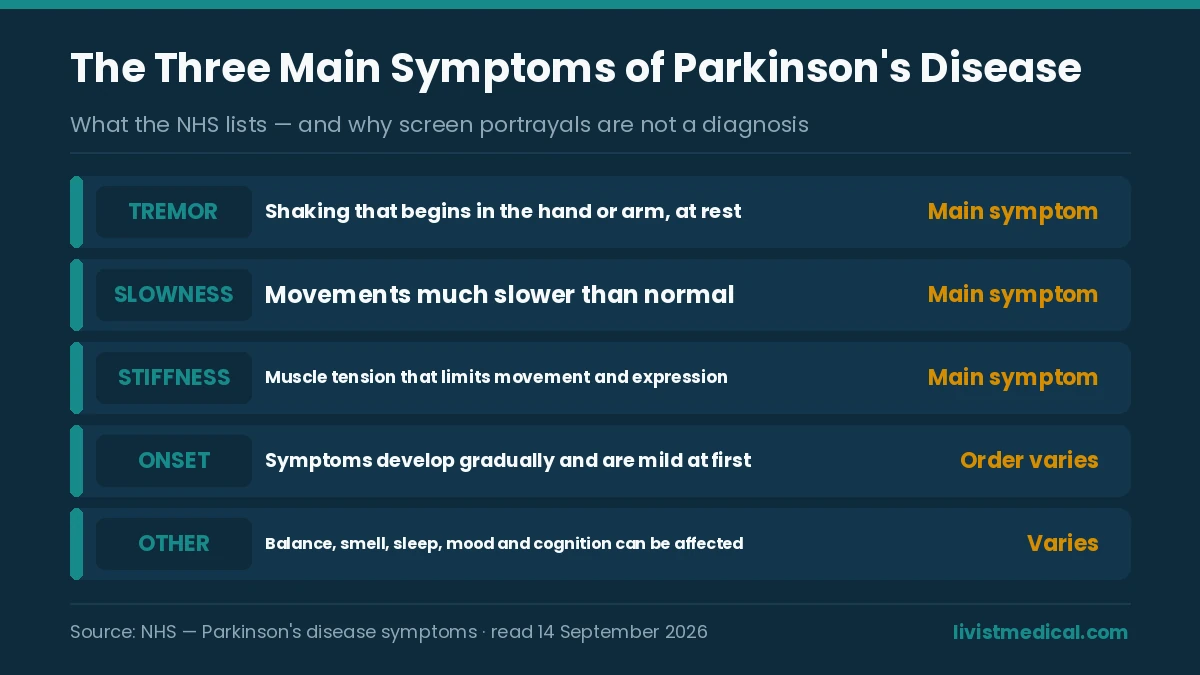
| Main symptom of Parkinson’s | How the NHS describes it |
|---|---|
| Tremor | “Shaking, which usually begins in the hand or arm and is more likely to occur when the limb is relaxed” |
| Slowness of movement | “Physical movements are much slower than normal, which can make everyday tasks difficult” |
| Muscle stiffness | “Stiffness and tension in the muscles, which can make it difficult to move around and make facial expressions” |
The NHS adds that “symptoms of Parkinson’s disease usually develop gradually and are mild at first”, and that “the order in which these develop and their severity is different for each individual”. Source: NHS — Parkinson’s disease symptoms, read 14 September 2026. That variability is exactly why an on-screen portrayal, or a clip of someone’s hand, proves nothing about a diagnosis.
There is no cure, but modern treatment helps many people live full, active lives for years. Management is usually built around:
Ongoing research — much of it funded by The Michael J. Fox Foundation — continues to improve these options each year.
While Parkinson's care is highly specialised, Livist Medical helps international patients reach Turkey's leading, internationally trained consultants and contracted health institutions holding a health-tourism authorisation certificate for assessments, second opinions, and a range of treatments — with transparent pricing and dedicated coordination from your first message to your follow-up care. Browse our specialist doctors and accredited hospitals, or get in touch to discuss your needs.
Have a health question or want a specialist assessment? Book a free consultation and our medical coordinators will respond within 24 hours.
This article is for general information and is not a substitute for personalised medical advice. The statement that Harrison Ford does not have Parkinson's disease reflects his own public comments and consistent reporting as of June 2026. If you are worried about neurological symptoms, please consult a qualified doctor.
Related articles: What Happened to Zac Efron's Face? Jaw Injury Truth (2026), Nicole Kidman Face: Botox, Before & After, and What Surgeons Say (2026), Madonna Plastic Surgery: Before & After (2026 Update).
NeurologyCan you die from Parkinson's disease? A sourced life expectancy chart by age, the real causes of death, and what actually lowers the risk.
 Plastic Surgery
Zac Efron’s face changed after a 2013 jaw fracture, not surgery — what happened, how a broken jaw reshapes a face, and where it stands in 2026.
 Plastic Surgery
Natural, non-surgical, and surgical options for mild vs severe sagging — plus 2026 costs in Turkey.