 Neurology
9
Does Harrison Ford Have Parkinson's? The Truth (2026)Harrison Ford does not have Parkinson’s — he plays a therapist living with it. What is documented, the Michael J. Fox link, and the real symptoms.
June 14, 2026Read More
Can you die from Parkinson's disease? A sourced life expectancy chart by age, the real causes of death, and what actually lowers the risk.
Parkinson's disease is not usually fatal in itself. People are far more likely to die with Parkinson's than from it, and the recognised leading cause of death is aspiration pneumonia — inhaling food, saliva or stomach contents into the lungs. Life expectancy is still reduced: research puts the reduction at about 10.1 years for diagnosis at 55, falling to 1.2 years at 85.
If you are asking whether you can die from Parkinson's, you deserve numbers rather than reassurance. This article sets out what the published data says: how much life expectancy is reduced by age at diagnosis, what people with Parkinson's really die of, which events signal faster progression, and which routine measures reduce the biggest risks — plus what Harrison Ford's case shows about diagnosis rumours. This is educational content only. It is not a diagnosis, not a treatment plan, and it does not replace assessment by a neurologist who knows the individual case.
Parkinson's disease is rarely recorded as the direct cause of death, so asking whether Parkinson's is fatal has a nuanced answer: it shortens life without usually killing directly. Death certificates far more often name pneumonia, injury after a fall, or another illness the condition made harder to survive.
Parkinson's is a progressive neurodegenerative condition that damages movement, swallowing, balance and — over time, in many people — thinking. Those failing together makes ordinary events dangerous: food enters the airway instead of the stomach, a stumble becomes a hip fracture, an infection is harder to clear. That is how Parkinson's shortens life.
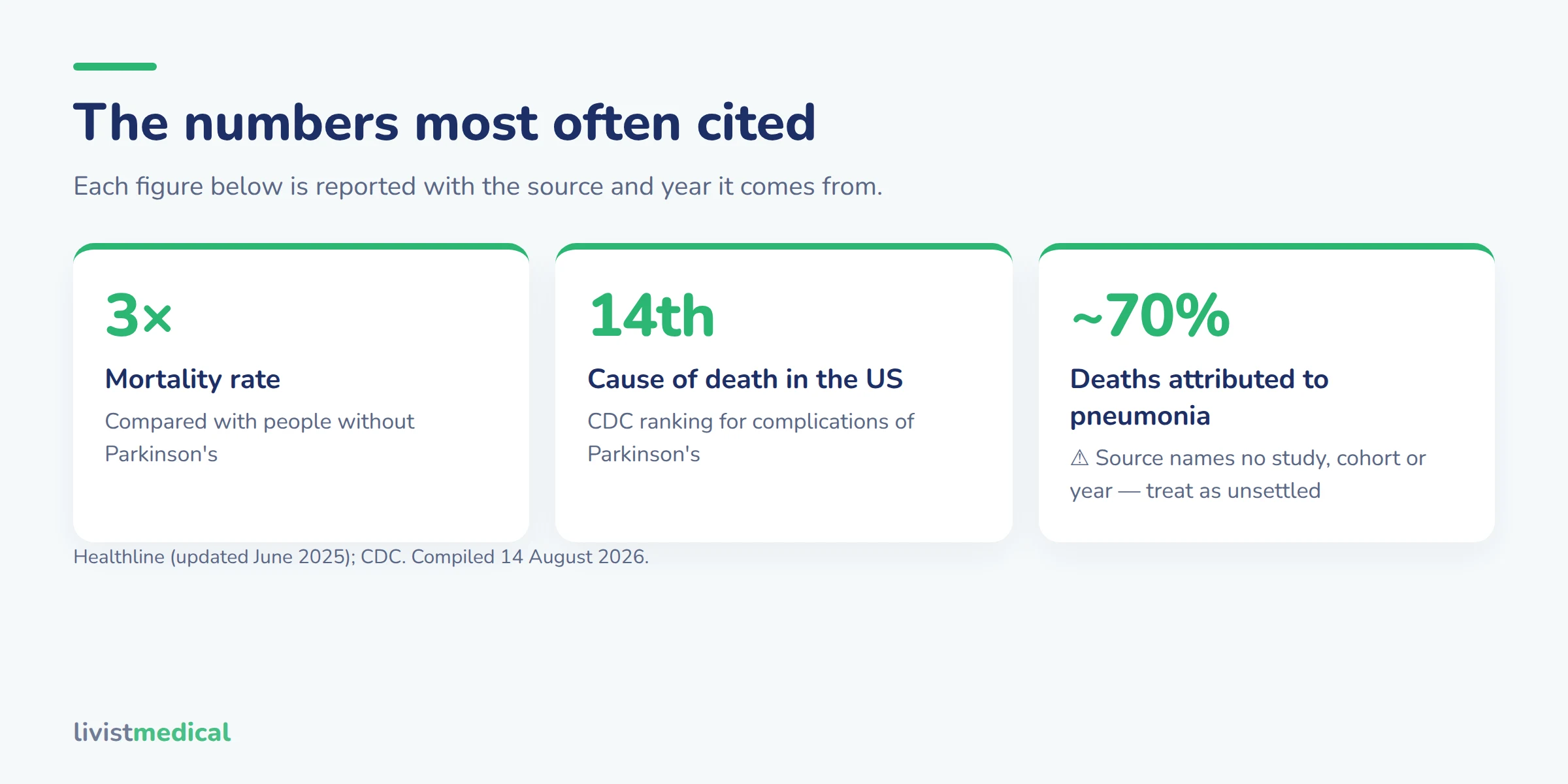
Figures compiled in a Healthline medical review updated in June 2025 report a mortality rate roughly three times that of people of the same age without the condition, and note that the US Centers for Disease Control and Prevention has ranked complications of Parkinson's the 14th leading cause of death in the United States. Both describe populations, not individuals.
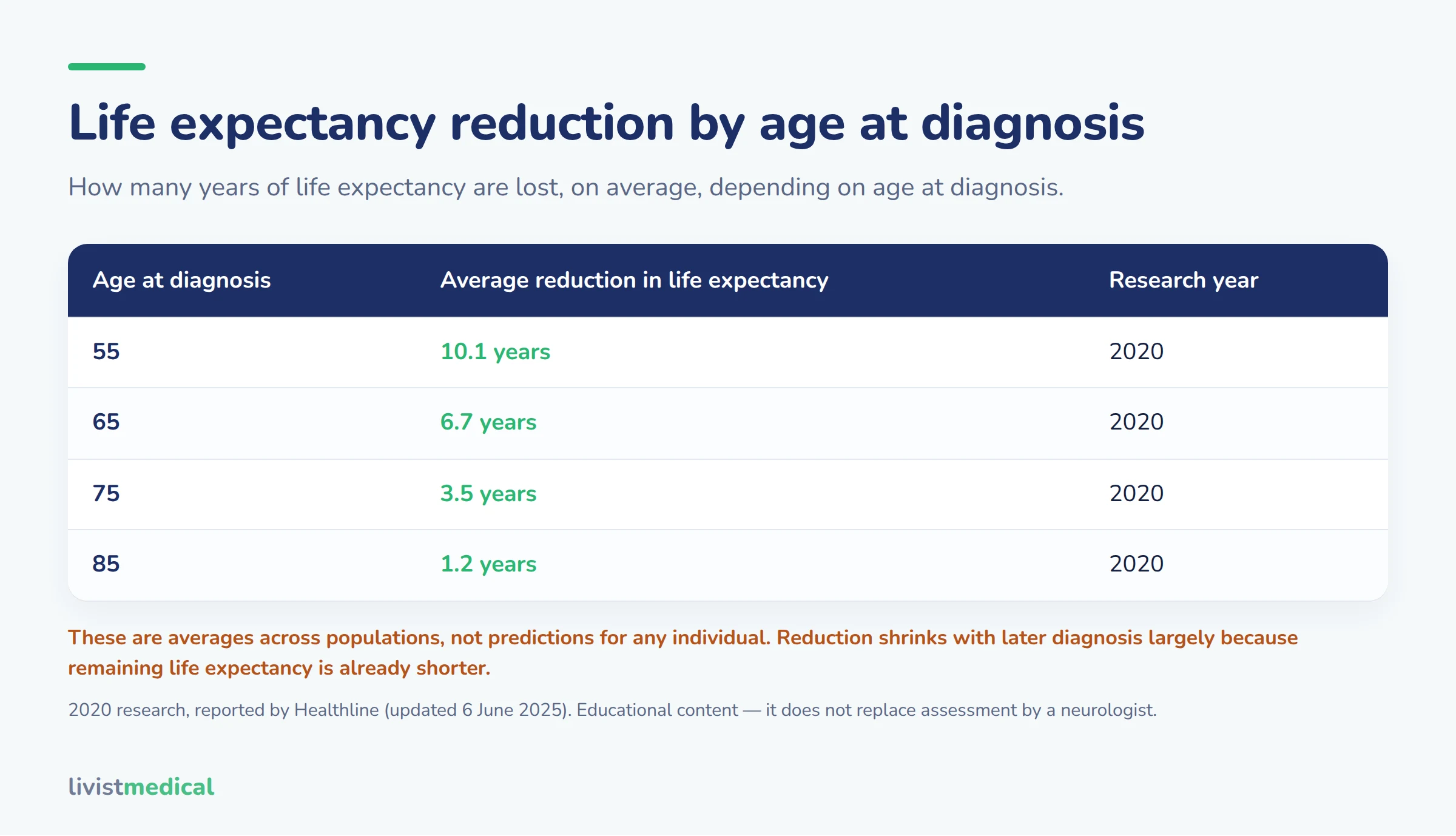
Research published in 2020 estimates that Parkinson's reduces life expectancy by about 10.1 years when diagnosis comes at 55, 6.7 years at 65, 3.5 years at 75 and 1.2 years at 85. The younger the diagnosis, the larger the average loss.
| Age at diagnosis | Average reduction in life expectancy | Research year | How to read it |
|---|---|---|---|
| 55 years | 10.1 years | 2020 | Largest reduction — most remaining years for the disease to affect |
| 65 years | 6.7 years | 2020 | Closest to the typical diagnosis age |
| 75 years | 3.5 years | 2020 | Reduction narrows as other age-related causes compete |
| 85 years | 1.2 years | 2020 | Smallest reduction of the four age bands |
People with Parkinson's most often die of complications rather than the disease itself. Aspiration pneumonia is the recognised leading cause, followed by injuries and complications after falls. The CDC has ranked Parkinson's complications the 14th leading cause of death in the United States.
Parkinson's weakens the muscles and reflexes that coordinate swallowing, a problem clinicians call dysphagia. When that fails, food, liquid or saliva can enter the airway instead of the oesophagus, and material in the lungs can cause infection. Because the cough reflex is often blunted too, it can happen quietly — silent aspiration, with no visible choking.
A figure of roughly 70% of Parkinson's deaths involving pneumonia circulates widely, including in the Healthline review updated in June 2025. It should be read with caution: the source presenting it names no study, cohort, country or year, so the population described and the way pneumonia was recorded cannot be verified. The direction of the finding — that pneumonia dominates — is consistent across sources. The precise percentage should not be treated as settled.
Balance impairment, rigidity, freezing of gait and blood pressure drops on standing make falls common as Parkinson's progresses. The fall itself is rarely fatal. Fractures, head injuries, surgery in a frail patient and the immobility that follows — raising the risk of chest infection and clots — turn a fall into a life-threatening event.
Research indexed in the US National Library of Medicine's PMC archive describes sudden unexpected death in Parkinson's disease: death without an identifiable cause on investigation. It is uncommon, and the proposed mechanisms — including autonomic nervous system disturbance — remain unproven. SUDPAR is a research category rather than an established everyday risk.
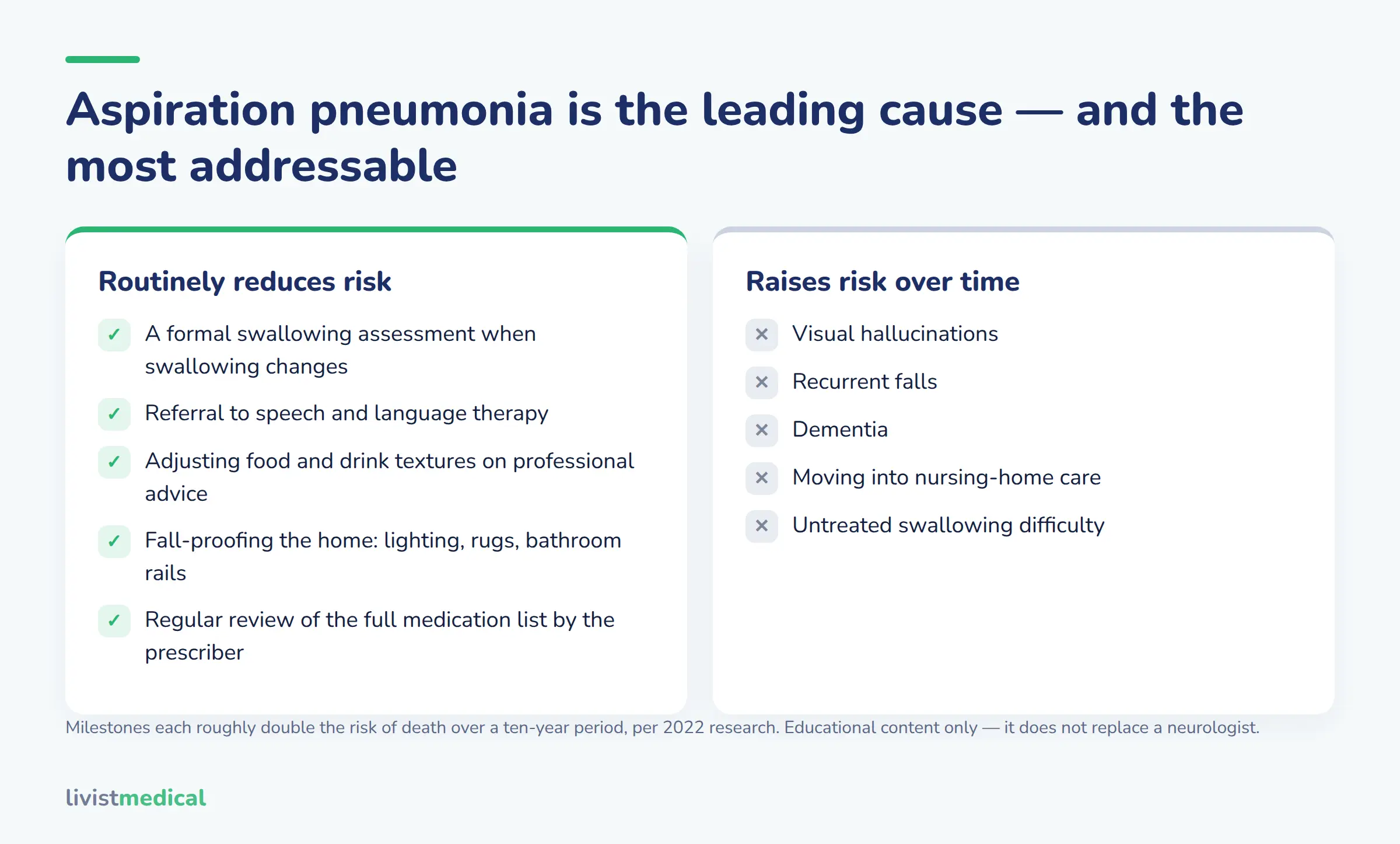
Research published in 2022 identified four clinical milestones — visual hallucinations, recurrent falls, dementia and admission to a care home — and reported that reaching any one of them roughly doubled the risk of dying within the following ten years. They mark disease progression rather than a fixed prognosis.
Two cautions. Doubling a risk is not the same as making an outcome likely; the increase depends on a baseline risk that differs enormously between a 58-year-old and an 84-year-old. And these are markers, not switches — reaching one sets no date.
Because aspiration pneumonia and falls cause most Parkinson's deaths, the measures that address them matter most: swallowing assessment, referral to a speech and language therapist, fall-proofing the home, and regular medication review with the prescribing team. These are routine parts of Parkinson's care, not experimental additions.
Most sources name aspiration pneumonia as the leading cause of death and then stop. The four areas below are standard components of Parkinson's care, and each maps onto a cause of death described above.
A formal swallowing evaluation identifies dysphagia before it produces pneumonia, including silent aspiration. It is the measure aimed most directly at the leading cause of death. When it is appropriate is a clinical decision, and it is worth asking the treating team whether one has been done.
Speech and language therapists assess and manage swallowing as well as speech and voice. Their work can include texture guidance for food and drink, positioning during meals, and techniques for safer swallowing. Referral typically comes through the neurologist or general practitioner, and can be raised at any appointment.
Environmental change addresses the second-largest cause of death with no medical intervention at all: removing loose rugs and trailing cables, improving lighting on stairs and routes to the bathroom, fitting grab rails and non-slip surfaces in wet areas, and reviewing footwear. Occupational therapists carry out structured home hazard assessments in many systems.
People with Parkinson's often take several medicines, sometimes prescribed by different clinicians, and some combinations worsen dizziness, blood pressure drops or confusion — all of which increase fall risk. Periodic review of the complete list by the prescribing clinician or a pharmacist is a recognised safety step. No one should start, stop or change any medication based on an article. That decision belongs to the prescribing doctor.
Parkinson's is commonly described in five stages, from mild one-sided symptoms to severe impairment requiring full-time assistance. The scale describes function, not a timetable: people move through the stages at very different speeds, and many spend years in the early stages with little change in daily life.
In stage one, symptoms affect one side of the body and are often mild enough that others do not notice — a slight tremor, changed handwriting, reduced arm swing. In stage two, symptoms appear on both sides and tasks take longer, but balance is preserved and independent living continues. Public misreadings of tremor in well-known figures usually concern this phase.
Stage three is defined by loss of balance and slowed movement. Falls become a genuine risk for the first time, and activities such as dressing and eating take more effort. Most people remain independent, though many benefit from support with specific tasks.
In stage four, standing may still be possible but movement generally requires assistance, and living alone becomes difficult or unsafe. In stage five, standing and walking usually require substantial help or are impossible, and round-the-clock care is typically needed. Swallowing difficulty and cognitive change are more common here, which is why the causes of death described earlier concentrate at this stage.
End-stage Parkinson's is defined by dependence rather than by a specific date. Movement, swallowing, speech and thinking are usually all affected, and care shifts from slowing progression to comfort, safety and dignity. Reported signs include swallowing difficulty, weight loss, repeated infections and long immobility.
Other reported changes include very limited mobility, reduced speech volume and clarity, increased sleeping, and cognitive change that may include hallucinations or confusion. None individually establishes that death is near — several can persist for a long time, and some have other explanations a clinician should assess.
Palliative care is often misunderstood as care for the final weeks. It is symptom- and quality-of-life-focused care that can run alongside active treatment, and in many health systems it is introduced well before the final stage. Hospice care is narrower, generally considered when treatment aimed at the disease is no longer the goal.
Availability differs between countries and institutions. What exists locally, and what a given hospital offers, is worth establishing early rather than during a crisis — including at the hospitals we work with. Raising the subject early is not giving up; it usually widens the options.
No article can predict an individual course, and the numbers above are population averages. The most useful questions for an appointment concern staging, swallowing and falls, what the current medication list is doing, and when to involve additional specialists. Written questions make short appointments far more productive.
If answers are unclear, neurologists and neurosurgeons can review a case in more detail.
Diagnosis rumours travel faster than diagnoses: the most searched recent example is whether Harrison Ford has Parkinson's, and what he has actually said.
You can die from complications of Parkinson's, but rarely from Parkinson's itself. Life expectancy is reduced — by about 10.1 years for diagnosis at 55 and 1.2 years at 85, per 2020 research — and the largest single cause of death, aspiration pneumonia, is the one routine care most directly targets.
That is the honest position: the disease is not harmless, and a diagnosis is not a sentence. What is actionable sits in the interventions rather than the statistics — swallowing assessment, speech and language therapy, a safer home and a reviewed medication list all address the mechanisms by which the disease shortens life.
This article is educational information only. It does not diagnose, does not recommend any treatment or medication, and does not replace the judgement of a neurologist who has examined the patient. If a second clinical view would help with staging or care planning, you can ask for a neurology second opinion.
NeurologyHarrison Ford does not have Parkinson’s — he plays a therapist living with it. What is documented, the Michael J. Fox link, and the real symptoms.
 Plastic Surgery
Zac Efron’s face changed after a 2013 jaw fracture, not surgery — what happened, how a broken jaw reshapes a face, and where it stands in 2026.
 Plastic Surgery
Natural, non-surgical, and surgical options for mild vs severe sagging — plus 2026 costs in Turkey.