 Neurology
10
Can You Die From Parkinson's Disease? What Data ShowsCan you die from Parkinson's disease? A sourced life expectancy chart by age, the real causes of death, and what actually lowers the risk.
August 24, 2026Read More
Deep brain stimulation cost: $35,000–$100,000+ in the US, $12,000–$48,000 in Turkey. Device vs surgery costs, insurance, battery and evidence.
Deep brain stimulation costs $35,000 to over $100,000 in the US in the first year; a systematic review of 26 studies found a mean device cost of $21,496, total surgery cost of $40,943 and first-year treatment cost of $47,632. Unilateral DBS costs $35,000–$60,000 and bilateral $60,000–$80,000+. Turkey ranges $12,000–$48,000. Medicare and most insurers cover approved indications. Non-rechargeable batteries last about 3–5 years, rechargeable up to 15. DBS treats Parkinson's, essential tremor and dystonia; it reduces symptoms but does not cure them.
Written and medically reviewed by Prof. Dr. Lütfü Hanoğlu — neurology, Parkinson's disease and movement disorders.
Deep brain stimulation (DBS) costs $35,000 to over $100,000 in the United States for the first year. A systematic review of 26 studies put the average total cost of surgery at about $40,900 and the first-year treatment cost at about $47,600. In Turkey the range is $12,000 to $48,000.
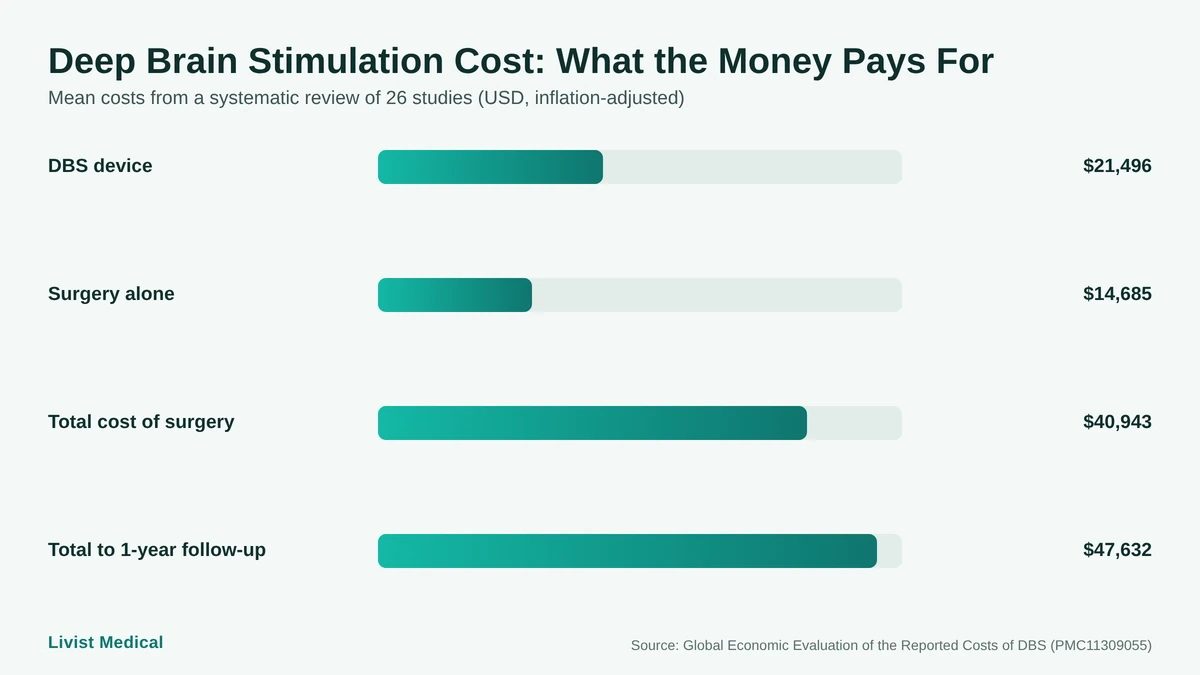
The most complete cost data come from a systematic review of 26 studies published between 2001 and 2021, with every figure converted to US dollars and adjusted for inflation to April 2022 (Global Economic Evaluation of the Reported Costs of Deep Brain Stimulation, PMC):
| Deep brain stimulation cost item | Mean cost (USD) |
|---|---|
| DBS device (stimulator and leads) | $21,496 |
| Surgery alone | $14,685 |
| Total cost of surgery | $40,943 |
| Total cost of treatment to 1-year follow-up | $47,632 |
Two points stand out. The device is roughly half of the surgical bill, and the reviewers found no difference in cost across surgical indication or country in the studies they pooled; they called for standardised cost reporting because the way costs are reported varied widely.
| Deep brain stimulation option (US) | Typical range |
|---|---|
| Unilateral DBS (one side of the brain) | $35,000 – $60,000 |
| Bilateral DBS (both sides) | $60,000 – $80,000+ |
| Device alone (neurostimulator and leads) | $20,000 – $50,000 |
| Total first year | $35,000 – $100,000+ |
Ranges as shown in Google's AI Overview for "deep brain stimulation cost", October 2026.
In the US, Medicare and most private insurers cover DBS for approved conditions such as Parkinson's disease, essential tremor and dystonia when the patient meets clinical criteria and has prior authorization. What you pay then depends on your deductible, co-pay and coinsurance.
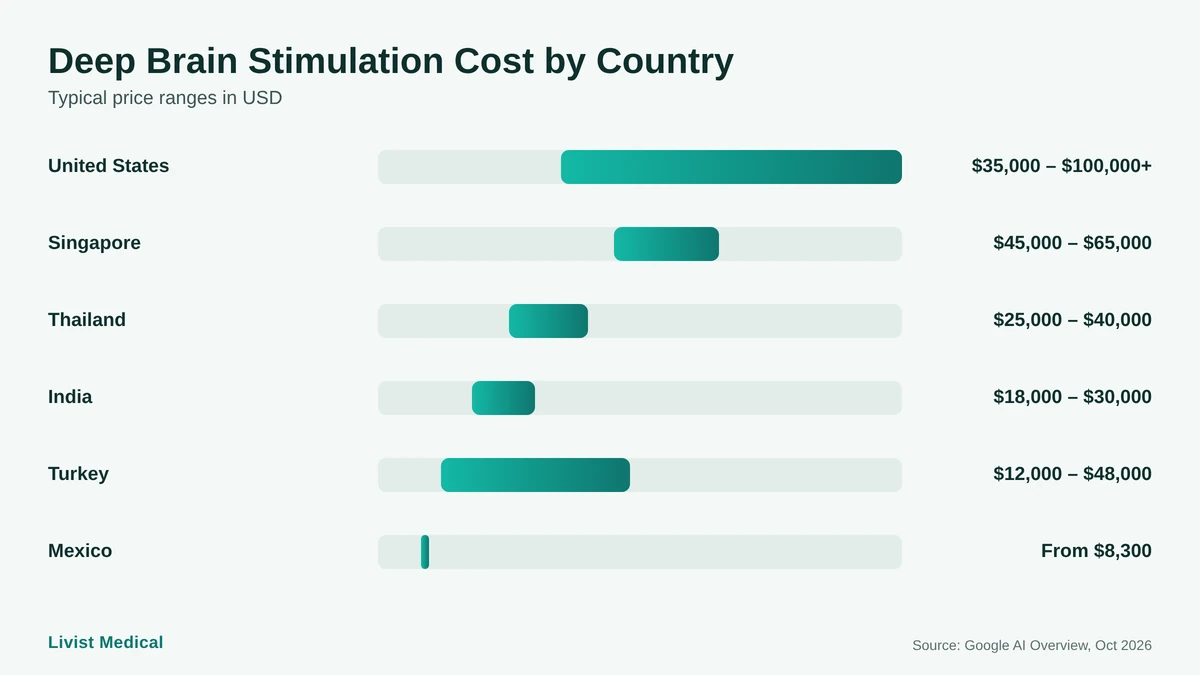
| Country | Deep brain stimulation cost (USD) |
|---|---|
| United States | $35,000 – $100,000+ |
| Singapore | $45,000 – $65,000 |
| Thailand | $25,000 – $40,000 |
| India | $18,000 – $30,000 |
| Turkey | $12,000 – $48,000 |
| Mexico | From $8,300 |
Ranges as shown in Google's AI Overview for "deep brain stimulation cost", October 2026. Ask any quote to state the device model and whether the battery is rechargeable, since the device is the largest single cost item.
DBS is not a one-off expense. A non-rechargeable pulse generator typically lasts about 3 to 5 years before it must be replaced surgically, while rechargeable models can last up to 15 years. Mayo Clinic notes that battery life varies with how much the device is used, and that finding the best stimulation settings can take as long as 4 to 6 months of programming visits after the device is switched on (Mayo Clinic).
Mayo Clinic describes DBS as an established treatment for movement disorders — essential tremor, Parkinson's disease and dystonia — in people whose symptoms are not controlled with medicines. It is also used for obsessive-compulsive disorder and Tourette syndrome and is FDA-approved to reduce seizures in hard-to-treat epilepsy. For background on the disease itself, read can you die from Parkinson's?
In a randomised trial of 156 patients with advanced Parkinson's disease and severe motor symptoms, stimulation plus medication beat medication alone after six months: quality of life improved more in 50 of 78 patient pairs and motor scores in 55 of 78 pairs (mean gains of 9.5 and 19.6 points). Serious adverse events, however, were more common with DBS — 13% versus 4% — including one fatal brain haemorrhage (Deuschl et al., NEJM, 2006). Mayo Clinic adds that DBS won't cure the condition, symptoms often don't disappear, and many people still need medication.
Mayo Clinic considers DBS generally low risk, but lists possible surgical complications: misplaced leads, bleeding in the brain, stroke, infection, breathing problems, nausea, heart problems and seizures. Side effects afterwards can include headache, confusion or trouble concentrating, hardware problems such as an eroded lead wire, and short-term pain and swelling at the implant site.
A stereotactic frame holds the head still while MRI or CT maps the target. Electrodes are most often placed while the patient is awake, with local anaesthetic numbing the scalp — the brain itself has no pain receptors. A pacemaker-like device with the battery is then placed under the skin of the chest and switched on a few weeks later.
Many readers first learn about tremor treatment through public figures; our article does Harrison Ford have Parkinson's? separates rumour from medical fact.
Send your neurologist's report and recent MRI for a free review. Livist Medical connects you with neurology and neurosurgery specialists — including Prof. Dr. Zeki Şekerci — at contracted healthcare institutions holding a health tourism authorization certificate, and prepares a written quote that lists the device and battery type.
NeurologyCan you die from Parkinson's disease? A sourced life expectancy chart by age, the real causes of death, and what actually lowers the risk.
 Neurology
Harrison Ford does not have Parkinson’s — he plays a therapist living with it. What is documented, the Michael J. Fox link, and the real symptoms.
 Plastic Surgery
Zac Efron’s face changed after a 2013 jaw fracture, not surgery — what happened, how a broken jaw reshapes a face, and where it stands in 2026.