 Plastic Surgery
9
What Happened to Zac Efron's Face? Jaw Injury Truth (2026)Zac Efron’s face changed after a 2013 jaw fracture, not surgery — what happened, how a broken jaw reshapes a face, and where it stands in 2026.
June 14, 2026Read More
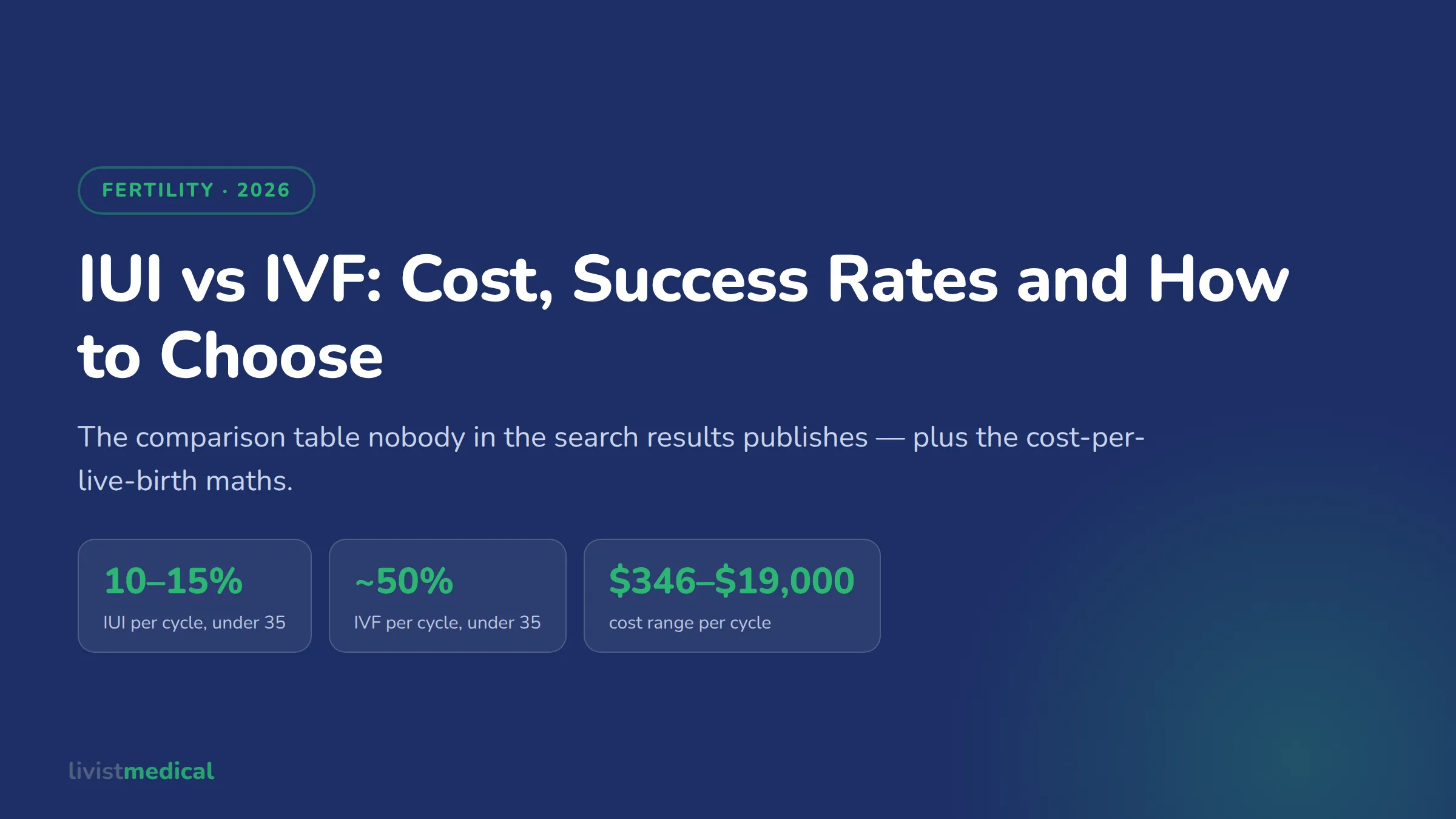
IUI vs IVF compared in one table: success rates by age, cost per cycle in 4 countries, and the cost-per-live-birth maths that changes the answer.
IUI succeeds in about 10–15% of cycles for women under 35 and 8–10% after 35, while IVF reaches roughly 50% per cycle in the same younger group. IUI costs $770–$2,045 per cycle internationally versus $3,000–$19,000 for IVF. Because IVF succeeds far more often per attempt, its cost per live birth is often lower than three or four IUI cycles — the comparison most price lists never make.
This article is informational only: no diagnosis, no treatment recommendation, no promise of pregnancy. Every figure below names its source and year. The decision belongs to you and a qualified fertility specialist who has seen your test results.
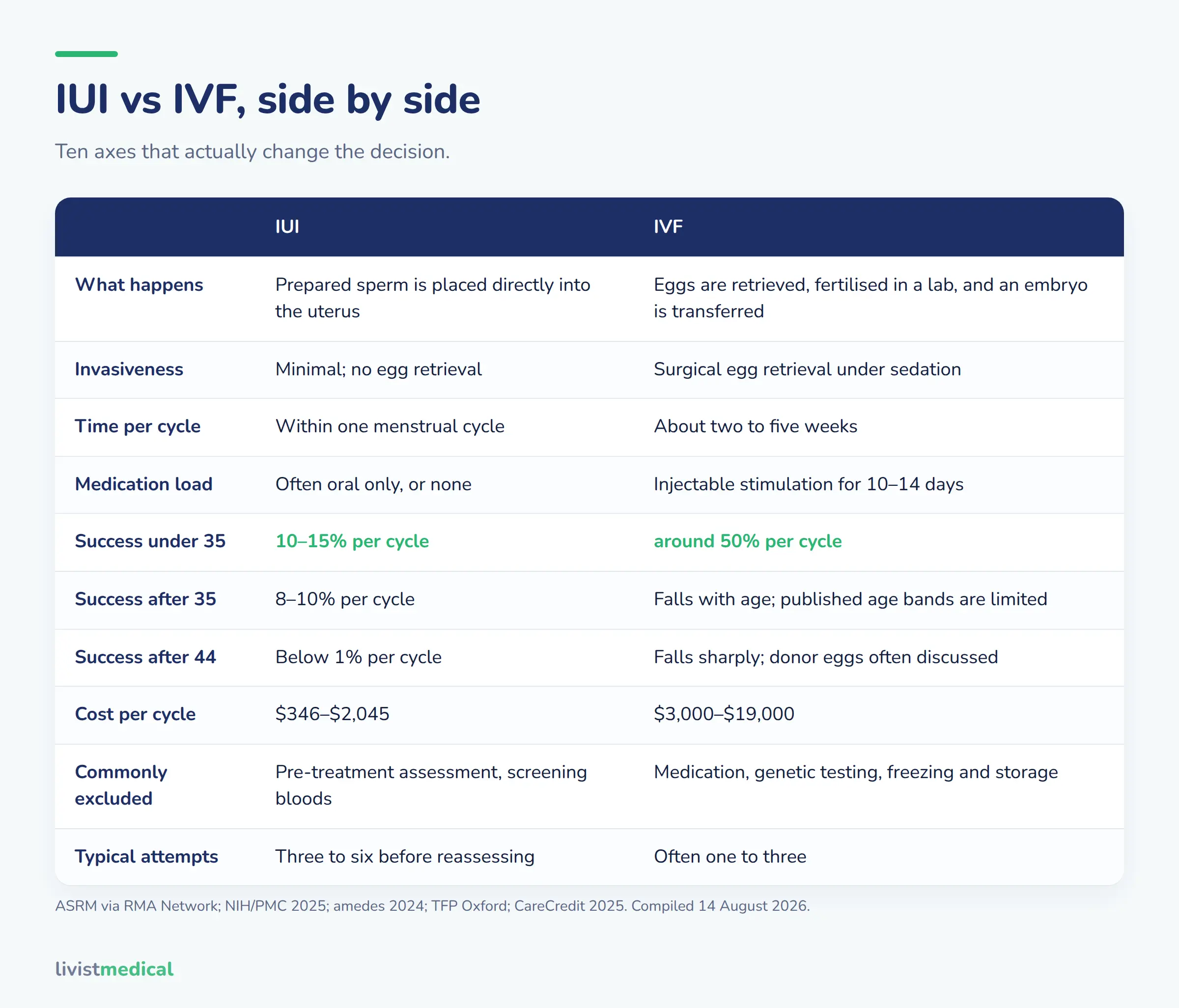
IUI places washed sperm into the uterus at ovulation and leaves fertilisation to the body. IVF collects eggs surgically, fertilises them in a laboratory and transfers an embryo days later. IUI is cheaper and lighter per attempt; IVF succeeds far more often. Ten axes, side by side.
| Axis | IUI | IVF |
|---|---|---|
| What it is | Prepared sperm passed by catheter into the uterus; fertilisation happens in the body. | Eggs collected, fertilised in a laboratory (often by ICSI), cultured, one transferred. |
| Invasiveness | Non-surgical, minutes, no anaesthesia. | Surgical retrieval under sedation, plus separate transfer. |
| Time per cycle | Two to three weeks; two to four visits. | Four to six weeks: 10–14 days stimulation, retrieval ~36 hours after trigger, 5–6 days culture, transfer. |
| Medication load | None, tablets, or low-dose injections. | Daily injections for 10–14 days, a trigger shot, progesterone support. |
| Success per cycle | 10–15% under 35 (RMA Network, 2020/2023); 10% in one clinic series (Advanced Fertility Center of Chicago). | About 49% live birth under 35 in that clinic's own data — one clinic's figure, not a national benchmark. |
| Success by age | 8–10% after 35; under 1% after 44 (ASRM via RMA Network, 2020/2023). | Also falls with age; no dated per-age-band figure in the sources reviewed. |
| Cost per cycle | $770–$1,050 in Turkey (clinic quotes, May–July 2026) to ~$2,045 in the UK (TFP Oxford). | $3,000–$5,200 in Turkey (same source) to $9,000–$19,000 in the US (CareCredit/SART, 2025). |
| What quotes exclude | Monitoring scans, sperm-preparation extras, medication. | UK and US prices exclude medication; US injectables cost $3,991 per cycle (CareCredit, 2025). Turkish quotes exclude medication ($2,000–$3,500) but often include ICSI. |
| Main risks | Cramping, spotting, small infection risk; multiples when stimulation is used. | Ovarian hyperstimulation syndrome; sedation, bleeding, infection at retrieval. |
| Typical attempts | Three to six; stopping rules run 2–6 (Northwestern Medicine) to 4–6 (RMA Network). | One to three retrievals, plus frozen transfers from each. |
The difference is where fertilisation happens. IUI shortens the sperm's journey and leaves the rest to the body, so it needs an open fallopian tube and workable sperm. IVF replaces that journey entirely, which is why it works where IUI structurally cannot.
The cycle is tracked by ultrasound, with no medication, tablets or low-dose injections used to mature a follicle, and a trigger injection may time ovulation. A semen sample is washed to concentrate motile sperm and a catheter passes it into the uterus. A pregnancy test follows two weeks later.
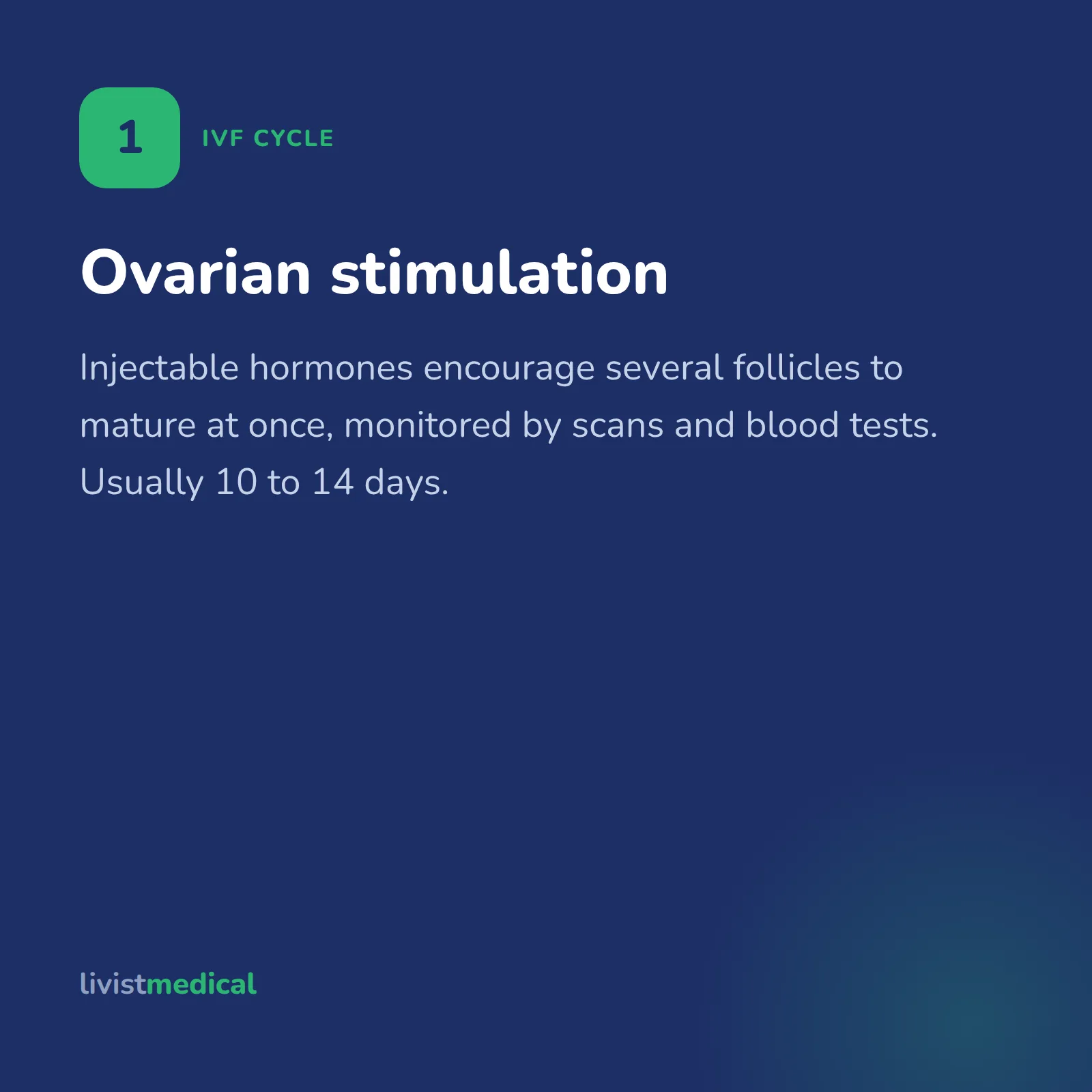
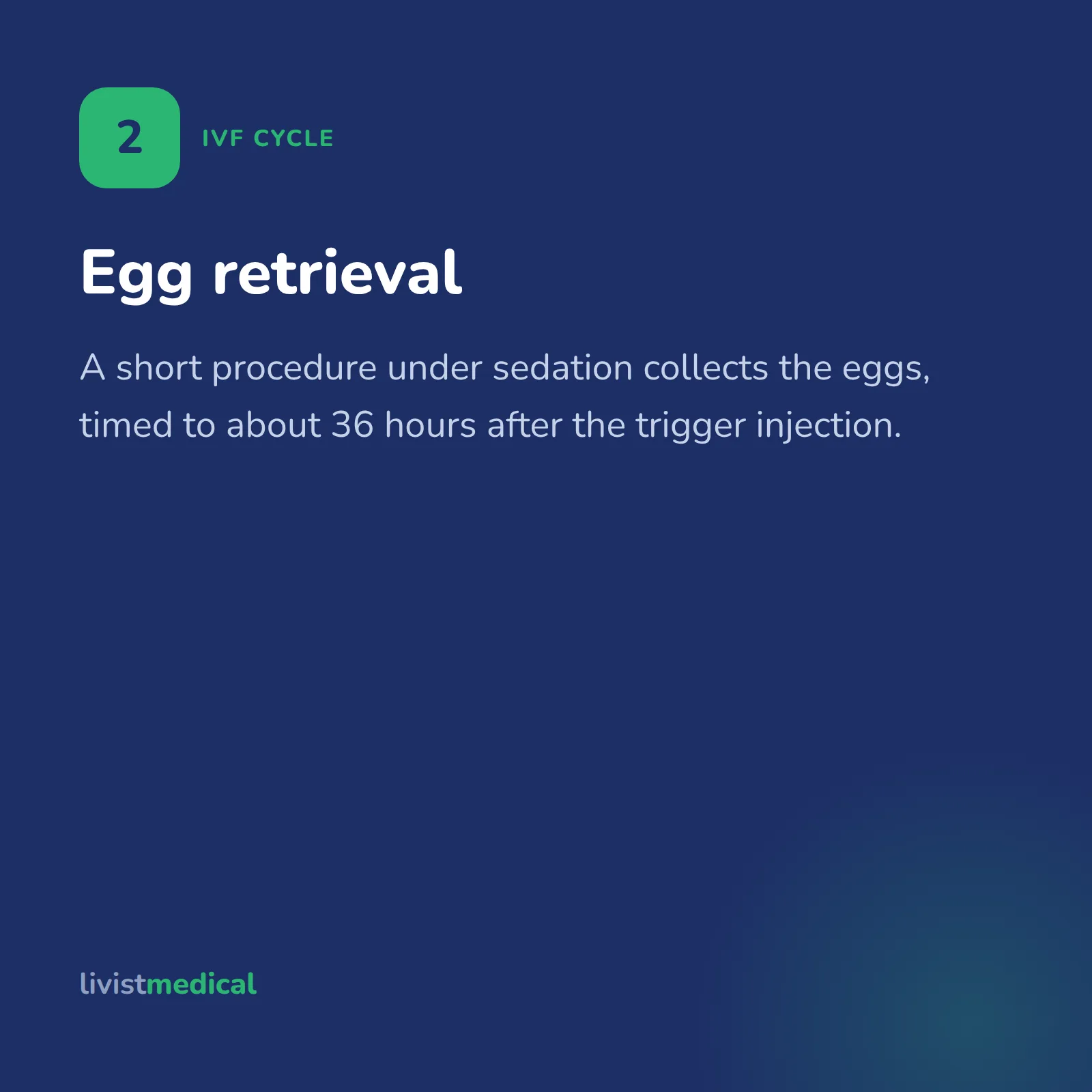
Daily injections run 10 to 14 days to mature several eggs, monitored by scans. Retrieval follows about 36 hours after the trigger, under sedation. Eggs are fertilised conventionally or by ICSI and cultured five to six days; one embryo is transferred and spares frozen.

Age is the strongest predictor in both treatments. RMA Network reports IUI at 10–15% per cycle under 35, 8–10% after 35 and under 1% after 44. One named clinic reports 49% live birth per IVF cycle under 35. Per-age-band IVF figures are rarely published.
| Age band | IUI per cycle | IVF per cycle | Source and date |
|---|---|---|---|
| Under 35 | 10–15% | — | RMA Network, 2020/2023 (ASRM figures) |
| Under 35 | 10% | 49% live birth | Advanced Fertility Center of Chicago — that clinic's own series, not a national average |
| 35 to 40 | 8–10% | Not published | RMA Network, 2020/2023 |
| Over 40 | Below 8–10%, falling | Not published | RMA Network, 2020/2023 |
| Over 44 | Under 1% | Not published | RMA Network, 2020/2023 |
| Study population | 39.2% | 52.3% | NIH/PMC comparative analysis, 2025 — cumulative, not per cycle |
The only band where both numbers are published. IUI sits at 10–15% per cycle (RMA Network, 2020/2023) and at 10% in the Advanced Fertility Center of Chicago series; that same clinic reports 49% live birth per IVF cycle in its own data.
IUI falls to 8–10% per cycle here (RMA Network, 2020/2023), and no dated IVF figure for this band appeared in the sources reviewed. As egg quality declines, the time available for repeated low-yield attempts shrinks.
After 40, fewer chromosomally normal eggs are available each month, and IUI does nothing about that: it improves sperm delivery, not egg quality. RMA Network (2020/2023) puts IUI under 1% per cycle after 44, while IVF at least assesses several eggs per attempt.
Three IUI cycles do not equal three times one cycle's chance. Compounding the published 10–15% range gives roughly 27–39% across three attempts, against about 49% for one IVF cycle in a single clinic's series. What follows is illustrative arithmetic from published rates, not clinic outcome data.
If a cycle succeeds 12% of the time it fails 88% of the time, so three failures in a row is 0.88 × 0.88 × 0.88 = 0.68 and the chance of at least one success is 32%. The same sum across the range:
One IVF cycle reported at 49% by the Advanced Fertility Center of Chicago still leads, before frozen transfers. Two caveats: the model assumes independent cycles, and people who fail early IUI cycles are as a group harder to treat, so real rates run lower.
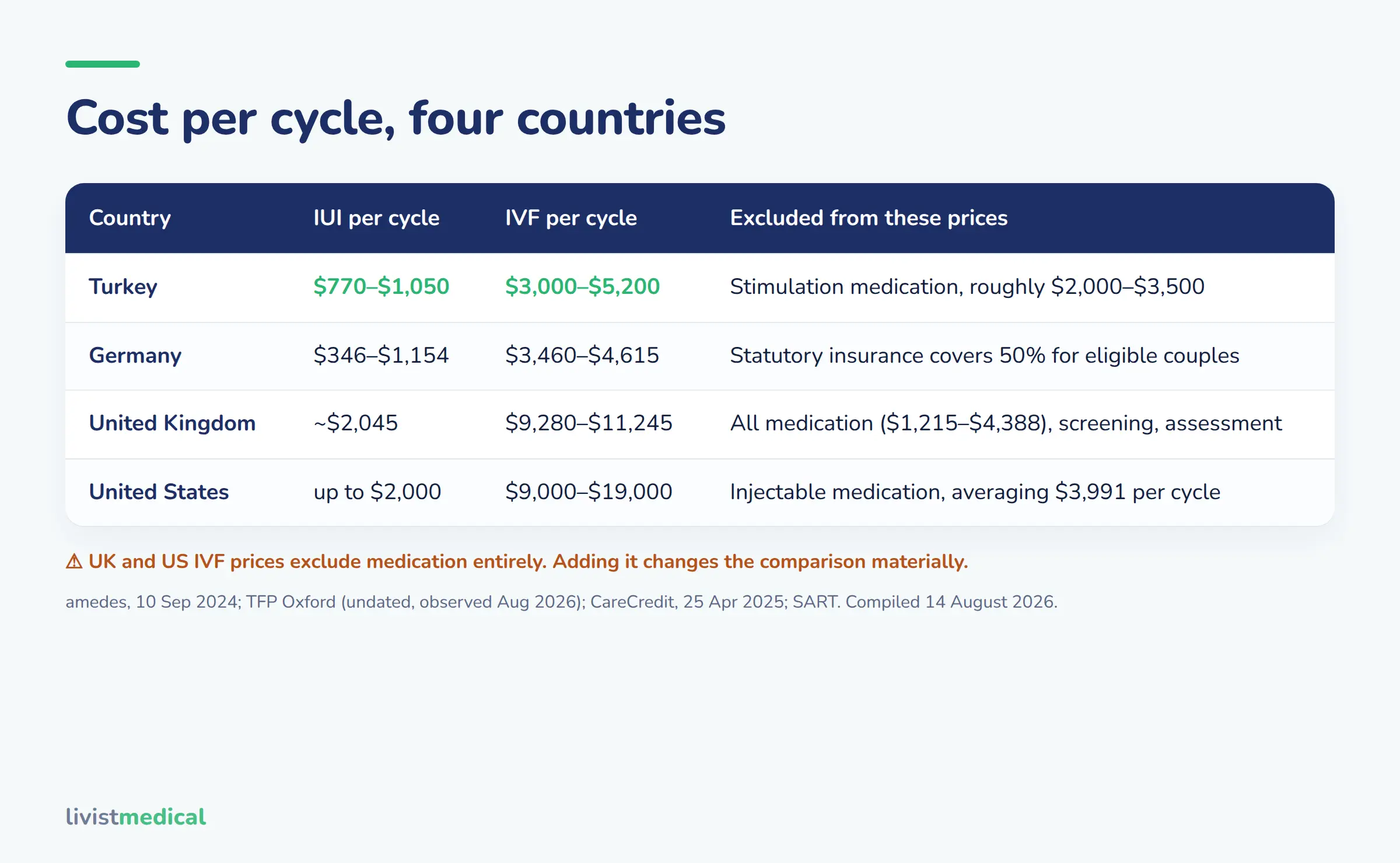
IUI runs from about $770 per cycle in Turkey to roughly $2,045 in the UK. IVF runs from about $3,000 in Turkey to $19,000 in the US for a fresh-egg cycle. Most of the gap between advertised and actual cost is medication, quoted separately in several markets.
| Country | IUI per cycle | IVF per cycle | Excluded from this price | Source and date |
|---|---|---|---|---|
| Turkey | $770–$1,050 | $3,000–$5,200 | Medication separate at $2,000–$3,500; ICSI often included. | Clinic quotes, May–July 2026 (indicative) |
| Germany | ~$346 unstimulated; ~$1,154 stimulated | IVF ~$3,460; ICSI ~$4,615 | Statutory insurance covers 50% for eligible patients, halving the out-of-pocket cost. | amedes fertility pricing, September 2024 |
| United Kingdom | ~$2,045 | IVF ~$9,280; with ICSI ~$11,245 | Medication excluded, at $1,215–$4,388 per cycle. | TFP Oxford price list (undated) |
| United States | Up to ~$2,000 | $9,000–$19,000, fresh-egg cycle | Medication excluded: injectables at $3,991 per cycle. Full journey $17,000–$75,000+. | CareCredit/SART, April 2025 |
UK and US IVF prices are treatment-only, so the $3,991 medication figure (CareCredit, April 2025) belongs in any comparison. Our treatment packages list inclusions, the hospitals we work with in Istanbul show their accreditations, and you can speak to our fertility coordinator about a quote.
The omissions are consistent across markets: monitoring scans and blood tests, anaesthesia at retrieval, embryo freezing and storage, each later frozen transfer, genetic testing and donor fees. International patients add flights and accommodation for a two- to three-week stay.
Cost per cycle answers the wrong question. What matters is the expected cost of one live birth — roughly the cycle price divided by the per-cycle success rate. The table applies that to the prices and rates already cited. It is illustrative arithmetic, not clinic outcome data.
Assumptions, stated openly: IUI at 12% per cycle (mid-point of RMA Network's 10–15% under-35 range) and IVF at 49% (the Advanced Fertility Center of Chicago's own under-35 figure, not a national average). Mid-points are used for ranges.
| Country | IUI: cost ÷ 0.12 | IVF: cost with medication ÷ 0.49 | IUI rate below which IVF is the cheaper route |
|---|---|---|---|
| Turkey | $910 ÷ 0.12 = ~$7,580 | ($4,100 + $2,750) ÷ 0.49 = ~$13,980 | About 6.5% per cycle |
| Germany | $1,154 ÷ 0.12 = ~$9,620 | $3,460 ÷ 0.49 = ~$7,060 | IVF is already cheaper at every published IUI rate |
| United Kingdom | $2,045 ÷ 0.12 = ~$17,040 | ($9,280 + $2,800) ÷ 0.49 = ~$24,650 | About 8.3% per cycle |
| United States | $2,000 ÷ 0.12 = ~$16,670 | ($14,000 + $3,991) ÷ 0.49 = ~$36,720 | About 5.4% per cycle |
The result is more interesting than the slogan. Where IVF is priced close to IUI — Germany, on the September 2024 amedes figures — one IVF cycle already costs less per live birth even in the best age band. Elsewhere IUI holds its advantage only while its per-cycle chance stays near 12%. The final column shows where that flips: below roughly 5–8%, which RMA Network's figures put after 35, IVF is cheaper everywhere in the table.
IUI suits situations where the pathway to fertilisation is intact but needs help: at least one open fallopian tube, adequate sperm numbers and motility after washing, and a reason to expect better timing to change the outcome. That is a diagnostic judgement, not a preference.
PCOS usually causes infertility through irregular ovulation rather than blocked tubes, so when ovulation induction restores a predictable cycle, IUI adds well-timed sperm to a working system. PCOS ovaries respond briskly to stimulation, raising multiple-pregnancy risk, so monitoring matters more here.
With open tubes, normal sperm parameters and regular ovulation but no conception, IUI is a reasonable low-cost next step. It modestly raises a monthly chance rather than fixing a fault — which is why the number of cycles should be agreed in advance.
For single parents by choice, same-sex female couples and couples using donor sperm, IUI is often the logical first route when the person carrying the pregnancy has no known fertility problem. It solves access to sperm rather than a pathology, so results sit at the healthier end of the range.
In some situations IUI is structurally unlikely to work, so starting there mainly costs time. Specialists then move directly to IVF, because it addresses the actual obstacle rather than a step that was never the bottleneck. Only a specialist reviewing your results can judge.
The recognised examples are blocked or absent tubes; severe male-factor infertility needing ICSI; advanced maternal age, given IUI rates under 1% after 44 (RMA Network, 2020/2023); endometriosis affecting anatomy; a genetic condition needing embryo testing; and failed IUI cycles.
Published stopping points differ: Northwestern Medicine cites 2–6 cycles, RMA Network cites 4–6, and several clinic pages give no number at all. A workable rule combines cycle count with age and response — and is agreed in writing before the first cycle, not renegotiated after a disappointment.
Before switching, ask for a costed treatment plan setting out the cycle count, inclusions and what triggers a change.
Both treatments are generally well tolerated, and neither is risk-free. IUI's risks are mostly minor and short-lived. IVF adds the risks of ovarian stimulation and a surgical retrieval. Multiple pregnancy is the risk they share whenever stimulation is used, and the most consequential.
With IUI, expect mild cramping, occasional spotting and, where stimulation is used, bloating. With IVF, stimulation can cause abdominal distension, and ovarian hyperstimulation syndrome is the complication clinics monitor for. Retrieval carries small risks of sedation, bleeding and infection.
The intuition that IVF is the twin-heavy treatment is now often backwards: modern IVF usually transfers a single embryo, while stimulated IUI cannot control how many follicles ovulate. Multiples raise the risk of preterm birth, low birth weight and pre-eclampsia, so such cycles are cancelled.
The questions that change a decision are specific: your numbers, this clinic's numbers, and what the written quote covers. Ask before paying a deposit, and ask for answers in writing. A clinic that publishes its own outcome data is far easier to compare than one quoting averages.
You can review the credentials of our consultants before booking.
Neither is better in the abstract. IVF has a far higher chance per attempt — about 49% live birth under 35 in the Advanced Fertility Center of Chicago's own data, against 10–15% per IUI cycle (RMA Network, 2020/2023). IUI is cheaper and non-surgical. The choice depends on diagnosis and age.
Multiplying published per-cycle prices: about $2,310–$3,150 in Turkey (clinic quotes, May–July 2026), $3,462 in Germany with stimulation (amedes, 2024), $6,135 in the UK (TFP Oxford) and up to $6,000 in the US (CareCredit, 2025).
Yes, when stimulation is used and more than one follicle matures. IUI itself does not cause twins; stimulated cycles can. Multiples carry higher risks of preterm birth, so clinics track follicle numbers and cancel cycles in which too many develop.
Because it is non-surgical, cheaper per attempt and quick, so where the diagnosis makes it plausible it is a proportionate first step. That depends on open tubes and adequate sperm; where those are absent, the logic argues for IVF.
PCOS usually disrupts ovulation rather than blocking tubes, so ovulation induction with IUI is often offered before IVF. PCOS ovaries respond strongly to stimulation, raising multiple-pregnancy risk, so monitoring is essential. This is a decision for a specialist reviewing your workup.
IUI falls below the 8–10% band reported after 35 and drops under 1% per cycle after 44 (RMA Network, 2020/2023). For IVF over 40 the sources reviewed publish no dated figure, so ask each clinic for its own age-banded rate.
The IUI vs IVF question is usually framed as cheap versus effective, and the arithmetic above shows why that is incomplete. Per cycle, IUI costs a fraction of IVF. Per live birth the gap narrows sharply, and where IVF is priced close to IUI it reverses entirely.
None of this is medical advice and none of it predicts your result. The figures are published averages from named sources; outcomes depend on diagnosis, ovarian reserve, sperm parameters and age. No clinic can promise a pregnancy. Discuss your results with a fertility specialist, and if a plan is unclear, request a second opinion.
Plastic SurgeryZac Efron’s face changed after a 2013 jaw fracture, not surgery — what happened, how a broken jaw reshapes a face, and where it stands in 2026.
 Plastic Surgery
Natural, non-surgical, and surgical options for mild vs severe sagging — plus 2026 costs in Turkey.
 Hair Transplant
Eyelash transplants use scalp hair, so lashes keep growing and need lifelong trimming. Published risks, who it is for, and Turkey's official price floor.