Plastic SurgeryThe real story behind Zac Efron’s changed face — the 2013 jaw accident, the surgery and muscle recovery that reshaped his jawline, and what is rumour versus fact.

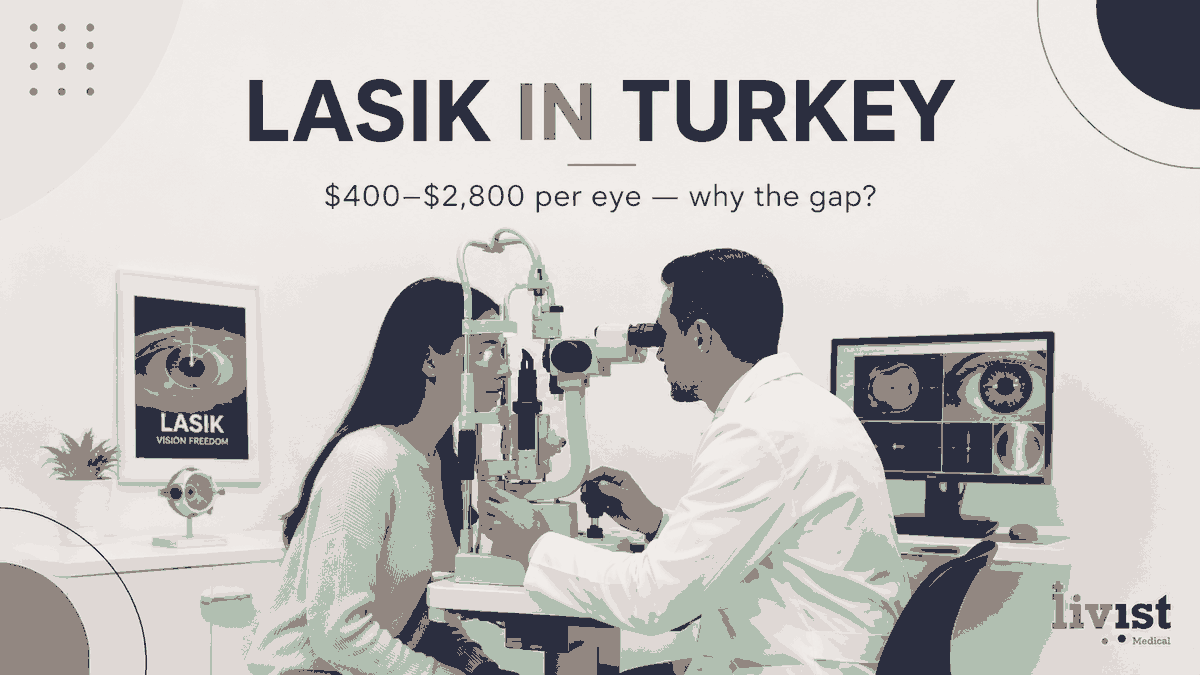
LASIK in Turkey costs $400 to $2,800 per eye. Why the spread is so wide, what a low price leaves out, safety checks, and what happens 10 years later.
LASIK in Turkey costs anywhere from about $400 to $2,800 per eye, and all-inclusive packages typically land between roughly €1,490 and €2,450. That spread is not random, and understanding what drives it is the same thing as answering the safety question. A price at the bottom of that range and a price at the top usually buy two genuinely different procedures. This guide explains the difference, what a quote should include, and what the evidence says about your eyes ten years later.
Note: This article is informational and is not medical advice. Whether you are a candidate for laser vision correction can only be determined by a full eye examination.
Yes, substantially. Published ranges put laser vision correction in Turkey well below United States pricing, where treating both eyes commonly exceeds $4,000. Reported savings of around 40% compared with home-country pricing are typical, and packages frequently bundle accommodation and transfers that would be separate costs elsewhere.
The reasons are structural rather than a reflection of quality: lower operating costs, favourable currency, very high procedure volumes concentrated in a few large centres, and genuine competition among more than a hundred clinics. High volume in particular tends to work in a patient's favour in laser surgery, because surgeon experience is one of the strongest predictors of outcome.
This is the single most useful section of this article. A quote of $400 per eye and a package of €2,450 are both real, and the difference between them is almost entirely explainable.
| What changes the price | Low-end quote | Higher-end quote |
|---|---|---|
| Technique | Older blade-based or basic surface laser | Femto-LASIK or lenticule extraction |
| Pre-operative testing | Minimal · sometimes done on the day of surgery | Full corneal topography and thickness mapping |
| Who operates | Not always named in advance | Named ophthalmologist with stated volume |
| Laser platform | Older generation equipment | Current generation, regularly serviced |
| Follow-up | One check before you fly home | Structured follow-up plus remote review |
| Enhancement policy | Charged separately if needed | Included for a defined period |
| What is bundled | Surgery only | Hotel nights, transfers, medications |
The item that matters most on that list is pre-operative testing. Laser vision correction is not suitable for everyone, and the whole safety question turns on whether unsuitable candidates are identified before surgery rather than treated anyway. A clinic that compresses testing into the same morning as the operation has removed the step that protects you.
Laser vision correction is one of the most studied elective procedures in medicine, with a strong safety record when performed on properly selected patients using current technology. The country is not the variable that determines your outcome. Candidate selection, surgeon experience and equipment are — and those vary enormously within Turkey exactly as they do within any other country.
What a safe pathway looks like in practice:
You can review surgeon profiles and accredited hospitals before arranging a consultation.
"LASIK" is often used loosely to mean any laser eye surgery, but the options differ in how they work and who they suit.
| Procedure | How it works | Best suited to |
|---|---|---|
| Femto-LASIK | A femtosecond laser creates the corneal flap instead of a blade, then an excimer laser reshapes the cornea | The mainstream choice for most suitable candidates |
| Lenticule extraction (SMILE-type) | A small lenticule of tissue is removed through a tiny incision, with no flap created | Active lifestyles, contact sports, some dry-eye profiles |
| Surface ablation (PRK-type) | No flap · the surface layer is reshaped directly · longer recovery | Thinner corneas where a flap is unwise |
| Trifocal or multifocal lens exchange | The natural lens is replaced with an artificial one | Older patients, high prescriptions, or where laser is unsuitable |
The right answer is determined by your corneal thickness and shape, your prescription and your age, not by which option a clinic promotes. Detailed pages are available for femto-LASIK, femto-SMILE and trifocal smart lens surgery.
One point worth understanding early: from roughly the mid-forties onward, the natural lens stiffens and reading glasses become necessary regardless of any laser treatment. Laser correction fixes distance vision; it does not stop that age-related change. In that age group a lens-based procedure is sometimes the more sensible conversation.
Being declined is a good outcome, not a wasted trip. Proceeding despite a warning sign is how the small number of poor results happen. If eye disease rather than refractive error is the issue, procedures such as cataract surgery or glaucoma surgery address a different problem entirely.
This question sits in Google's own People Also Ask box and almost no clinic page answers it. Here is the straight version.
| Timeframe | What typically happens |
|---|---|
| First week | Vision usable within a day or two · fluctuation and light sensitivity are normal |
| Weeks 2 – 6 | Vision stabilises · dryness is common and usually improving |
| 3 – 12 months | Final settled result · any dryness generally continues to improve |
| Years 1 – 10 | The corneal reshaping is permanent and does not wear off |
| Mid-forties onward | Reading glasses become necessary due to natural lens ageing, independent of the surgery |
| Long term | A minority experience some regression and may consider an enhancement · cataract can still develop with age and remains treatable |
The core misconception worth dispelling: people who need reading glasses in their late forties often conclude their LASIK "wore off". It did not. Two different parts of the eye are involved, and age affects the one the laser never touched.
Comparing treatment packages rather than bare surgical fees is the only way to compare like with like when the market spans $400 to $2,800.
Both cities have established eye centres, and the choice is more practical than clinical.
| Istanbul | Antalya | |
|---|---|---|
| Choice of centres | The widest, including large hospital groups | Fewer, more concentrated |
| Flights | Best connected internationally | Strong seasonal routes, thinner in winter |
| Pace | Busy · transfers can be long across the city | Calmer · shorter distances |
| Combining with recovery | Less restful | Easier, though sun and sea need care after surgery |
On reviews, the volume of published testimonials in this market makes them close to useless taken at face value. What is actually informative:
Laser vision correction is one of the more travel-friendly procedures, but the timing has fixed points that cannot be compressed.
Turkey offers laser vision correction at a genuine and substantial saving, and the quality available at the upper end of the market is comparable to anywhere. The risk is not the country — it is the bottom of the price range, where the savings usually come from removing the pre-operative testing and the follow-up that make the procedure safe. Judge a quote by what it includes and by whether the clinic is willing to tell you no. The reshaping itself is permanent, and reading glasses in your late forties are a fact of ageing rather than a failure of the surgery.
This content is informational and does not constitute medical advice. Candidacy for laser vision correction requires a full eye examination by a qualified ophthalmologist.
To have your prescription and corneal measurements reviewed and receive a detailed written estimate, book a free consultation with Livist Medical, or browse our available procedures.
Plastic SurgeryThe real story behind Zac Efron’s changed face — the 2013 jaw accident, the surgery and muscle recovery that reshaped his jawline, and what is rumour versus fact.
Plastic SurgeryNatural, non-surgical, and surgical options for mild vs severe sagging — plus 2026 costs in Turkey.
IVF & FertilityIUI vs IVF compared in one table: success rates by age, cost per cycle in 4 countries, and the cost-per-live-birth maths that changes the answer.