 Orthopedics
13
Limb Lengthening Surgery in Turkey: Cost and Methods 2026Limb lengthening surgery in Turkey: 2026 package costs against the official state price floor, methods, realistic height gain, safety and recovery.
June 12, 2026Read More
Herniated disc surgery in Turkey costs $2,500 to $6,750 versus $20,000+ in the US. But most herniated discs heal without surgery. When you actually need it.
Herniated disc surgery in Turkey costs roughly $2,500 to $6,750 depending on the technique and the number of levels treated, compared with $20,000 to $50,000 in the United States. Before comparing those numbers, there is a more important one to know: the large majority of herniated discs improve without any surgery at all, usually within six to twelve weeks. This guide covers when surgery is genuinely indicated, what it costs, and how to tell a necessary operation from an avoidable one.
Note: This article is informational and is not medical advice. Whether you need spinal surgery can only be determined by a qualified specialist who has examined you and reviewed your imaging.
For most people, yes. A herniated disc is not a mechanical fault that stays broken until someone fixes it. The herniated material shrinks over time through natural resorption, and the inflammation that causes most of the pain settles. The majority of cases improve substantially with conservative treatment within six to twelve weeks, and surgery for pain alone is generally considered only after that period has been given a fair trial.
This matters because pain intensity is a poor guide to surgical need. Severe sciatica is frightening and genuinely disabling, and it is also the presentation most likely to resolve on its own. Meanwhile the findings that do require urgent surgery are sometimes less painful than expected.
What conservative management actually involves, done properly:
There are clear situations where waiting is the wrong choice, and knowing them protects you in both directions — from unnecessary surgery and from dangerous delay.
| Situation | Urgency |
|---|---|
| Cauda equina syndrome — loss of bladder or bowel control, numbness in the saddle area, sudden severe weakness in both legs | Emergency. Go to hospital immediately. This is the one true spinal emergency |
| Progressive motor weakness — a foot that is dropping, weakness that is worsening rather than steady | Urgent surgical assessment |
| Severe pain unrelieved after 6 to 12 weeks of genuine conservative treatment | Elective — reasonable to consider |
| Recurrent disabling episodes over months or years | Elective — discuss |
| Pain alone, under 6 weeks, no weakness | Not an indication. Conservative treatment first |
| An MRI finding with no matching symptoms | Not an indication. Disc bulges are common in people with no pain at all |
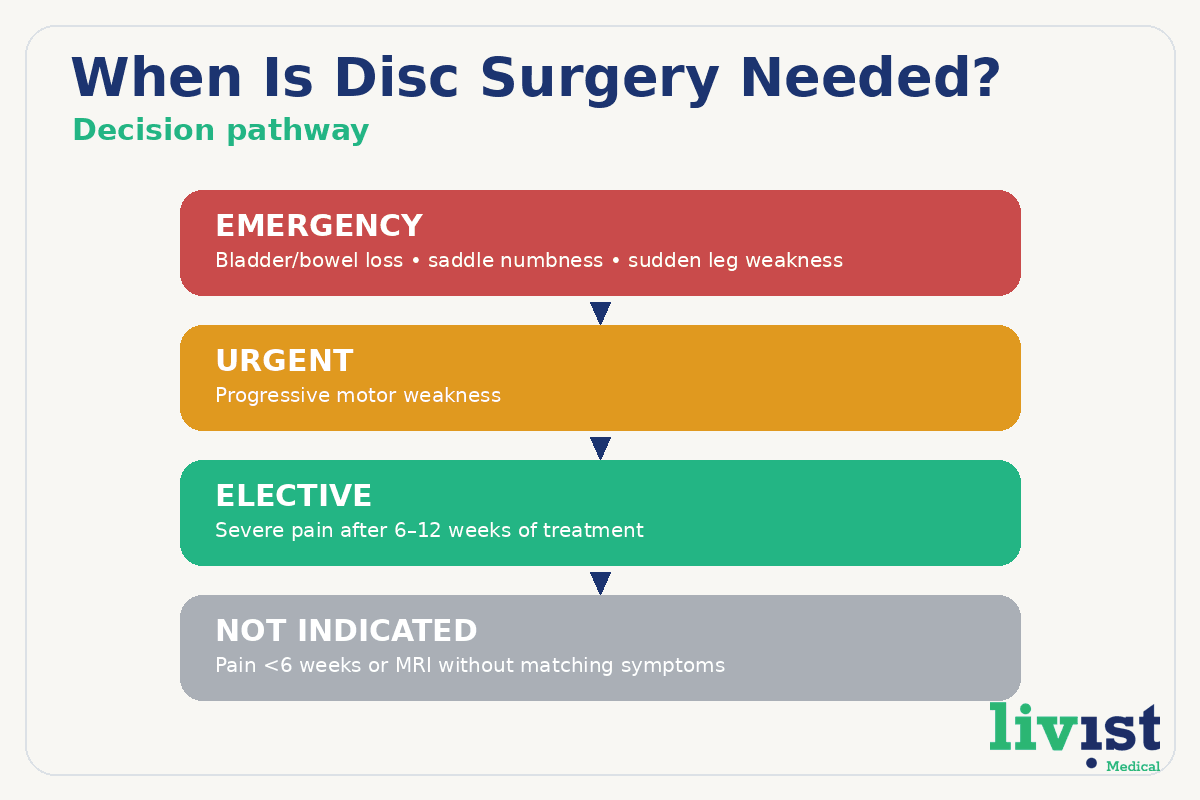
That last row deserves emphasis. Imaging routinely shows disc changes in people who have never had back pain. An abnormal MRI does not by itself justify an operation — the imaging has to match the clinical picture and the specific nerve involved.
Discs sit between the vertebrae as shock absorbers, each with a tough outer ring and a softer gel-like centre. A herniation happens when the outer ring weakens and some of that inner material pushes out, pressing on a nearby nerve root. The pain that follows is caused as much by chemical inflammation around the nerve as by physical pressure, which is why it often settles before the disc itself changes shape on imaging.
Two of these — sitting habits and smoking — are modifiable and directly affect how well you recover with or without surgery.
Turkey is one of the more affordable destinations for spinal surgery, and the saving is real. The figures below reflect published 2026 ranges.
| Procedure | Turkey | United States |
|---|---|---|
| Microdiscectomy (per disc level) | $2,500 – $3,000 | $20,000 – $50,000 |
| Lumbar herniated disc surgery (typical) | $3,500 – $5,500 | |
| Endoscopic discectomy | Around $6,750 | |
| Spinal decompression | Around $6,530 |
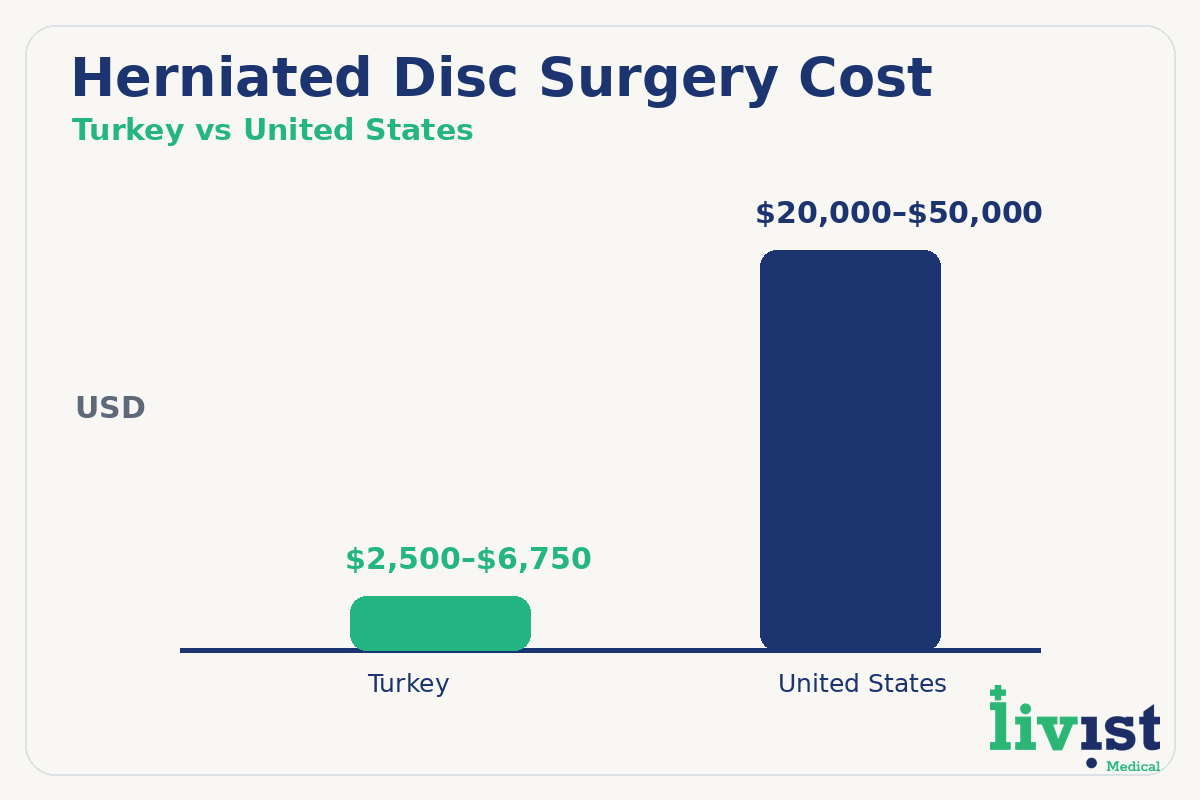
Prices are estimates based on published 2026 ranges and vary by hospital, surgeon, technique, and the number of levels treated.
You will also encounter quotes spanning far wider bands, some as broad as $2,500 to $31,000. Such a range is not information — it means the quote has not specified the procedure. Always establish which operation, at how many levels, before comparing prices at all. A cost per level is the only figure that can be compared meaningfully.
The L4-L5 and L5-S1 levels are where most lumbar herniations occur, and they are also the standard case that most published pricing describes. A single-level microdiscectomy at L5 typically falls in the $2,500 to $5,500 band in Turkey.
What moves the price within that band:
Full detail on the operations themselves is on our herniated disc surgery and spine surgery pages.
It depends far more on your case than on the destination. Spinal surgery differs from most medical travel in one important way: the rehabilitation matters as much as the operation, and rehabilitation happens after you fly home.
| Travelling works well when | Travelling is a poor idea when |
|---|---|
| Single-level, clearly indicated microdiscectomy | Complex multi-level disease or planned fusion |
| You already have a confirmed diagnosis and recent MRI | You have not been assessed anywhere yet |
| You have a physiotherapist arranged at home | No rehabilitation plan after return |
| You can stay long enough to be cleared for flying | You need to fly home within days |
| You have a second opinion agreeing surgery is needed | A single clinic has told you to operate quickly |
Get an independent second opinion before booking any spinal operation abroad. This is standard advice among patients who have been through it, and it costs a fraction of the surgery. If two independent specialists agree, you can proceed with confidence. If they disagree, you have just avoided a serious mistake. You can review surgeon profiles and accredited hospitals as part of that process.
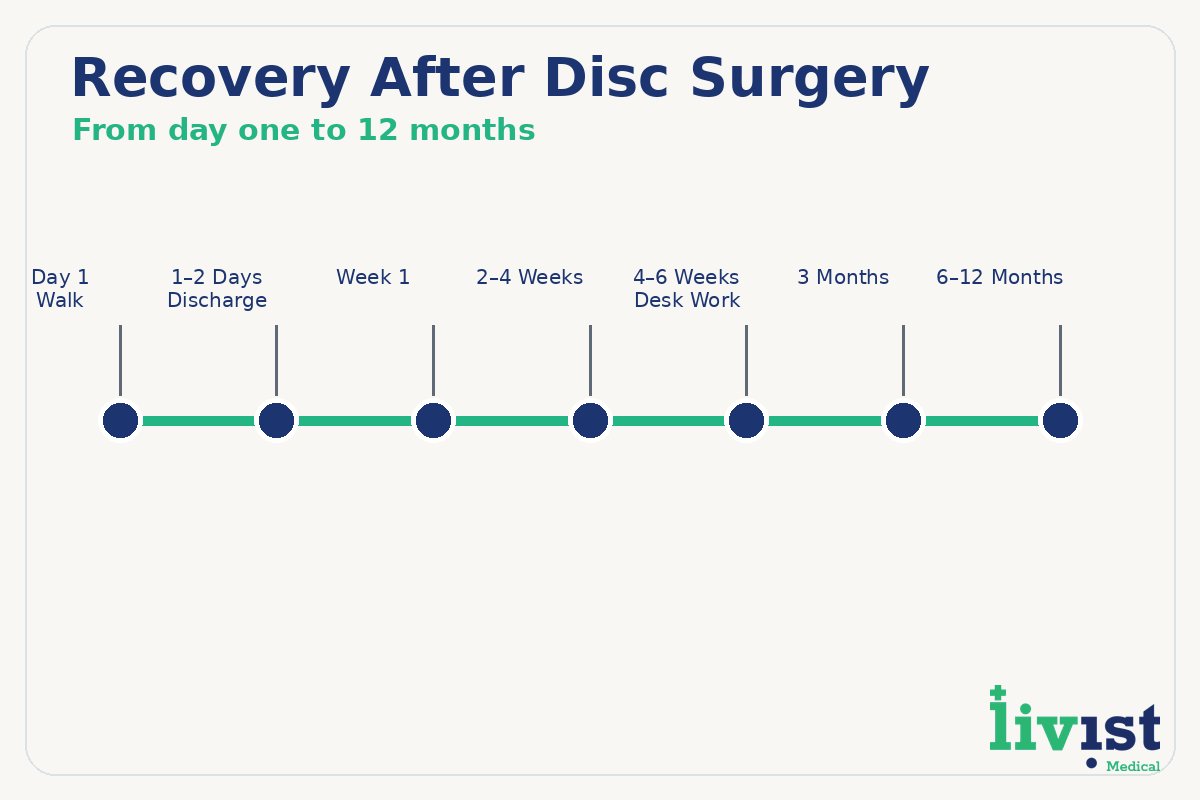
| Period | What to expect |
|---|---|
| Day of surgery | Walking short distances the same day is usual and encouraged |
| 1 – 2 days | Hospital discharge in a straightforward single-level case |
| Week 1 | Leg pain often improves immediately · back soreness at the incision is normal |
| Weeks 2 – 4 | Gradual increase in walking · no lifting, bending or twisting |
| Weeks 4 – 6 | Return to desk work · physiotherapy typically begins in earnest |
| 3 months | Most restrictions lifted · core strengthening is the focus |
| 6 – 12 months | Full recovery · long-term outcome depends heavily on rehabilitation adherence |
On flying: confirm the timing with your surgeon rather than assuming. Prolonged immobility after any surgery raises clot risk, so aisle seating, hourly movement and hydration are not optional extras. Plan the return flight around clearance, not around the cheapest fare.
Comparing treatment packages makes these inclusions visible in a way that comparing surgical fees alone never does.
Microdiscectomy for correctly selected patients has a strong track record, particularly for leg pain. Some honest framing:
Turkey publishes a binding minimum price for international patients across orthopaedic surgery — the clearest worked example is in our guide to limb lengthening surgery cost in Turkey.
Herniated disc surgery in Turkey costs roughly $2,500 to $6,750 against $20,000 to $50,000 in the United States, and for a clearly indicated single-level microdiscectomy that saving is genuine. But the first question is not where to have the operation — it is whether you need one. Most herniated discs improve within six to twelve weeks without surgery. Red-flag symptoms require urgent care regardless of cost. Everything in between deserves a second opinion before a booking. A clinic that supports you getting one is the clinic worth using.
This content is informational and does not constitute medical advice. Loss of bladder or bowel control, saddle numbness, or sudden severe leg weakness require emergency medical attention.
To have your MRI and symptoms reviewed by a specialist and receive a detailed written estimate, book a free consultation with Livist Medical, or browse our available procedures.
OrthopedicsLimb lengthening surgery in Turkey: 2026 package costs against the official state price floor, methods, realistic height gain, safety and recovery.
 Plastic Surgery
Zac Efron’s face changed after a 2013 jaw fracture, not surgery — what happened, how a broken jaw reshapes a face, and where it stands in 2026.
 Plastic Surgery
Natural, non-surgical, and surgical options for mild vs severe sagging — plus 2026 costs in Turkey.