Breast Reduction Size Chart: Grams to Cup Size (2026)
How surgeons convert grams of tissue into cup sizes — and what the Schnur scale means for you
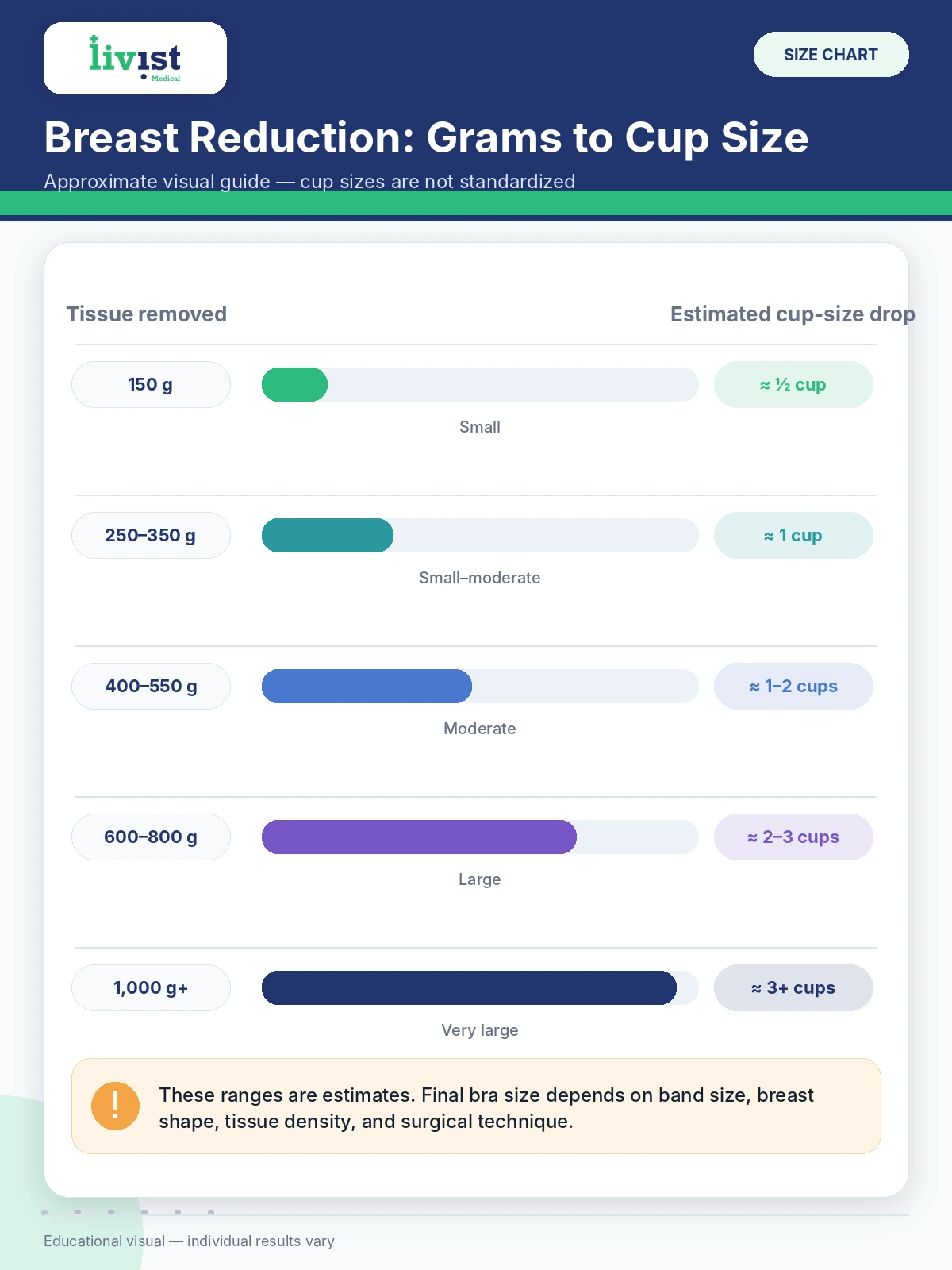
A breast reduction size chart converts grams of tissue removed into an expected drop in cup size. As a general guide, removing 200–300 grams per breast equals about one cup size, 400–500 grams equals roughly two cup sizes, and 600–800 grams equals three or more. Surgeons plan by weight, not by cup size, because bra sizing is not standardised.
That single sentence explains most of the confusion around this topic. Patients think in cup sizes. Surgeons think in grams. Insurers think in grams relative to your body size. This guide translates between all three, and shows you where the numbers stop being reliable.
Breast Reduction Size Chart: Grams to Cup Size
This is the conversion most surgeons work from. Treat it as a planning tool, not a promise — tissue density varies enormously between patients, so 400 grams of dense, fibrous tissue in a 30-year-old occupies less volume than 400 grams of fatty tissue in a 55-year-old.
Tissue removed (per breast)
Approximate cup size drop
Reduction category
150–200 g
Less than 1 cup size
Very small / refinement
200–300 g
About 1 cup size
Small
300–400 g
1–2 cup sizes
Small to moderate
400–500 g
About 2 cup sizes
Moderate
500–700 g
2–3 cup sizes
Moderate to large
700–1,000 g
3–4 cup sizes
Large
1,000 g and above
4+ cup sizes
Very large
Grams removed per breast and the cup-size drop you can expect.
For scale: 500 grams is about the weight of a full tin of soup — per breast. Patients are often surprised at how much weight comes off, and this is exactly why breast reduction consistently ranks among the highest-satisfaction procedures in plastic surgery.
How Many Grams Equal One Cup Size?
Roughly 200 to 300 grams per breast equals one cup size for most patients. The range is wide because a "cup size" is not a fixed volume — it is a ratio between your bust measurement and your band measurement.
This is the part most charts skip. A D cup on a 32 band holds far less tissue than a D cup on a 42 band, even though both say "D". So removing 400 grams from a 32DD produces a much bigger visual change than removing 400 grams from a 42DD. Your band size determines how much a given number of grams actually shows.
Two practical consequences follow:
Your band size may change too. Removing weight from the chest wall can reduce your band measurement, so a 38DD might become a 36C rather than a 38C.
Brands are not interchangeable. Post-surgery, you will need re-measuring rather than assuming your new size across every label.
Breast Reduction Size Chart by Current Bra Size
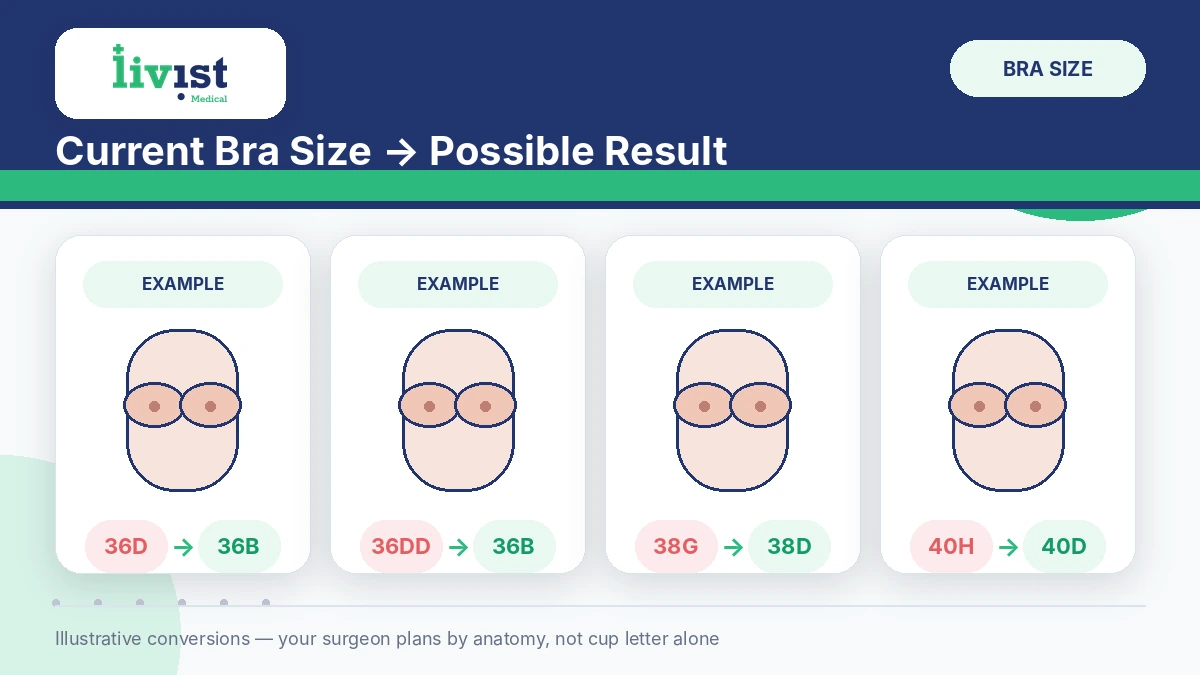
This is the chart most patients actually search for — what happens when you go from a specific starting size to a target. These figures assume an average build and typical tissue density.
Current size
Target size
Estimated removal (per breast)
Cup drop
36D
36B
350–500 g
2
36DD
36B
500–700 g
3
38DDD / 38F
38D
400–600 g
2
38G
38D
700–900 g
3
40F
40C
800–1,000 g
3
40H
40D
900–1,200 g
4
42DD
42C
800–1,100 g
2–3
Typical results by starting bra size — your surgeon plans by anatomy, not cup letter.
Notice that 42DD → 42C needs more grams than 36DD → 36B despite a smaller cup drop. That is the band-size effect in action: a larger frame needs more tissue removed to move a single cup.
The Schnur Sliding Scale: How Insurers Decide Medical Necessity
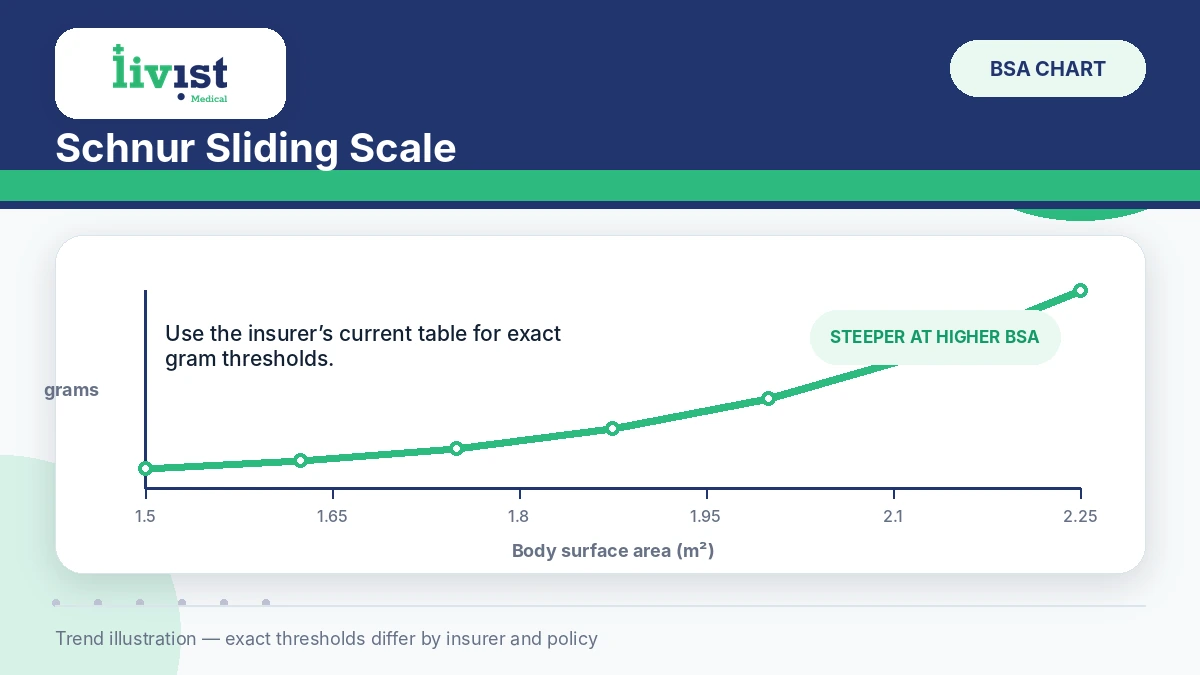
The Schnur Sliding Scale is the chart insurers use to decide whether your breast reduction is medically necessary or cosmetic. It sets a minimum number of grams your surgeon must remove per breast, based on your Body Surface Area (BSA). Remove less than the threshold and the claim is typically denied as cosmetic.
The logic is that a fixed gram threshold would be unfair — 400 grams is a huge reduction on a small frame and a modest one on a large frame. So the scale rises with body size.
How the Mosteller Formula Calculates BSA
BSA is usually calculated with the Mosteller formula:
BSA (m²) = √[ height (cm) × weight (kg) ÷ 3600 ]
A woman who is 165 cm and 70 kg has a BSA of roughly 1.79 m². Once BSA is known, the Schnur table gives the corresponding minimum removal. As BSA rises, the required grams rise steeply:
Body Surface Area (m²)
Approximate minimum removal per breast
1.50
~260 g
1.65
~340 g
1.80
~440 g
1.95
~575 g
2.10
~750 g
2.25
~980 g
The Schnur scale rises steeply with body surface area. Exact thresholds differ by insurer.
These values are approximate and illustrative. Insurers publish their own versions of the Schnur table and thresholds differ between them — always request the exact table your specific insurer applies before assuming you qualify.
What If You're Paying Out of Pocket?
Here is what almost every article on this topic misses: if you are not claiming on insurance, the Schnur scale does not apply to you at all.
The Schnur scale exists to ration insurance coverage. It is not a surgical safety rule and it is not a medical standard of care. For self-pay patients — which includes most international and medical-tourism patients — the only limits that matter are anatomical: how much tissue you have, and how much can be removed while keeping the nipple and remaining tissue reliably supplied with blood.
This matters in a specific and common scenario. Patients with genuine symptoms — neck pain, shoulder grooving, back pain, rashes beneath the breast — are sometimes told they "don't qualify" because their BSA puts the threshold above what they want removed. Being denied by an insurer is not the same as being told the surgery is inappropriate. It is a coverage decision, not a clinical one.
What Is a Good Size for Breast Reduction?
Most patients choose to finish somewhere between a B and a D cup, and satisfaction is highest when the target is proportionate to the frame rather than as small as possible. Surgeons generally steer patients away from the extremes for good reasons.
Going too small carries real trade-offs. Aggressive removal increases the risk of compromising blood supply to the nipple, can leave the chest looking hollow in the upper pole, and is the most common source of long-term regret in reduction patients — under-correction can be revised, over-correction largely cannot.
Going too conservative is the other common regret: if the original symptoms were caused by weight and volume, a one-cup reduction often fails to resolve them, and you have accepted scars without the benefit.
A useful way to frame the conversation with your surgeon is not "what cup size can I be?" but "what is the smallest size my anatomy supports safely, and what size resolves my symptoms?" The answer usually sits between those two, and a breast lift is often combined with the reduction to reposition the remaining tissue rather than simply removing more of it.
Factors That Change Your Final Size
Even with a precise gram target, several variables move the outcome:
Tissue density. Glandular tissue is heavier per unit of volume than fat. Younger patients tend to have denser breasts, so the same gram count produces a smaller visual change.
Degree of ptosis (sagging). Some of the perceived size is position, not volume. Lifting alone can make breasts look a cup smaller without removing much tissue.
Swelling. Final size is not visible immediately. Most swelling settles by three months, but the shape continues to refine for six to twelve months.
Weight change. Significant weight loss or gain after surgery will change your size, as breast tissue includes fat.
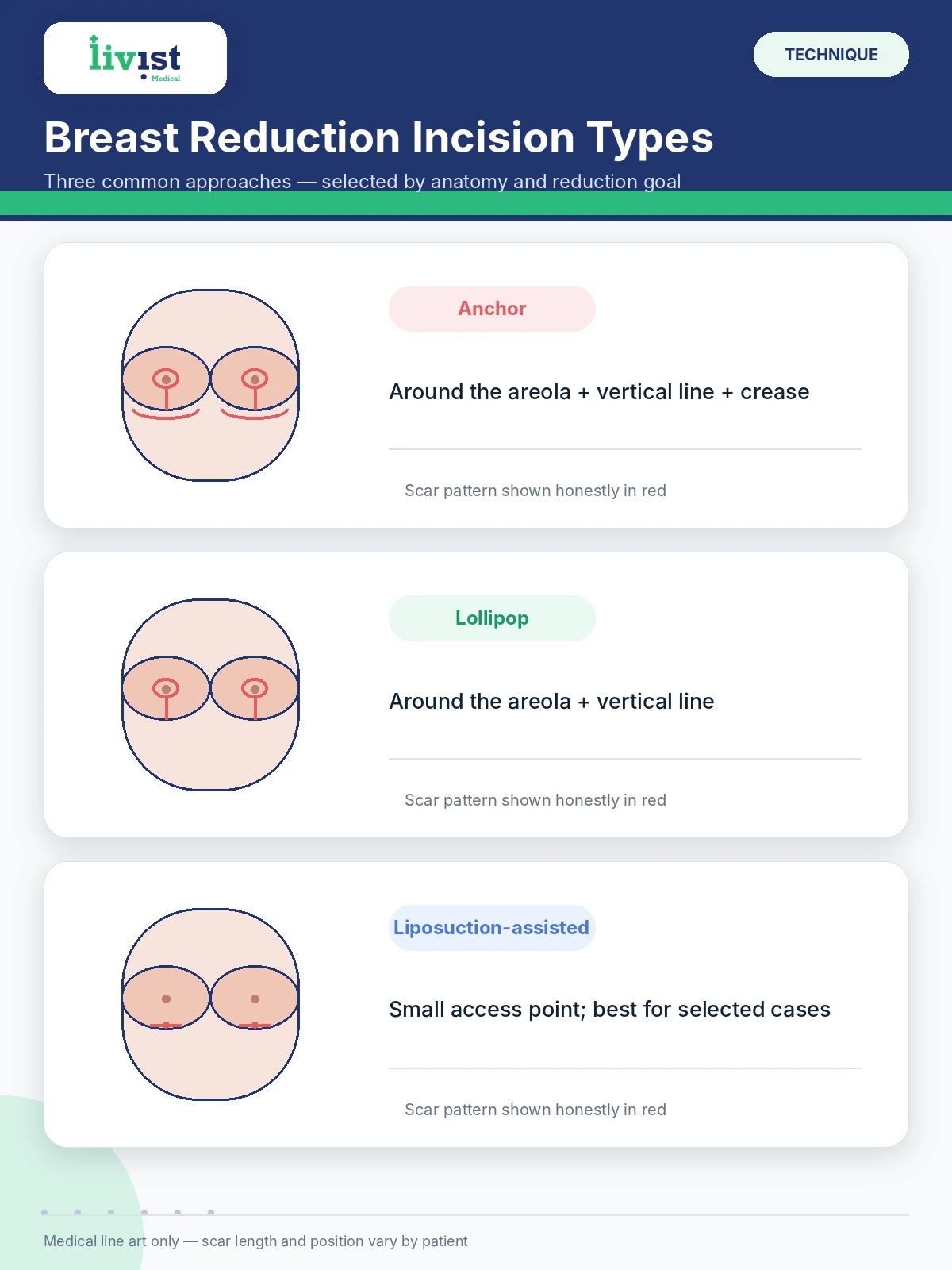
Technique. Liposuction-assisted reduction removes fat but not glandular tissue and produces a more modest change than an excisional technique with an anchor or lollipop incision.
Pregnancy. A future pregnancy can enlarge the breasts again and may undo part of the result.
Common incision patterns — the technique affects both the scar and the achievable size.
Breast Reduction Cost and Planning at Livist Medical
For patients travelling to Turkey, planning starts with the same measurements described above. Before you travel, our team reviews your height, weight, current bra size, target size and symptoms, and your surgeon returns a realistic gram estimate and expected final size — so that the size conversation happens before you book a flight, not after you arrive.
Livist Medical coordinates breast reduction procedures with board-certified plastic surgeons in accredited Istanbul hospitals. Because most international patients are self-pay, the Schnur threshold is not a barrier — planning is based on your anatomy and your symptoms.
To get a personalised size and cost estimate, request a free consultation and include your measurements and target size.
Medically reviewed by the Livist Medical Team. This article is for general information only and does not replace a personal assessment. Size estimates are approximate and cannot be confirmed without an in-person examination by a qualified plastic surgeon.
Frequently Asked Questions
#breast reduction#breast reduction size chart#schnur scale#plastic surgery turkey
Share Article :
Related Articles
Plastic Surgery
8
AirSculpt Cost in 2026: Price by Area and Cheaper Options
AirSculpt cost by body area in 2026, how it compares with the average liposuction price, what the quote excludes, and Turkey's official price floor.
 Plastic Surgery