LASIK in Turkey Cost 2026: £1,000–£1,900, Safety & Results
LASIK in Turkey costs £1,000–£1,900 for both eyes in 2026. Prices for Femto-LASIK, SMILE and PRK, safety checks, who qualifies and 10-year results.
LASIK in Turkey costs £1,000–£1,900 ($1,200–$2,400) for both eyes, or roughly $400–$800 per eye, depending on the technique and what the package includes. Standard LASIK runs £750–£1,500, Femto-LASIK £1,100–£1,800 and ReLEx SMILE £1,400–£2,500. A price at the bottom of that range and a price at the top usually buy two genuinely different procedures, and understanding why is the same thing as answering the safety question.
Written and medically reviewed by: Prof. Dr. Sevil Karaman — Ophthalmology, Medipol Mega University Hospital · Last updated: 26 October 2026
Quick summary:
Laser eye surgery in Turkey costs £1,000–£1,900 for both eyes in 2026.
Femto-LASIK costs £1,100–£1,800, ReLEx SMILE £1,400–£2,500 and PRK/LASEK £700–£1,200.
The operation usually takes about 20 to 30 minutes, according to the NHS, and you go home the same day.
In a review of 2,198 patients, 95.4% were satisfied with their LASIK outcome.
Reading glasses in your mid-forties are natural lens ageing, not LASIK wearing off.
Note: This article is informational and is not medical advice. Whether you are a candidate for laser vision correction can only be determined by a full eye examination.
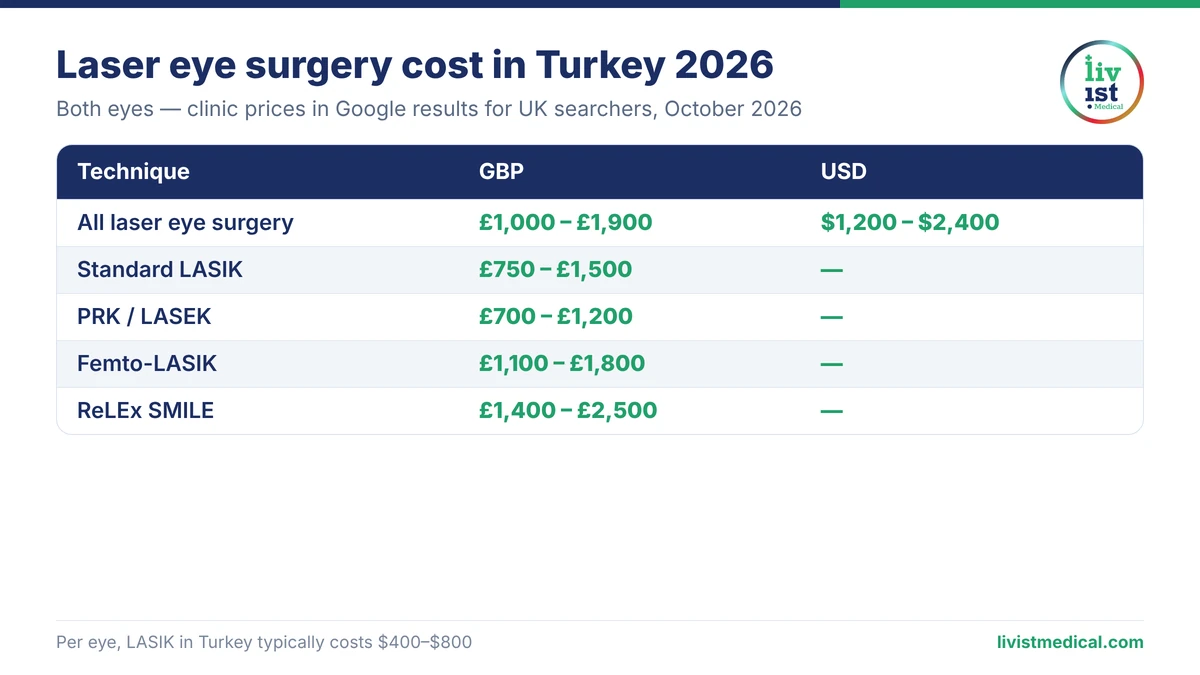
Laser eye surgery cost in Turkey by technique, both eyes
How Much Does Laser Eye Surgery Cost in Turkey in 2026?
Laser eye surgery in Turkey costs £1,000–£1,900 ($1,200–$2,400) for both eyes. These are the clinic prices shown in Google's results for UK searchers in October 2026, and they usually include pre-operative scans, the procedure, medication and a follow-up check.
Laser eye surgery technique (both eyes)
Price in Turkey (GBP)
USD
All laser eye surgery
£1,000 – £1,900
$1,200 – $2,400
Standard LASIK
£750 – £1,500
—
PRK / LASEK
£700 – £1,200
—
Femto-LASIK (bladeless)
£1,100 – £1,800
—
ReLEx SMILE (flapless)
£1,400 – £2,500
—
Quoted per eye, LASIK in Turkey typically costs $400–$800. Always check whether a headline price is per eye or for both eyes. At Livist Medical, the Femto-LASIK package and the PRK package start at €765 per eye.
Is It Cheaper to Get LASIK in Turkey?
Yes, substantially. Published ranges put laser vision correction in Turkey well below United States pricing, where treating both eyes commonly exceeds $4,000. Reported savings of around 40% compared with home-country pricing are typical, and packages frequently bundle accommodation and transfers that would be separate costs elsewhere.
The reasons are structural rather than a reflection of quality: lower operating costs, favourable currency, very high procedure volumes concentrated in a few large centres, and genuine competition among more than a hundred clinics. High volume in particular tends to work in a patient's favour in laser surgery, because surgeon experience is one of the strongest predictors of outcome.
Why LASIK Prices in Turkey Vary So Widely
This is the single most useful section of this article. A quote of $400 per eye and a package of £1,900 for both eyes are both real, and the difference between them is largely explainable.
What changes the price
Low-end quote
Higher-end quote
Technique
Older blade-based or basic surface laser
Femto-LASIK or lenticule extraction
Pre-operative testing
Minimal · sometimes done on the day of surgery
Full corneal topography and thickness mapping
Who operates
Not always named in advance
Named ophthalmologist with stated volume
Laser platform
Older generation equipment
Current generation, regularly serviced
Follow-up
One check before you fly home
Structured follow-up plus remote review
Enhancement policy
Charged separately if needed
Included for a defined period
What is bundled
Surgery only
Hotel nights, transfers, medications
The item that matters most on that list is pre-operative testing. Laser vision correction is not suitable for everyone, and the whole safety question turns on whether unsuitable candidates are identified before surgery rather than treated anyway. A clinic that compresses testing into the same morning as the operation has removed the step that protects you.
Is LASIK Safe in Turkey?
Laser vision correction is widely studied: a systematic review in Ophthalmology covering 2,198 patients found that 95.4% were satisfied with their LASIK outcome. The Mayo Clinic notes that eight in ten people no longer need glasses or contact lenses for most activities afterwards, and that complications leading to loss of vision are rare. The country is not the variable that determines your outcome. Candidate selection, surgeon experience and equipment are — and those vary enormously within Turkey exactly as they do within any other country.
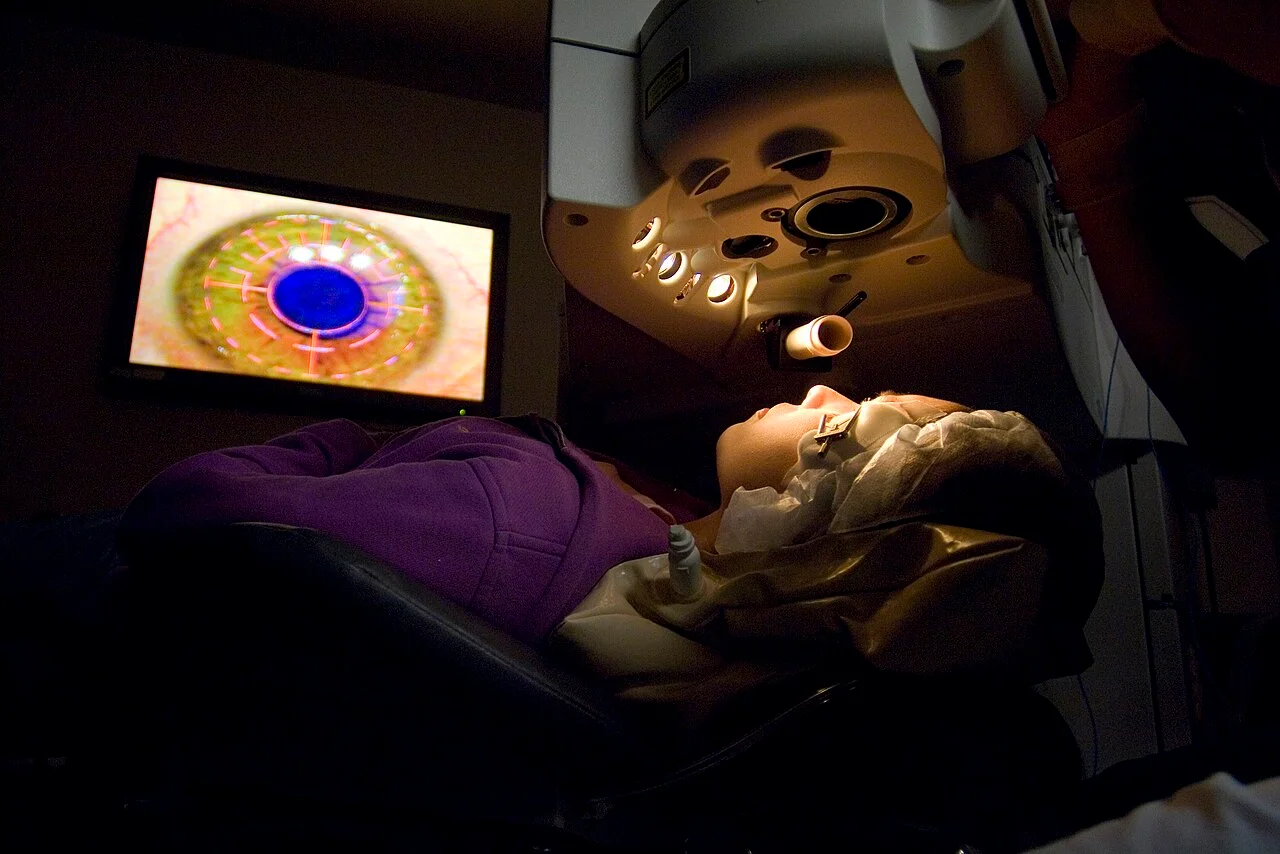
An ophthalmic surgeon performing laser eye surgery. Photo: U.S. Air Force — public domain, via Wikimedia Commons.
What a safe pathway looks like in practice:
A full examination before you commit, ideally with results reviewed before you book flights.
Corneal topography and pachymetry — mapping the shape and thickness of the cornea. Skipping this is the most consequential shortcut in the field.
A stable prescription for at least the previous 12 months.
Willingness to decline you. A clinic that has never turned a patient away is not selecting patients.
A named surgeon you can research, not an unnamed "our expert team".
A written aftercare plan covering what happens once you are home.
"LASIK" is often used loosely to mean any laser eye surgery, but the options differ in how they work and who they suit.
Procedure
How it works
Best suited to
Femto-LASIK
A femtosecond laser creates the corneal flap instead of a blade, then an excimer laser reshapes the cornea
The mainstream choice for most suitable candidates
Lenticule extraction (SMILE-type)
A small lenticule of tissue is removed through a tiny incision, with no flap created
Active lifestyles, contact sports, some dry-eye profiles
Surface ablation (PRK-type)
No flap · the surface layer is reshaped directly · longer recovery
Thinner corneas where a flap is unwise
Trifocal or multifocal lens exchange
The natural lens is replaced with an artificial one
Older patients, high prescriptions, or where laser is unsuitable
The right answer is determined by your corneal thickness and shape, your prescription and your age, not by which option a clinic promotes. Detailed pages are available for femto-LASIK, femto-SMILE and trifocal smart lens surgery.
Is LASIK worth it over 40?
It can be, but one point is worth understanding early: from roughly the mid-forties onward, the natural lens stiffens and reading glasses become necessary regardless of any laser treatment. Laser correction fixes distance vision; it does not stop that age-related change. In that age group a lens-based procedure is sometimes the more sensible conversation.
Who Is Not a Candidate for LASIK
Corneas that are too thin for the correction required
Signs of keratoconus or an irregular corneal shape
A prescription that has shifted in the past year
Severe or poorly controlled dry eye
Uncontrolled diabetes, certain autoimmune conditions, or active eye disease
Pregnancy or breastfeeding, when prescriptions fluctuate
Under 18, and generally under the early twenties
Being declined is a good outcome, not a wasted trip. Proceeding despite a warning sign is how the small number of poor results happen. If eye disease rather than refractive error is the issue, procedures such as cataract surgery or glaucoma surgery address a different problem entirely.
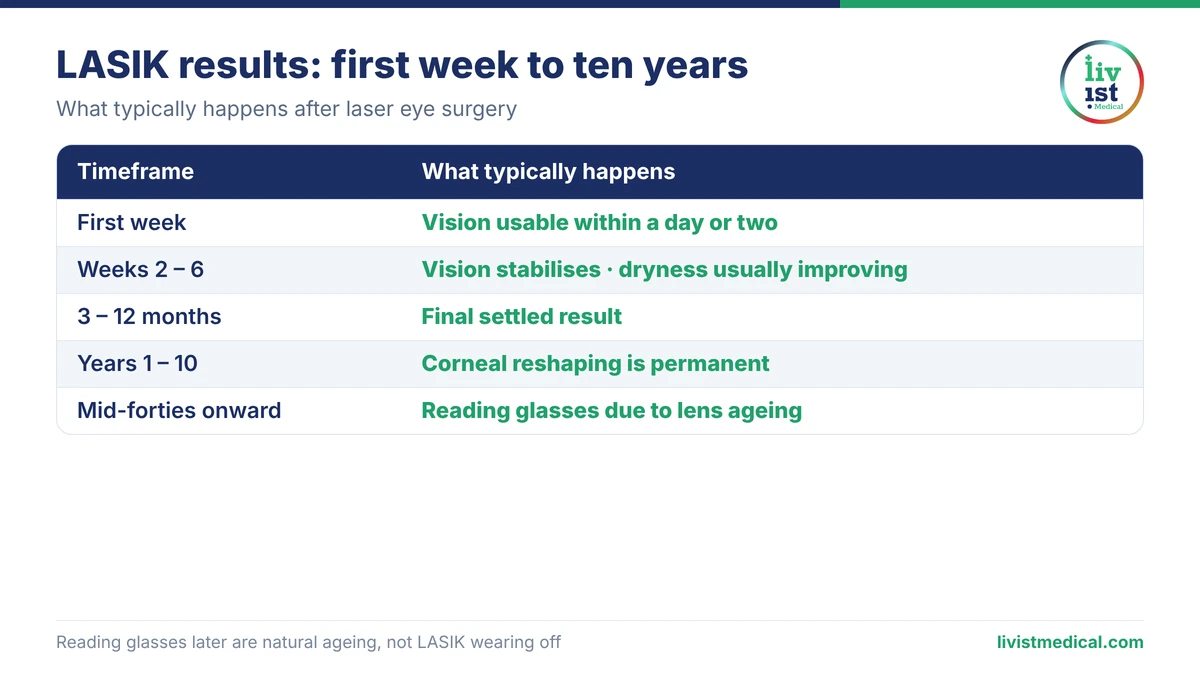
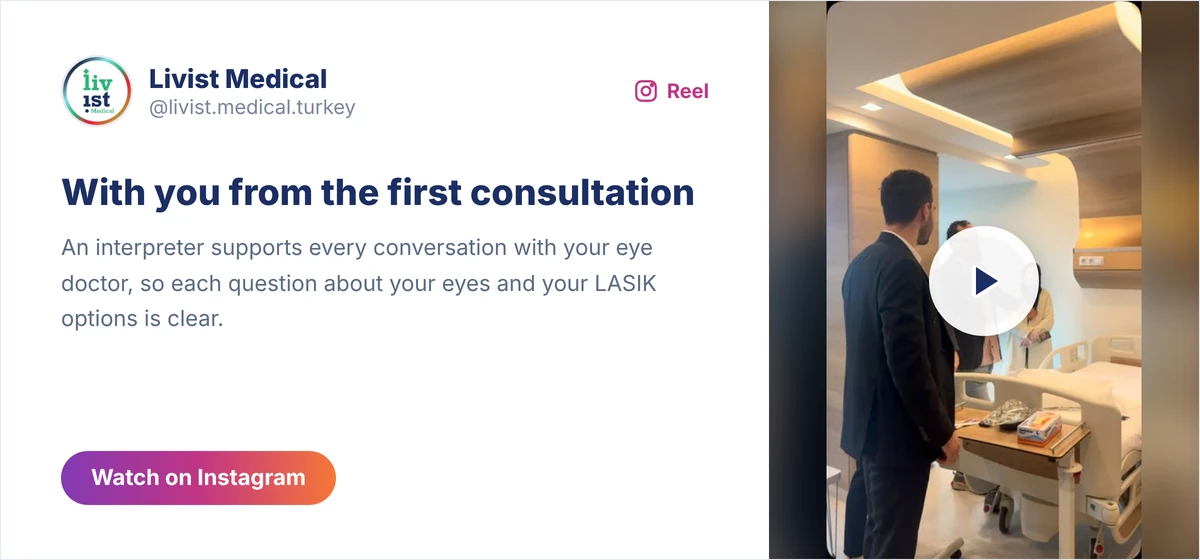
LASIK results timeline: first week to ten yearsWatch on Instagram: how @livist.medical.turkey supports patients from the first consultation with the doctor, with an interpreter to keep every question clear.
LASIK 10 Years Later: What Changes and What Doesn't
This question sits in Google's own People Also Ask box and almost no clinic page answers it. Here is the straight version.
Timeframe
What typically happens
First week
Vision usable within a day or two · fluctuation and light sensitivity are normal
Weeks 2 – 6
Vision stabilises · dryness is common and usually improving
3 – 12 months
Final settled result · any dryness generally continues to improve
Years 1 – 10
The corneal reshaping is permanent and does not wear off
Mid-forties onward
Reading glasses become necessary due to natural lens ageing, independent of the surgery
Long term
A minority experience some regression and may consider an enhancement · cataract can still develop with age and remains treatable
The core misconception worth dispelling: people who need reading glasses in their late forties often conclude their LASIK "wore off". It did not. Two different parts of the eye are involved, and age affects the one the laser never touched.
What a LASIK Quote in Turkey Should Include
Which exact procedure, named — not just "laser eye surgery"
Both eyes or one, stated explicitly, since low headline prices are often per eye
Full pre-operative testing, and whether it happens before or on the day
The surgeon's name and how many procedures they perform annually
Post-operative medications and drops
Follow-up visits before departure and after returning home
Enhancement policy: covered or not, and for how long
Accommodation and transfers if presented as a package
Comparing treatment packages rather than bare surgical fees is the only way to compare like with like when the market spans £700 to £2,500.
LASIK in Istanbul or Antalya, and How to Read the Reviews
Both cities have established eye centres, and the choice is more practical than clinical.
Istanbul
Antalya
Choice of centres
The widest, including large hospital groups
Fewer, more concentrated
Flights
Best connected internationally
Strong seasonal routes, thinner in winter
Pace
Busy · transfers can be long across the city
Calmer · shorter distances
Combining with recovery
Less restful
Easier, though sun and sea need care after surgery
On reviews, the volume of published testimonials in this market makes them close to useless taken at face value. What is actually informative:
Reviews written months later, not on the day. Everyone is delighted 24 hours after surgery. The useful signal is at six months.
Reviews that mention being declined or advised to wait. These are the strongest indicator that a clinic screens properly.
How the clinic responds to a negative review — a specific clinical reply says more than a hundred five-star ratings.
Complaints about follow-up rather than surgery. This is the most common real-world failure point for medical travel, and it is the one worth checking.
Independent patient forums alongside clinic-hosted testimonials, since the two often tell different stories.
Planning Your Laser Eye Surgery Trip to Turkey
Laser vision correction is one of the more travel-friendly procedures, but the timing has fixed points that cannot be compressed.
Allow 4 to 5 days minimum: examination, surgery, and at least one follow-up before flying.
Stop contact lenses first — typically around two weeks for soft lenses and longer for rigid ones, because lenses temporarily change corneal shape and distort the measurements everything depends on.
Bring your prescription history, ideally covering the last two years, to demonstrate stability.
Arrange someone to accompany you, or plan on not driving and needing help on the day.
Expect light sensitivity for the first days — sunglasses are genuinely necessary, not a nicety.
Avoid swimming pools, the sea and dusty environments for the period your surgeon specifies. Booking surgery at the start of a beach holiday defeats the purpose.
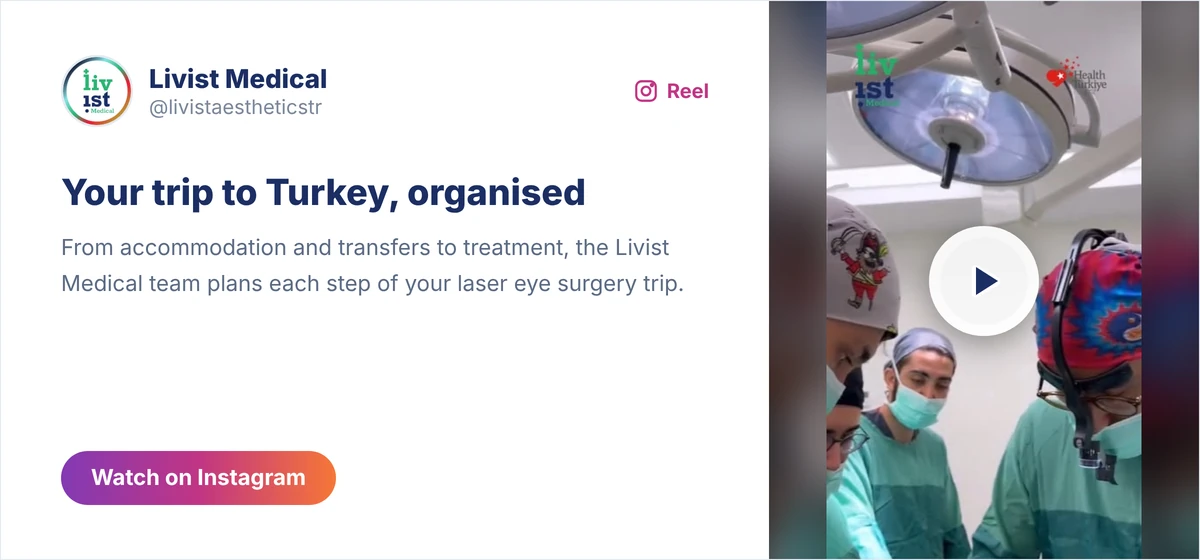
Watch on Instagram: how the Livist Medical team organises the trip in Turkey, from accommodation and transfers to treatment.
Book a LASIK Consultation in Turkey with Livist Medical
Turkey offers laser eye surgery at £1,000–£1,900 for both eyes, a genuine saving. The risk is not the country — it is the bottom of the price range, where the savings usually come from removing the pre-operative testing and the follow-up that make the procedure safe. Judge a quote by what it includes and by whether the clinic is willing to tell you no. The reshaping itself is permanent, and reading glasses in your late forties are a fact of ageing rather than a failure of the surgery.
Medical sources: Mayo Clinic — LASIK eye surgery. NHS — Laser eye surgery and lens surgery. Solomon KD et al. LASIK world literature review: quality of life and patient satisfaction. Ophthalmology. 2009 (PMID 19344821).
#lasik turkey#laser eye surgery#femto lasik#eye surgery cost
Share Article :
Related Articles
Ophthalmology
4
Refractive Lens Exchange Cost & Smart Lens Surgery 2026
Refractive lens exchange (smart lens surgery) costs $2,000–$8,000 per eye in the US and $1,600–$3,400 in Turkey. Lens types, candidacy, risks, recovery.
 Ophthalmology

